



Contents: Gasoline engine ↓ Diesel engine ↓
Attention! Valve clearance adjustment is performed on a cold engine!
Gasoline engine
Note. To perform this procedure, you will need special tools that can be purchased at Toyota service centers, branded automotive accessories stores, and wholesale markets.
If the clearances in the valve train are large, the valves will not open sufficiently. The train will be noisy and the engine will have poor traction, since the cylinders will not be completely filled with the working mixture. The exhaust valves will not open sufficiently to ventilate the cylinders, the remaining gas pressure will prevent a new charge of the mixture from entering the cylinder. If the clearances are too small, the intake and exhaust valves will not sit tightly in the seats when closing. This will worsen the heat transfer from the heated valves to the head. Due to this, the engine will also lose traction (there will be a gas leak), the valves will overheat and burn out.
The valve drive clearances are adjusted by selecting adjusting washers of a certain thickness, which are installed in the valve tappets. During manufacture, the valve drive has some variation within the tolerances, so when adjusting the clearances, it is necessary to install washers that differ slightly in thickness from each other. Toyota produces repair washers of different thicknesses with a step of 0.02 mm. To properly adjust the clearances in the valve drive, the necessary adjusting washers can be purchased from a Toyota dealer.
This procedure requires Toyota specialized tools to push the tappet back to provide sufficient clearance for replacing the washer (this compresses the valve spring) a tool similar to large pliers is used. To fix the tappet in this position, a lever is used, installed as a spacer between the tappet and the camshaft. A magnetic tool is used to remove the washer, and a micrometer is used to accurately measure its thickness. It is not recommended to adjust the gap if such tools are not available.
Valve adjustment should certainly be done as accurately as possible, but if there is no other option, it is better to leave the clearance in the drive slightly increased than "overtightened", since in the latter case the valves may burn out. It is better to have a slightly noisy engine than a faulty one.
Examination
1. Disconnect the negative cable from the battery.
Warning! If the car stereo system is equipped with a security code, make sure you have the correct combination to activate the audio system before disconnecting the battery!
2. Drain the cooling system.
3. Disconnect the coils from the spark plugs and remove any other components that interfere with removing the cylinder head cover.
4. Blow out the spark plug recesses and remove the spark plugs (see section Checking the condition and replacing spark plugs (gasoline engines)).
Caution! When using compressed air, do not forget to wear safety glasses!
5. Remove the cylinder head cover (see chapter Engine).
6. Bring the piston of the first cylinder to the TDC position at the end of the compression stroke (see chapter Engine).
7. Using blade-type feeler gauges, measure the clearances of the valves shown in the accompanying illustration.
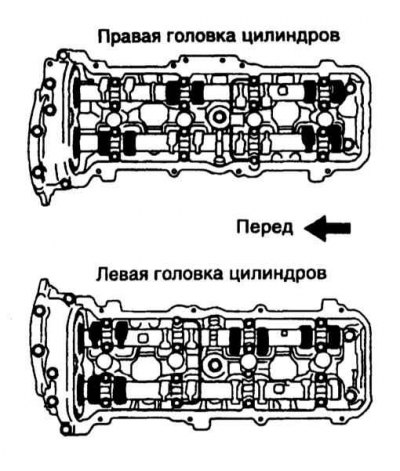
8. Rotate the crankshaft one full revolution in the normal direction and measure the clearances of the remaining valves (refer to the accompanying illustration).
Adjustment
1. Once you have completed your measurements, compare them with the requirements Specifications.
2. On the 2UZ-FE engine, remove the camshaft (see the relevant part of Chapter Engine).
3. Using a micrometer, measure the thickness of the removed adjusting shim. To determine the thickness of the new shim, perform the following calculations:
N = T (A – V)
Where:
T = Thickness of the old adjusting washer
A = Measured gap size
V = Required valve clearance
N = Required thickness of new adjusting washer (see Specifications).
4. Select a new adjusting shim of a thickness that allows the valve clearance to be adjusted as close as possible to the required value. Adjusting shims 41 are available in standard sizes in the range from 2,000 to 2,800 mm (No. 00 to 80) in 0.020 mm increments.
Note: In some cases, an old washer removed from the tappet of one valve may be suitable for installation on the tappet of another valve that needs adjustment; do not rush to buy replacement washers.
5. Install the selected adjusting washer on the pushrod. Using a measuring gauge of the appropriate thickness, verify that the adjustment has been made correctly.
6. Proceed in a similar manner to adjust all valves with a damaged clearance.
7. Reinstall the spark plugs, cylinder head cover, protective boots, accelerator cable bracket and any other components removed for access.
Diesel engine
Examination
1. Remove the air ducts and cylinder head cover.
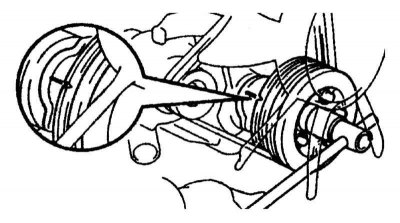
2. Move the piston of the first cylinder to TDC. To do this, rotate the crankshaft clockwise, align the timing marks (refer to the accompanying illustration). In this case, the cams of the valve drive of the first cylinder should be facing upwards, otherwise, turn the crankshaft one more revolution. Make sure that the rocker arms of the valves of the first cylinder are free, and the rocker arms of the valves of cylinder No.6 are tightened.
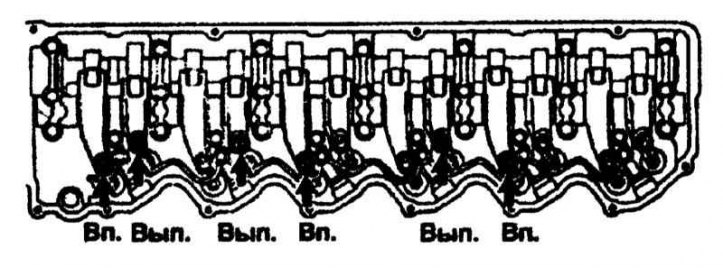
3. Measure the clearance between the rocker arm adjusting screw of the valves shown in the accompanying illustration and the valve drive lever.
4. Turn the crankshaft one revolution and measure the clearance on the remaining valves.
5. Compare the measurement results with the requirements Specifications and adjust the valve clearances if necessary.
Adjustment
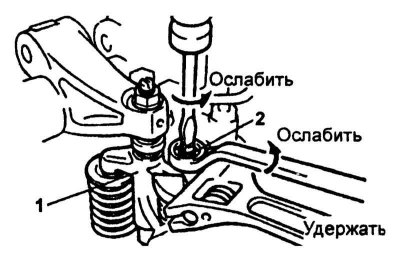
1. Loosen the lock nut on the valve drive lever (1) and turn the adjusting screw (2) so that the latter and the valve stem are completely separated (refer to the accompanying illustration).
Note: While doing this, hold the valve drive lever with an adjustable wrench.
2. Loosen the lock nut of the adjusting screw on the rocker arm.
3. Insert a blade-type feeler gauge between the adjusting screw on the rocker arm and the valve actuator lever. For intake valves, use a 0.20 mm thick feeler gauge, and for exhaust valves, use a 0.50 mm thick feeler gauge.
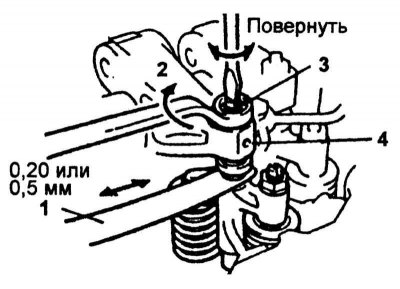
4. Turn the adjusting screw in the rocker arm until a slight resistance is felt when moving the feeler gauge, then secure the adjusting screw with the lock nut (refer to the accompanying illustration).
5. With the feeler gauge inserted, check that the resistance to its movement does not change when the adjusting screw on the valve drive lever is loosened. Otherwise, return to paragraph 2.
6. Tighten the adjusting screw on the valve drive lever and secure it with the lock nut when the feeler gauge resistance increases.
Note: While doing this, hold the valve drive lever with an adjustable wrench.
7. Loosen the lock nut on the rocker arm.
8. Move the adjusting screw until the feeler gauge begins to move with very little resistance, then secure the adjusting screw with the lock nut.
9. Install the cylinder head cover and previously removed parts.