



Examination
Drive belts play an important role in the operation of the engine and many other systems in the car. Over time, belts wear out and should be inspected regularly as part of the car's routine maintenance schedule to avoid serious engine failures that can be costly to fix.
The number of drive belts used on a particular vehicle model depends on the vehicle's auxiliary equipment. Belts are used to drive the alternator, steering and water pumps, and the air conditioning compressor. Depending on the nature of the pulley arrangement, one belt can drive more than one unit.
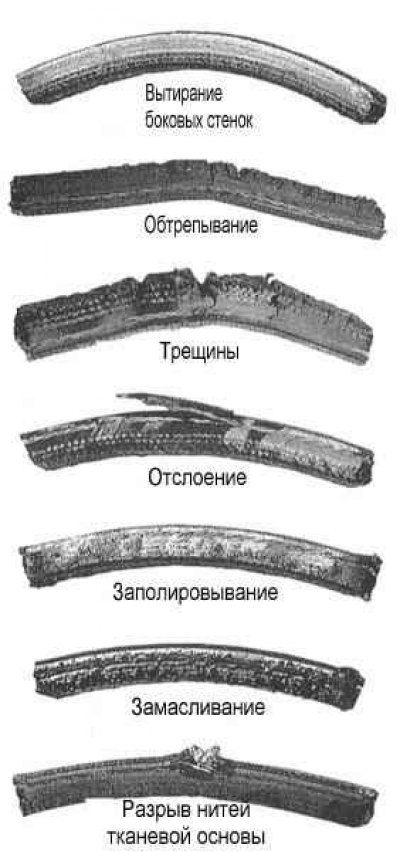
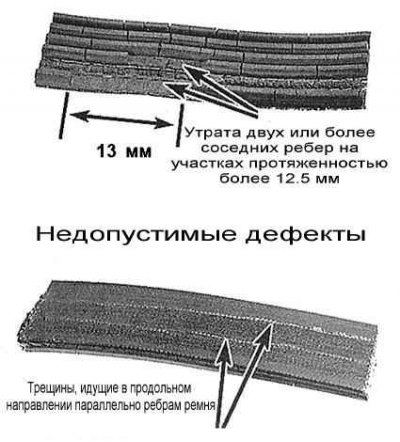
1a. Turn off the engine, open the hood and find the drive belts. Using a flashlight, feel the belts along their entire length with your fingers, checking for cracks and delamination. The presence of scuffs, polished areas and other obvious defects on the belt is also unacceptable (refer to accompanying illustrations).
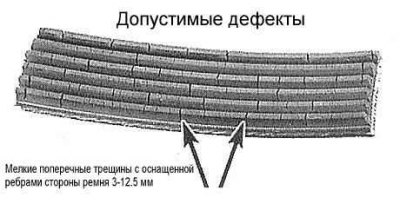
1b. Inspect the belts on both sides, twisting them. Defective belts must be replaced without fail.
Publication Reprinted from a web portal toyotaman.ru
1c. Check the condition of the ribs on the underside of the belts, they should be of equal depth and show no signs of deformation.
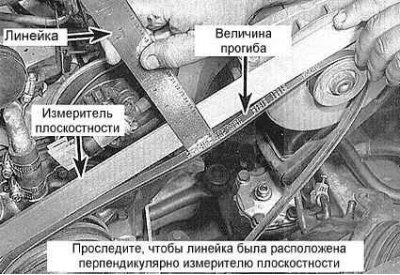
2. The belt tension force can be assessed by pressing it with your thumb on the area in the middle between two adjacent pulleys. The pressure should be firm enough. The parameter characterizing the belt tension force is the amount of its deflection when pressed (refer to the accompanying illustration). As a rule, if the pulleys are spaced from 180 to 280 mm apart, the deflection should be 6.4 mm; a distance between pulleys of 305–405 mm corresponds to a deflection of 12.5 mm for a V-belt, and 6.4 mm for a multi-ribbed belt.
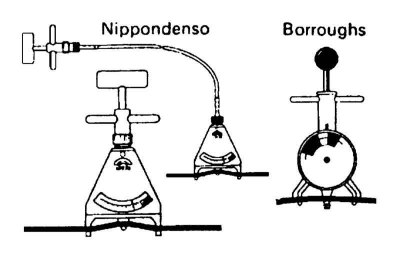
Toyota specialists measure belt tension with a special dynamometer (please refer to the accompanying illustration).
You can buy dynamometer testers from Nippondenso and Borroughs from dealers in the parts and tool departments. The tester is attached to the short arm of the drive belt and when tensioned, the reading is read from the dynamometer scale. This method is the most accurate.
Adjustment
Diesel engines
1. As a rule, adjusting the belt tension force (weakening/strengthening) is achieved by shifting the belt-driven auxiliary unit in the appropriate direction.
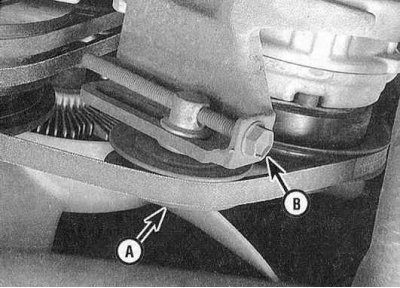
2. Typically, there is one component for each of the drive belts used on the engine, which is secured by means of an axle/stop bolt and an adjusting bolt. The axle/stop bolt is loosened, then the adjusting bolt is turned in the appropriate direction (refer to the accompanying illustration).
3. To reduce the belt tension, the component should be moved towards the engine and vice versa. After completing the adjustment, check that the bolts are securely tightened.
Engine 2UZ-FE
If an automatic drive belt tensioner is installed, manual adjustment is not required. However, to ensure that the tensioner is working properly, the belt tension can be checked as follows.
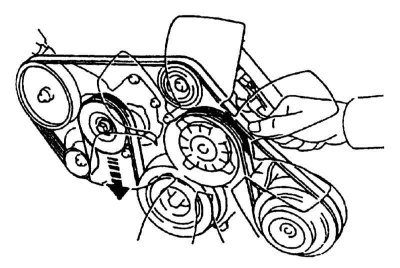
1. Make sure that when you press the belt with a force of about 98 N, the tensioner moves downwards (refer to the accompanying illustration).
2. Check the alignment of the tensioner pulley marks to ensure that the belt does not slip on it. Replace the tensioner if necessary.
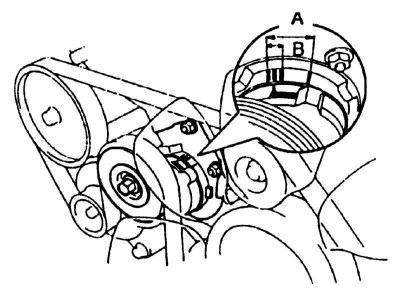
3. Make sure that the arrow mark is inside the "A" zone of the scale (refer to the accompanying illustration). If the mark is outside the "A" zone, the belt needs to be replaced. When installing a new belt, the mark should be inside the "B" zone.
Replacement
Diesel engines
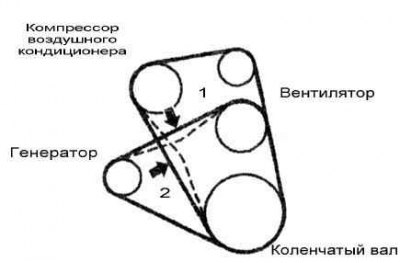
1. To replace, loosen the belt tension (see above) and remove it from its pulleys. It is wise to replace all belts at the same time, since they wear out at approximately the same rate. On most models, a label with a diagram of the drive belt routing is attached to the bottom of the hood (refer to the accompanying illustration).
2. When buying new belts, take the old ones with you as samples - replacement belts must strictly correspond to the size of those removed from the car. Make sure that the belts are correctly seated on the pulleys.
3. Once replacement is complete, adjust the tension of the new belts (see above).
2UZ-FE engines
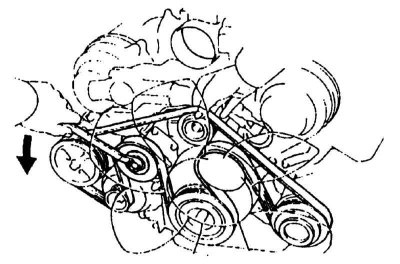
1. To remove the drive belt on this engine, grasp the tensioner bolt with a socket or ratchet, turn the tensioner counterclockwise to release tension, then remove the belt (refer to the accompanying illustration). The tensioner pulley bolt has a left-hand thread.
2. When installing the belt, make sure that all of its wedges are placed in the grooves of the pulleys and that the belt does not slip off the groove at the bottom of the pulley.