



- Turn the engine until the piston of the first cylinder is set to the TDC position. In this case, the mark on the pulley should coincide with the pin on the oil pump housing.
- Check that the valve tappets of the first cylinder have a small play, and that the valve tappets of the fourth cylinder are tight. If this is not the case, turn the engine one more revolution.
- Measure the valve clearances in accordance with Figure 310 using feeler gauges inserted between the tappet and the cam surface. The clearances of the intake (E) and exhaust (A) valves are not the same on all engines and are given in the tables of dimensions and adjustments.
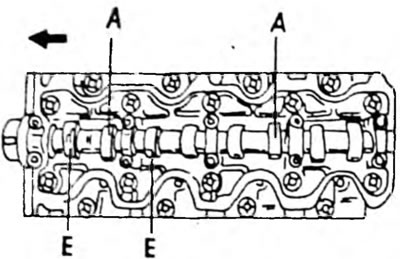
Fig. 310. Sequence of valve clearance adjustment when setting the first cylinder to the TDC position. E = intake camshaft; A = exhaust camshaft
- Rotate the engine one full revolution and measure the clearances shown in Fig. 311. The correct adjustment is indicated when the end of the feeler gauge is inserted and then, with light pressure, the feeler gauge bends and goes in. To adjust the valve clearances, the adjusting shims on the top of the tappets should be replaced, but a special tool is required to remove and install the adjusting shims. To do this, rotate the crankshaft until the appropriate cam is installed with the tip upwards and, using the special tool shown in Fig. 312, or otherwise, press the tappet inward so that the adjusting shim can be grasped and pulled out with a small screwdriver and magnet. Before pressing the tappet, it should be turned so that the notch on the top side faces the spark plugs. Both tappets are pressed simultaneously, that is, it is necessary to ensure that both tappets are pressed by the foot of the device.
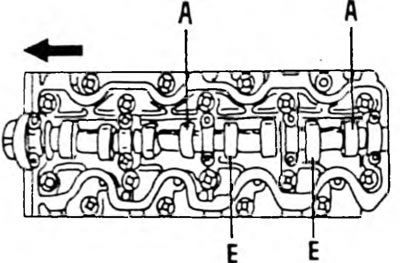
Fig. 311. Adjust the cancelled valve clearances when setting the piston of the fourth cylinder to the TDC position. E = intake camshaft; A = exhaust camshaft
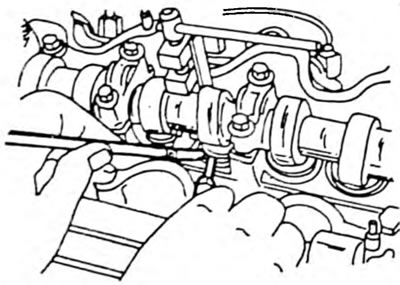
Fig. 312. Using a special device to press the tappets into their holes. A screwdriver and magnet are used to remove the adjusting washers.
- The adjusting washer to be installed can be calculated using the following formula:
- Measure the removed washer with a micrometer (Fig. 85) and record the result.
- Calculate the thickness of the new washer to provide the required valve clearance. The following formula is used:
Inlet valves:
N = T + (A - 0.25 mm)
Exhaust valves:
N = T + (A - 0.30 mm), where "T" is the thickness of the removed washer, "A" is the measured valve clearance and "N" is the thickness of the new washer to be installed.
- Select the washer that is closest in thickness to the required clearance. There is a range of 25 washer sizes with thicknesses from 2.2 mm to 3.4 mm in 0.05 mm increments.
- To install the adjusting washer, press the pusher inward again and insert the washer.
- Measure the valve clearance as described above.
- Adjust the clearances of the remaining valves.
- The adjusting washer must not fall into the engine under any circumstances. To avoid this, use a small screwdriver and a magnet, as shown in Figure 312. The washer can then be pulled out to the side and "caught" by the magnet.