



Service warning indicators and buzzers
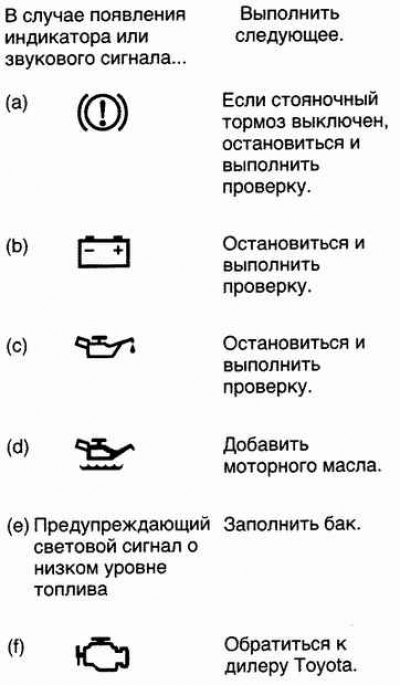
(A) Brake system warning light
This light signal has the following functions:
- parking brake on reminder. If this light appears, make sure the parking brake is fully released. The light should go out;
- low brake fluid warning.
If this light appears while driving, slow down and pull off the road. Then stop the vehicle carefully. There may be a problem with the brake system. Check the fluid level in the visible reservoir.
To ensure that the parking brake is not the cause of the warning light, check that the parking brake is fully released.
If the brake fluid level is low, check the brakes in a safe place by starting and stopping. If the brakes still function adequately, drive carefully to a Toyota dealer or repair shop for repair. If the brakes do not work, have the vehicle towed to a repair shop.
(b) Low battery warning light
This light warns that the battery is running low. If the light comes on while driving, there is a problem somewhere in the charging system. However, the engine ignition will continue to operate until the battery is discharged. Turn off the air conditioner, fan, radio, etc. and go to a Toyota dealer or repair shop.
(With) Warning light for low pressure in lubrication system
This light warns that the engine oil pressure is too low. If the light flashes or comes on while driving, pull off the road to a safe place and stop the engine immediately. Contact your Toyota dealer or repair shop for assistance.
The light may start to flash when the engine is idling or when stopping with sudden braking. There is no cause for concern if the light goes out when the engine accelerates slightly.
The light may appear when the oil level is extremely low. However, since the light is not intended to inform you of a low oil level, you should periodically check the oil level using the dipstick.
(d) Low Engine Oil Warning Light
This indicator indicates that the engine oil level is too low. Add oil as soon as possible.
When driving on rough roads or steep slopes, or on zigzag roads, the vehicle may sway excessively, causing this indicator to light up due to oil sway.
(e) Low fuel level warning light
This light comes on when the fuel level is approaching zero. Fill the tank as soon as possible. On slopes or winding roads, the low fuel warning light may come on earlier than usual due to the fuel in the tank fluctuating.
(f) Malfunction indicator light
This light warns that there is a problem with the engine electrical system. If it comes on while driving, have it checked/repaired by a Toyota dealer as soon as possible.
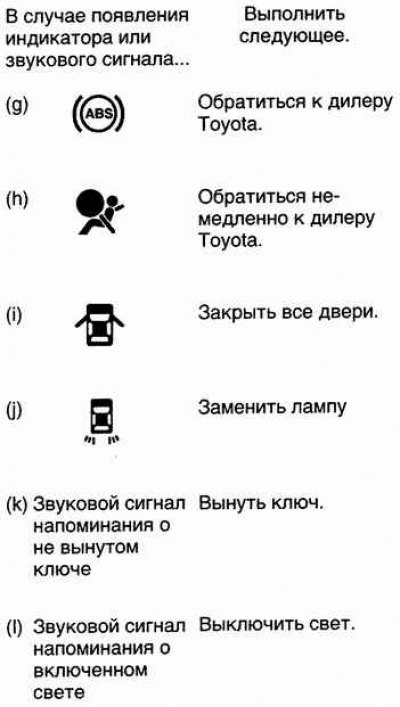
(g) Warning light "ABS"
This indicator warns that there is a problem somewhere in the anti-lock brake system. If this indicator comes on while driving, have it checked by your Toyota dealer as soon as possible. This indicator comes on when the ignition switch is turned to the "ON" position. The indicator goes out after about 3 seconds. If the "ABS" warning light comes on (and the warning light about the brake system malfunction does not light up), the braking system operates as normal, but the anti-lock braking system is unable to assist the braking function, so the wheels may lock up during sudden braking or braking on a slippery road.
(h) SRS warning light
This indicator comes on when the ignition switch is turned to the "ON" or "ACC" position. After about 6 seconds, the indicator goes out. This means that the air bag and front seat belt retractor system are working normally.
[The original can be viewed on the website: toyotaman.ru]
The warning light system monitors the front airbag sensors, airbag sensor unit, airbag sensor unit, seat belt retractor, airbag blowers, warning light indicators, internal wiring, power supplies.
If any of the following occurs, there is a problem somewhere in the components monitored by the warning light system. Have your Toyota dealer check your vehicle as soon as possible.
The indicator does not light when the key is turned to the "ACC" or "ON" position.
Lights up or flashes during control.
(i) Open door warning light
This light will not go out until all side doors and the rear door are completely closed.
(j) Rear light malfunction warning light
If the indicator light comes on when the headlights are on (in the first or second position of the switch), this means that one or more of the tail light bulbs have burned out.
(k) Sound signal to remind you of the key not being removed
This chime reminds you to remove the key if you open the driver's door while the ignition key is in the "ACC" or "LOCK" position.
(l) Sound signal to remind you that the light is on
This chime will sound if the headlight switch is left in the on position and the driver's door is opened with the key removed from the ignition switch.
Service warning indicators for inspection (except for the low fuel warning light)
Apply the parking brake.
Open one of the doors. A warning light should appear indicating that the door is open.
Close the door. The door open warning light should go out.
Turn the ignition switch to the "ACC" position. The SRS warning light should come on. It will go off after approximately 6 seconds.
Turn the ignition switch to the "ON" position, but do not start the engine. All service warning indicators except the door warning light and the SRS warning light should be on. The "ABS" warning light will turn off after a few seconds.
If any of the service warning lights or buzzers do not function as described above, either the bulb is burned out or the electrical circuit needs repair. Have them checked by your Toyota dealer as soon as possible.