



Share information:
6-cylinder car engine Toyota Camry 3 (XV30)

General information about 1MZ-FE engines
The 1MZ-FE engine is a six-cylinder V-shaped, 3-liter engine with two overhead camshafts in the cylinder head and 24 valves, developed on the basis of the 1MZ-FE engine of the previous generation Camry (table 2.19)....
The 1MZ-FE engine is a six-cylinder V-shaped, 3-liter engine with two overhead camshafts in the cylinder head and 24 valves, developed on the basis of the 1MZ-FE engine of the previous generation Camry (table 2.19)....

Distinctive features of the 1MZ-FE engine model
The following are the characteristics of the 1MZ-FE engines: (see table 2.20) are ensured by using the elements and systems specified in the table. High efficiency and fuel economy. Low noise and vibration levels. Low...
The following are the characteristics of the 1MZ-FE engines: (see table 2.20) are ensured by using the elements and systems specified in the table. High efficiency and fuel economy. Low noise and vibration levels. Low...

Cylinder head cover
Fig. 2.179. Cylinder head cover of the 1MZ-FE engine: 1 – gasket; 2 – for the right row of cylinders; 3 – for the left row of cylinders; 4 – cylinder head cover; 5 – rubber; 6 – aluminum; 7 – cylinder head Shoulder...
Fig. 2.179. Cylinder head cover of the 1MZ-FE engine: 1 – gasket; 2 – for the right row of cylinders; 3 – for the left row of cylinders; 4 – cylinder head cover; 5 – rubber; 6 – aluminum; 7 – cylinder head Shoulder...

Cylinder head gasket
Fig. 2.180. Cylinder head gasket for 1MZ-FE engine A metal cylinder head gasket is used to provide pressure resistance and improve sealing properties.
Fig. 2.180. Cylinder head gasket for 1MZ-FE engine A metal cylinder head gasket is used to provide pressure resistance and improve sealing properties.

Cylinder head — design description
The cylinder head is made of aluminum and has wedge-shaped combustion chambers. The spark plug is located in the center of the combustion chamber. The intake and exhaust valves are located at an acute angle of 22.5°,...
The cylinder head is made of aluminum and has wedge-shaped combustion chambers. The spark plug is located in the center of the combustion chamber. The intake and exhaust valves are located at an acute angle of 22.5°,...

Cylinder Block — Design Description
The cylinder block has a 60° camber angle and a mutual longitudinal displacement of the cylinder rows of 36.6 mm (1.44 inches), the distance between the cylinder axes is 105.5 mm (4.15 inches), which ensures its...
The cylinder block has a 60° camber angle and a mutual longitudinal displacement of the cylinder rows of 36.6 mm (1.44 inches), the distance between the cylinder axes is 105.5 mm (4.15 inches), which ensures its...

Piston — design description
The piston is made of aluminum alloy, and the skirt area is made compact and lightweight. The piston skirt is coated with polymer to reduce friction losses. The piston pins are floating type. The pistons of the right...
The piston is made of aluminum alloy, and the skirt area is made compact and lightweight. The piston skirt is coated with polymer to reduce friction losses. The piston pins are floating type. The pistons of the right...

Connecting rod — design description
Fig. 2.184. Connecting rod: 1 – pin; 2 – bolt with tightening torque in the plastic zone Connecting rods (fig. 2.184) are made of high-strength steel to reduce weight. Connecting rod bearings are coated aluminum....
Fig. 2.184. Connecting rod: 1 – pin; 2 – bolt with tightening torque in the plastic zone Connecting rods (fig. 2.184) are made of high-strength steel to reduce weight. Connecting rod bearings are coated aluminum....

Crankshaft — design description
Fig. 2.185. Crankshaft: 1 – crankshaft main journal No.1; 2 – knurling treatment; 3 – counterweight; 4 – crankshaft main journal No.4 Crankshaft (fig. 2.185) forged steel, has four main journals and nine counterweights....
Fig. 2.185. Crankshaft: 1 – crankshaft main journal No.1; 2 – knurling treatment; 3 – counterweight; 4 – crankshaft main journal No.4 Crankshaft (fig. 2.185) forged steel, has four main journals and nine counterweights....

Crankshaft pulley — design description
Fig. 2.186. Crankshaft pulley: 1 – cast iron; 2 – vibration damper rubber; 3 – steel; 4 – aluminum Crankshaft pulley bushing (fig. 2.186) made of aluminum to reduce weight and vibration. The rubber stiffness of the...
Fig. 2.186. Crankshaft pulley: 1 – cast iron; 2 – vibration damper rubber; 3 – steel; 4 – aluminum Crankshaft pulley bushing (fig. 2.186) made of aluminum to reduce weight and vibration. The rubber stiffness of the...

Valve Drive Mechanism — General Information
Fig. 2.187. Valve drive mechanism diagram: 1 – intake valves; 2 – exhaust valve drive camshaft; 3 – intake valve drive camshafts; 4 – exhaust valve drive camshaft; 5 – exhaust valves The valves are opened and closed...
Fig. 2.187. Valve drive mechanism diagram: 1 – intake valves; 2 – exhaust valve drive camshaft; 3 – intake valve drive camshafts; 4 – exhaust valve drive camshaft; 5 – exhaust valves The valves are opened and closed...

Camshafts — Design Description
Fig. 2.188. Camshafts: 1 – camshaft No.2 (outlet); 2 – gear transmission; 3 – synchronization rotor; 4 – driven gear; 5 – camshaft No.4 (outlet); 6 - camshaft No.3 (Intake); 7 – camshaft No.1 (intake) Camshafts (fig....
Fig. 2.188. Camshafts: 1 – camshaft No.2 (outlet); 2 – gear transmission; 3 – synchronization rotor; 4 – driven gear; 5 – camshaft No.4 (outlet); 6 - camshaft No.3 (Intake); 7 – camshaft No.1 (intake) Camshafts (fig....

Intake and exhaust valves and valve lifters
Fig. 2.189. Inlet and outlet valves and valve lifters: 1 – camshaft; 2 – adjusting washer; 3 – valve tappet; 4 – valve; 5 – adjusting washer; 6 – cutout; 7 – valve tappet Reduced diameter valve stems are used to reduce...
Fig. 2.189. Inlet and outlet valves and valve lifters: 1 – camshaft; 2 – adjusting washer; 3 – valve tappet; 4 – valve; 5 – adjusting washer; 6 – cutout; 7 – valve tappet Reduced diameter valve stems are used to reduce...

Timing belt for timing control
The developed configuration of the teeth of the timing belt drive mechanism ensures noise reduction and the possibility of power transmission at high load factors. Fig. 2.190. Timing mechanism drive toothed belt: 1 –...
The developed configuration of the teeth of the timing belt drive mechanism ensures noise reduction and the possibility of power transmission at high load factors. Fig. 2.190. Timing mechanism drive toothed belt: 1 –...

Timing belt tensioner for timing control
Fig. 2.191. Timing belt tensioner: 1 – plunger spring; 2 – belt tensioner; 3 – return spring The timing belt tensioner uses a spring and an oil damper, it constantly maintains the tension of the timing belt. Also, the...
Fig. 2.191. Timing belt tensioner: 1 – plunger spring; 2 – belt tensioner; 3 – return spring The timing belt tensioner uses a spring and an oil damper, it constantly maintains the tension of the timing belt. Also, the...

Lubrication system — general information
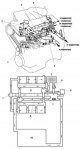
The lubrication system operates under pressure, the oil passes through the oil filter. The engine uses a lubrication system with full-flow oil cleaning and with oil supply under pressure to the main moving parts and...
The lubrication system operates under pressure, the oil passes through the oil filter. The engine uses a lubrication system with full-flow oil cleaning and with oil supply under pressure to the main moving parts and...
Cooling system — general information
The Camry with the 1MZ-FE engine has a closed-type cooling system with forced circulation of coolant and a thermostat with a bypass valve in the coolant inlet pipe. The thermostat with a bypass valve is located at the...
The Camry with the 1MZ-FE engine has a closed-type cooling system with forced circulation of coolant and a thermostat with a bypass valve in the coolant inlet pipe. The thermostat with a bypass valve is located at the...

Intake and exhaust system — general information
Application of ETCS-i (Intelligent Electric Throttle Control System) allowed for improved accelerator control. The use of ACIS (Acoustic intake control system) improved engine performance. The use of an intake control...
Application of ETCS-i (Intelligent Electric Throttle Control System) allowed for improved accelerator control. The use of ACIS (Acoustic intake control system) improved engine performance. The use of an intake control...

Intake manifold — design description
The diameter of the intake manifold passages has been increased and the length has been optimized to improve engine performance. Fig. 2.197. Intake manifold: 1 – engine cooling system channel; 2 – rubber coating The...
The diameter of the intake manifold passages has been increased and the length has been optimized to improve engine performance. Fig. 2.197. Intake manifold: 1 – engine cooling system channel; 2 – rubber coating The...

Exhaust manifold — design description
Fig. 2.198. Exhaust manifold: 1 – air-fuel ratio sensor (row 1, sensor 1); 2 – air-fuel ratio sensor (row 2, sensor 1); 3 - three-way catalytic converters Exhaust manifold (fig. 2.198), made of stainless steel, it is...
Fig. 2.198. Exhaust manifold: 1 – air-fuel ratio sensor (row 1, sensor 1); 2 – air-fuel ratio sensor (row 2, sensor 1); 3 - three-way catalytic converters Exhaust manifold (fig. 2.198), made of stainless steel, it is...

Exhaust system — design description
Fig. 2.199. Exhaust system: 1 – three-way catalytic converter; 2 – additional muffler; 3 – main muffler A thin-walled, high-cell ceramic three-component catalytic converter is used (fig. 2.199). This neutralizer has...
Fig. 2.199. Exhaust system: 1 – three-way catalytic converter; 2 – additional muffler; 3 – main muffler A thin-walled, high-cell ceramic three-component catalytic converter is used (fig. 2.199). This neutralizer has...

Fuel system — general information
Fig. 2.200. Fuel system of a Camry with a 1MZ-FE engine: 1 – fuel injector; 2 – pulsation damper; 3 – fuel tank; 4 – fuel pump The returnless fuel system is used to reduce fuel vapor emissions. The vehicle uses a...
Fig. 2.200. Fuel system of a Camry with a 1MZ-FE engine: 1 – fuel injector; 2 – pulsation damper; 3 – fuel tank; 4 – fuel pump The returnless fuel system is used to reduce fuel vapor emissions. The vehicle uses a...

Ignition system — general information
Fig. 2.203. Ignition system operation diagram DIS system is used (Direct ignition system, see Fig. 2.203). DIS improves the accuracy of ignition timing, reduces high voltage losses and increases the overall reliability...
Fig. 2.203. Ignition system operation diagram DIS system is used (Direct ignition system, see Fig. 2.203). DIS improves the accuracy of ignition timing, reduces high voltage losses and increases the overall reliability...
This section is available on: russian, bulgarian, belarusian, ukrainian, serbian, croatian, romanian, polish, slovak, hungarian
Similar sections for other Toyota models
➥ Engines 5E-FE Toyota Corona T190 (1992-1997)
➥ 6-cylinder engine Toyota Highlander 1 (2000-2007, petrol)
➥ Petrol engines 1.3 l Toyota Duet (1998-2004)
➥ Engine repair Toyota Corolla E80 (1983-1990)
➥ 4-cylinder engines Toyota 4Runner N120 (1989-1995)
➥ Engine adjustment Toyota Cruiser 70 (1985-1996, diesel)
Link in different formats to this article
TEXTHTMLBB Code
- User manual
- Vehicle description
- Keys, locks and alarms
- Governing bodies
- Salon equipment
- Driving and operation
- Maintenance
- Power unit
- 4-cylinder engine
- Control system (I4)
- Engine overhaul (I4)
- 6-cylinder engine
- Control system (V6)
- Engine overhaul (V6)
- Transmission
- Clutch
- Mechanical gearbox
- Automatic gearbox
- Drive mechanism
- Chassis, running gear
- Wheels and tires
- Car suspension
- Steering
- Brake system
- Body and interior
- Exterior (external elements)
- Doors, locks and windows
- Air conditioning and heater
- Electrical equipment
- Equipment and devices
- Power devices
- Electrical circuits
- General information
- Controls and instruments
- Driving and operation
- Daily care
- Maintenance
- Power unit
- 4-cylinder engine
- 6-cylinder engine
- Engine overhaul
- Engine electrical equipment
- Cooling system
- Heating and ventilation
- Fuel system
- Exhaust system
- Transmission
- Mechanical gearbox
- Automatic gearbox
- Clutch
- Chassis, running gear
- Suspension and axle shafts
- Steering
- Brake system
- Body and interior
- Exterior (external elements)
- Interior (internal elements)
- Doors, locks and windows
- Electrical equipment
- Equipment and devices
- Electrical circuits
- General information
- User manual
- Maintenance
- Power unit
- 4-cylinder engine
- 6-cylinder engine
- Overhaul of engines
- Cooling and heating
- Fuel system
- Engine electrical equipment
- Control system
- Transmission
- Mechanical gearbox
- Automatic gearbox
- Clutch and drive shafts
- Chassis, running gear
- Brake system
- Car suspension
- Steering
- Body and interior
- Exterior (external elements)
- Interior (internal elements)
- Doors, locks and windows
- Electrical equipment
- Equipment and devices
- Headlights and lighting
- Electrical circuits
- General information
- User manual
- Maintenance
- Power unit
- Petrol engines
- Diesel engines
- Engine overhaul
- Cooling and lubrication system
- Fuel system (diesel)
- Fuel injection (petrol)
- Engine electrical equipment
- Transmission
- Clutch and cardan
- Automatic gearbox
- Chassis, running gear
- Front suspension
- Rear suspension
- Steering
- Brake system
- Body and interior
- Body elements
- Air conditioning and heater
- SRS security system
- Electrical equipment
- Equipment and devices
- Electrical circuits