



Share information:
Car clutch repair Toyota Camry 3 (XV30)
Clutch — General Information
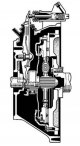
The new Camry vehicles use a single-plate dry clutch with hydraulic drive, equipped with a release mechanism that reduces the effort on the clutch pedal. This unification was introduced to improve the safety of the...
The new Camry vehicles use a single-plate dry clutch with hydraulic drive, equipped with a release mechanism that reduces the effort on the clutch pedal. This unification was introduced to improve the safety of the...

Clutch release control system when starting the engine
Fig. 3.2. Location of the clutch release control system elements when starting the engine: 1 - starter relay; 2 - clutch pedal switch This system prevents the engine from starting with the starter when the clutch pedal...
Fig. 3.2. Location of the clutch release control system elements when starting the engine: 1 - starter relay; 2 - clutch pedal switch This system prevents the engine from starting with the starter when the clutch pedal...

Bleeding the clutch release hydraulic drive
Fig. 3.4. Draining the working fluid of the clutch hydraulic drive Caution! Do not allow working fluid to come into contact with painted surfaces. If working fluid comes into contact with a painted surface, wash it off...
Fig. 3.4. Draining the working fluid of the clutch hydraulic drive Caution! Do not allow working fluid to come into contact with painted surfaces. If working fluid comes into contact with a painted surface, wash it off...
Adjusting the height of the clutch pedal
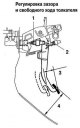
Inspect and adjust the clutch pedal. To do this, fold back the floor carpet and check the height of the clutch pedal. Pedal height from floor: 159.0–169.0 mm. If the height is not as specified, adjust it. Fig. 3.5....
Inspect and adjust the clutch pedal. To do this, fold back the floor carpet and check the height of the clutch pedal. Pedal height from floor: 159.0–169.0 mm. If the height is not as specified, adjust it. Fig. 3.5....

Checking the pedal free play and push rod clearance
If the cruise control system is equipped, disconnect the clutch switch connector. Press the pedal until you feel the clutch begin to resist. Pedal free play should be: 5.0–15.0 mm. Press the pedal gently until the...
If the cruise control system is equipped, disconnect the clutch switch connector. Press the pedal until you feel the clutch begin to resist. Pedal free play should be: 5.0–15.0 mm. Press the pedal gently until the...

Adjusting the pedal free play and push rod clearance
Remove the top of the instrument panel. Remove the left lower instrument panel insert. Disconnect the air duct. Loosen the lock nut and rotate the tappet until the correct tappet free play and clearance is achieved....
Remove the top of the instrument panel. Remove the left lower instrument panel insert. Disconnect the air duct. Loosen the lock nut and rotate the tappet until the correct tappet free play and clearance is achieved....

Checking the clutch release point
Tighten the parking brake lever and set the wheel stopper. Start the engine and let it idle. Without pressing the clutch pedal, slowly move the gear shift lever to the reverse position until the gears contact. Gradually...
Tighten the parking brake lever and set the wheel stopper. Start the engine and let it idle. Without pressing the clutch pedal, slowly move the gear shift lever to the reverse position until the gears contact. Gradually...
Removal the clutch pedal
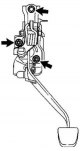
Remove the instrument cluster trim panel. Remove the instrument cluster unit. Remove the top of the instrument panel. Remove the clutch master cylinder push rod fork with the pin. Remove the clamp and pull the pin out...
Remove the instrument cluster trim panel. Remove the instrument cluster unit. Remove the top of the instrument panel. Remove the clutch master cylinder push rod fork with the pin. Remove the clamp and pull the pin out...

Disassembling the clutch pedal
Fig. 3.10. Removing the clutch pedal spring Release the clutch pedal spring fastening to the bracket (Fig. 3.10). Fig. 3.11. Removing the clutch pedal from the bracket Place the clutch pedal in a vice with soft jaws....
Fig. 3.10. Removing the clutch pedal spring Release the clutch pedal spring fastening to the bracket (Fig. 3.10). Fig. 3.11. Removing the clutch pedal from the bracket Place the clutch pedal in a vice with soft jaws....

Installing the clutch pedal
Install the clutch master cylinder pushrod bushing. Apply grease to the inside of the new bushing. Install the pushrod bushing into the clutch pedal hole. Install the first clutch pedal buffer. Install the clutch pedal...
Install the clutch master cylinder pushrod bushing. Apply grease to the inside of the new bushing. Install the pushrod bushing into the clutch pedal hole. Install the first clutch pedal buffer. Install the clutch pedal...
Removal the clutch master cylinder
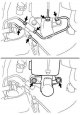
Drain the fluid from the clutch hydraulic system. Fig. 3.19. Master brake cylinder mounting bolts Remove the master brake cylinder by unscrewing the mounting bolts shown by the arrows in Figure 3.19. Fig. 3.20. Brake...
Drain the fluid from the clutch hydraulic system. Fig. 3.19. Master brake cylinder mounting bolts Remove the master brake cylinder by unscrewing the mounting bolts shown by the arrows in Figure 3.19. Fig. 3.20. Brake...

Removal the clutch master cylinder piston kit
Fig. 3.22. Removing the spring spline pin Using a punch with a thin tip (5 mm) and a hammer, knock out the slotted spring pin (Fig. 3.22). Remove the inlet fitting and sealing ring. Loosen the lock nut and remove the...
Fig. 3.22. Removing the spring spline pin Using a punch with a thin tip (5 mm) and a hammer, knock out the slotted spring pin (Fig. 3.22). Remove the inlet fitting and sealing ring. Loosen the lock nut and remove the...

Clutch Master Cylinder Piston Kit Installation
Fig. 3.24. Places of application of consistent lubricant on the piston body Lubricate the piston parts with lithium grease (the places where the lubricant is applied are shown by arrows in Figure 3.24). Install the...
Fig. 3.24. Places of application of consistent lubricant on the piston body Lubricate the piston parts with lithium grease (the places where the lubricant is applied are shown by arrows in Figure 3.24). Install the...

Installing the Clutch Master Cylinder
Fig. 3.26. Places of application of consistent lubricant on the contact surfaces of the pin and bushing Apply MP grease to the contact surfaces of the pin and bushing (Fig. 3.26). Connect the fork to the clutch pedal...
Fig. 3.26. Places of application of consistent lubricant on the contact surfaces of the pin and bushing Apply MP grease to the contact surfaces of the pin and bushing (Fig. 3.26). Connect the fork to the clutch pedal...

Clutch intermediate accumulator (since July 2003)
Fig. 3.30. Intermediate clutch accumulator The intermediate clutch accumulator is installed between the clutch master cylinder and the clutch slave cylinder in order to absorb excess vibration of the fluid in the clutch...
Fig. 3.30. Intermediate clutch accumulator The intermediate clutch accumulator is installed between the clutch master cylinder and the clutch slave cylinder in order to absorb excess vibration of the fluid in the clutch...

Removal and installation the clutch slave cylinder
Removal Fig. 3.31. Clutch slave cylinder bracket and intermediate clutch accumulator mounting bolts Loosen the clutch slave cylinder bracket mounting bolts (are shown by arrows in Figure 3.31). Using special tool...
Removal Fig. 3.31. Clutch slave cylinder bracket and intermediate clutch accumulator mounting bolts Loosen the clutch slave cylinder bracket mounting bolts (are shown by arrows in Figure 3.31). Using special tool...

Removal and installation the clutch
Removal Remove the gearbox in block with the main gear. Remove the clutch release fork boot. Remove the clutch release fork assembly. Remove the clutch release bearing sleeve clamp. Remove the clutch release fork...
Removal Remove the gearbox in block with the main gear. Remove the clutch release fork boot. Remove the clutch release fork assembly. Remove the clutch release bearing sleeve clamp. Remove the clutch release fork...

Checking the clutch elements
Use a vacuum cleaner or a clean cloth to remove dust from the clutch housing. Do not use compressed air, as inhaling dust containing asbestos is harmful to health. Check the condition of the flywheel friction surface...
Use a vacuum cleaner or a clean cloth to remove dust from the clutch housing. Do not use compressed air, as inhaling dust containing asbestos is harmful to health. Check the condition of the flywheel friction surface...
This section is available on: russian, bulgarian, belarusian, ukrainian, serbian, croatian, romanian, polish, slovak, hungarian
Similar sections for other Toyota models
➥ Clutch Toyota Cruiser 60/80 (1980-1997, petrol)
➥ Clutch Toyota 4Runner N120 (1989-1995)
➥ Clutch Toyota Dyna Y50/Y60 (1984-1995)
➥ Clutch Toyota Corona T190 (1992-1997)
➥ Clutch Toyota RAV 4 XA10 (1994-2000)
➥ Clutch and drive shafts Toyota Corolla Verso 3 (2004-2009)
Link in different formats to this article
TEXTHTMLBB Code
- User manual
- Vehicle description
- Keys, locks and alarms
- Governing bodies
- Salon equipment
- Driving and operation
- Maintenance
- Power unit
- 4-cylinder engine
- Control system (I4)
- Engine overhaul (I4)
- 6-cylinder engine
- Control system (V6)
- Engine overhaul (V6)
- Transmission
- Clutch
- Mechanical gearbox
- Automatic gearbox
- Drive mechanism
- Chassis, running gear
- Wheels and tires
- Car suspension
- Steering
- Brake system
- Body and interior
- Exterior (external elements)
- Doors, locks and windows
- Air conditioning and heater
- Electrical equipment
- Equipment and devices
- Power devices
- Electrical circuits
- General information
- Controls and instruments
- Driving and operation
- Daily care
- Maintenance
- Power unit
- 4-cylinder engine
- 6-cylinder engine
- Engine overhaul
- Engine electrical equipment
- Cooling system
- Heating and ventilation
- Fuel system
- Exhaust system
- Transmission
- Mechanical gearbox
- Automatic gearbox
- Clutch
- Chassis, running gear
- Suspension and axle shafts
- Steering
- Brake system
- Body and interior
- Exterior (external elements)
- Interior (internal elements)
- Doors, locks and windows
- Electrical equipment
- Equipment and devices
- Electrical circuits
- General information
- User manual
- Maintenance
- Power unit
- 4-cylinder engine
- 6-cylinder engine
- Overhaul of engines
- Cooling and heating
- Fuel system
- Engine electrical equipment
- Control system
- Transmission
- Mechanical gearbox
- Automatic gearbox
- Clutch and drive shafts
- Chassis, running gear
- Brake system
- Car suspension
- Steering
- Body and interior
- Exterior (external elements)
- Interior (internal elements)
- Doors, locks and windows
- Electrical equipment
- Equipment and devices
- Headlights and lighting
- Electrical circuits
- General information
- User manual
- Maintenance
- Power unit
- Petrol engines
- Diesel engines
- Engine overhaul
- Cooling and lubrication system
- Fuel system (diesel)
- Fuel injection (petrol)
- Engine electrical equipment
- Transmission
- Clutch and cardan
- Automatic gearbox
- Chassis, running gear
- Front suspension
- Rear suspension
- Steering
- Brake system
- Body and interior
- Body elements
- Air conditioning and heater
- SRS security system
- Electrical equipment
- Equipment and devices
- Electrical circuits