



Share information:
Vehicle owner's manual Toyota Camry 1 (XV10)


Primary and secondary keys
Warning! When you leave the car, even for a short time, always remove the key from the ignition. This is especially important when there are children in the car. They may start the engine or turn on some electrical...
Warning! When you leave the car, even for a short time, always remove the key from the ignition. This is especially important when there are children in the car. They may start the engine or turn on some electrical...

Keychain with key code
The plastic key ring contains the key numbers required to order spare keys. Only on the basis of these numbers can you order spare keys from a TOYOTA service center. You should keep the key fob especially safe because...
The plastic key ring contains the key numbers required to order spare keys. Only on the basis of these numbers can you order spare keys from a TOYOTA service center. You should keep the key fob especially safe because...

Opening the door with a key
From the outside, the driver's doors are locked by turning the key to the left and unlocked by turning the key to the right. On vehicles with central locking, when the driver's door is unlocked/locked with the key, all...
From the outside, the driver's doors are locked by turning the key to the left and unlocked by turning the key to the right. On vehicles with central locking, when the driver's door is unlocked/locked with the key, all...

Internal door lock handle
To lock the door from the inside, turn the lock handle forwards, and to close it, turn it backwards. On cars with central locking, the driver's door can be opened from the inside with the lock handle locked. If you need...
To lock the door from the inside, turn the lock handle forwards, and to close it, turn it backwards. On cars with central locking, the driver's door can be opened from the inside with the lock handle locked. If you need...

Central locking switch
To close all locks simultaneously, press the corresponding side of the "DOOR LOCK" switch. To open all locks simultaneously, press the opposite side of the "DOOR LOCK" switch.
To close all locks simultaneously, press the corresponding side of the "DOOR LOCK" switch. To open all locks simultaneously, press the opposite side of the "DOOR LOCK" switch.

Child safety latches on the rear door
The rear doors are equipped with additional child safety latches. Turn the latch handle at the end of the door in the direction of the arrow and close the door. The inner door lock actuator handle will be locked and the...
The rear doors are equipped with additional child safety latches. Turn the latch handle at the end of the door in the direction of the arrow and close the door. The inner door lock actuator handle will be locked and the...

Electric window control
The window switches are located in the door armrests. There is also a front passenger window switch on the driver's door. The power windows can only operate if the ignition key is in the "ON" position. If you need to...
The window switches are located in the door armrests. There is also a front passenger window switch on the driver's door. The power windows can only operate if the ignition key is in the "ON" position. If you need to...

Adjusting the seat headrests
The head restraints are height-adjustable and should be installed according to the driver and passenger body types. Correctly installed head restraints provide effective protection together with the seat belts. The...
The head restraints are height-adjustable and should be installed according to the driver and passenger body types. Correctly installed head restraints provide effective protection together with the seat belts. The...
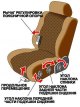
Front seats — adjustment
Caution: The front seats should not be positioned too close to the steering wheel and the dashboard. Adjust your seat as shown in the illustration, paying attention to the correct basic adjustments of the driver's and...
Caution: The front seats should not be positioned too close to the steering wheel and the dashboard. Adjust your seat as shown in the illustration, paying attention to the correct basic adjustments of the driver's and...

Rear seats — folding
To increase the luggage compartment to the backs of the front seats, it is necessary to fold down the back of the rear seat. If desired, each half of the back can be folded separately.
To increase the luggage compartment to the backs of the front seats, it is necessary to fold down the back of the rear seat. If desired, each half of the back can be folded separately.

Heated seats
To turn on the seat heating, press the side of the switch marked "HI" and to turn it off, press the side marked "LO". The seat heating is only possible when the ignition key is in the "ON" position. To avoid discharging...
To turn on the seat heating, press the side of the switch marked "HI" and to turn it off, press the side marked "LO". The seat heating is only possible when the ignition key is in the "ON" position. To avoid discharging...

Adjusting the steering wheel height
Caution! Adjustment of the steering column position should only be performed when the vehicle is stationary. Caution! For safety reasons, the locking handle must always be firmly pressed down to prevent the steering...
Caution! Adjustment of the steering column position should only be performed when the vehicle is stationary. Caution! For safety reasons, the locking handle must always be firmly pressed down to prevent the steering...

Light, wiper and turn signal switches
Turning on the headlights To turn on the headlights, turn the knob at the end of the lever. The first position turns on the parking lights. The second position turns on the parking lights and headlights. When the engine...
Turning on the headlights To turn on the headlights, turn the knob at the end of the lever. The first position turns on the parking lights. The second position turns on the parking lights and headlights. When the engine...

Control devices
Fuel gauge The indicator works when the ignition is on. It is desirable that in any case there is at least a quarter of a tank of fuel left in the fuel tank. If the indicator has reached the reserve fuel zone E, you...
Fuel gauge The indicator works when the ignition is on. It is desirable that in any case there is at least a quarter of a tank of fuel left in the fuel tank. If the indicator has reached the reserve fuel zone E, you...

Control lamps
Parking brake When the parking brake is applied and the ignition is on, the indicator lamp lights up. It should go out when the parking brake is released. Brake system Warning! If the warning lamp does not go out after...
Parking brake When the parking brake is applied and the ignition is on, the indicator lamp lights up. It should go out when the parking brake is released. Brake system Warning! If the warning lamp does not go out after...

Economometer (fuel consumption indicator)
The economizer informs the driver about the amount of fuel consumption. The green color of the indicator corresponds to the most favorable fuel consumption. If the yellow indicator lights up, indicating increased fuel...
The economizer informs the driver about the amount of fuel consumption. The green color of the indicator corresponds to the most favorable fuel consumption. If the yellow indicator lights up, indicating increased fuel...

Ignition switch
Attention! Remove the key from the ignition only after the car has come to a complete stop! Otherwise, the steering lock may be activated while driving. START — engine starter. After releasing, the key automatically...
Attention! Remove the key from the ignition only after the car has come to a complete stop! Otherwise, the steering lock may be activated while driving. START — engine starter. After releasing, the key automatically...

Automatic transmission
Normal driving mode (a) Caution: When moving the selector lever to position "D", do not press the accelerator pedal. 1. Set the selector lever to the "P" or "N" position and start the engine. In the selector positions...
Normal driving mode (a) Caution: When moving the selector lever to position "D", do not press the accelerator pedal. 1. Set the selector lever to the "P" or "N" position and start the engine. In the selector positions...

Manual transmission
Caution! While driving, the driver's right hand should not be constantly on the gearshift lever handle; the force from the weight of the hand is transferred to the gear shift forks, which can lead to accelerated wear of...
Caution! While driving, the driver's right hand should not be constantly on the gearshift lever handle; the force from the weight of the hand is transferred to the gear shift forks, which can lead to accelerated wear of...

Cruise control (maintaining speed)
Cruise control provides the ability to remember and maintain any speed constant, starting from 40 km/h to almost the maximum. Cruise control should not be used unless it is practical to drive at a constant speed (for...
Cruise control provides the ability to remember and maintain any speed constant, starting from 40 km/h to almost the maximum. Cruise control should not be used unless it is practical to drive at a constant speed (for...

Heating and ventilation system
Temperature controller The temperature switch changes the temperature of the air entering the passenger compartment. When you turn the switch towards HIGH, the temperature increases, and when you turn it towards LOW, it...
Temperature controller The temperature switch changes the temperature of the air entering the passenger compartment. When you turn the switch towards HIGH, the temperature increases, and when you turn it towards LOW, it...

Digital clock — setting the time
The digital clock displays the time when the ignition key is in the "ACC" or "ON" position. To set the hours, press the "H" button. To set the minutes, press the "M" button. When setting the time to a full hour, press...
The digital clock displays the time when the ignition key is in the "ACC" or "ON" position. To set the hours, press the "H" button. To set the minutes, press the "M" button. When setting the time to a full hour, press...
This section is available on: russian, bulgarian, belarusian, ukrainian, serbian, croatian, romanian, polish, slovak, hungarian
Similar sections for other Toyota models
➥ User manual Toyota 4Runner N120 (1989-1995)
➥ User manual Toyota RAV 4 XA10 (1994-2000)
➥ User manual Toyota Corona T190 (1992-1997)
➥ User manual Toyota Carina T190 (1992-1996)
➥ User manual Toyota Duet (1998-2004)
➥ User manual Toyota Corolla Verso 3 (2004-2009)
Link in different formats to this article
TEXTHTMLBB Code
- User manual
- Vehicle description
- Keys, locks and alarms
- Governing bodies
- Salon equipment
- Driving and operation
- Maintenance
- Power unit
- 4-cylinder engine
- Control system (I4)
- Engine overhaul (I4)
- 6-cylinder engine
- Control system (V6)
- Engine overhaul (V6)
- Transmission
- Clutch
- Mechanical gearbox
- Automatic gearbox
- Drive mechanism
- Chassis, running gear
- Wheels and tires
- Car suspension
- Steering
- Brake system
- Body and interior
- Exterior (external elements)
- Doors, locks and windows
- Air conditioning and heater
- Electrical equipment
- Equipment and devices
- Power devices
- Electrical circuits
- General information
- Controls and instruments
- Driving and operation
- Daily care
- Maintenance
- Power unit
- 4-cylinder engine
- 6-cylinder engine
- Engine overhaul
- Engine electrical equipment
- Cooling system
- Heating and ventilation
- Fuel system
- Exhaust system
- Transmission
- Mechanical gearbox
- Automatic gearbox
- Clutch
- Chassis, running gear
- Suspension and axle shafts
- Steering
- Brake system
- Body and interior
- Exterior (external elements)
- Interior (internal elements)
- Doors, locks and windows
- Electrical equipment
- Equipment and devices
- Electrical circuits
- General information
- User manual
- Maintenance
- Power unit
- 4-cylinder engine
- 6-cylinder engine
- Overhaul of engines
- Cooling and heating
- Fuel system
- Engine electrical equipment
- Control system
- Transmission
- Mechanical gearbox
- Automatic gearbox
- Clutch and drive shafts
- Chassis, running gear
- Brake system
- Car suspension
- Steering
- Body and interior
- Exterior (external elements)
- Interior (internal elements)
- Doors, locks and windows
- Electrical equipment
- Equipment and devices
- Headlights and lighting
- Electrical circuits
- General information
- User manual
- Maintenance
- Power unit
- Petrol engines
- Diesel engines
- Engine overhaul
- Cooling and lubrication system
- Fuel system (diesel)
- Fuel injection (petrol)
- Engine electrical equipment
- Transmission
- Clutch and cardan
- Automatic gearbox
- Chassis, running gear
- Front suspension
- Rear suspension
- Steering
- Brake system
- Body and interior
- Body elements
- Air conditioning and heater
- SRS security system
- Electrical equipment
- Equipment and devices
- Electrical circuits