



a) Check the alternator drive belt for wear and damage. If a defect is found, replace the belt.
Note: Separation of rubber from the cord on the inner side is not allowed (from the side of the ridges) and outer surfaces of the belt, exposed or damaged cord, delamination of the ridge from the rubber base, presence of cracks, delamination or wear on the side surfaces of the belt and on the side surfaces of the belt ridges. Replace the belt if necessary.
b) Check the drive belt deflection at the points indicated in the figure, using a force of 98 N.
Drive belt deflection (3S-FE, 4S-FE)
New belt
- A - 11-15 mm
- B - 6-9 mm
- C - 8-10 mm
Used belt
- A — 13-17 mm
- B — 9-12 mm
- C — 10-13 mm
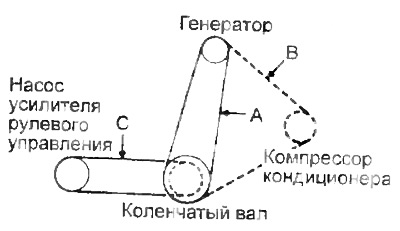
3S-FE, 4S-FE.
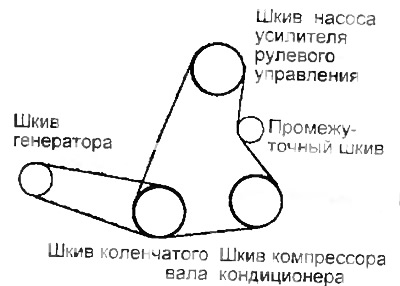
3C-T.
If necessary, adjust the belt tension as shown in the figure.
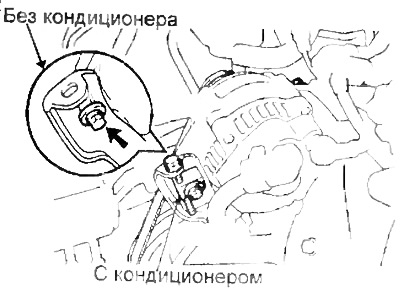
3S-FE, 4S-FE.
Note:
- The term "used belt" refers to a belt that has been in service for more than 5 minutes.
- After installing the belt, check that it is seated correctly on the pulleys. Check with your hand at the bottom of the pulleys to see if there is a loose groove on the pulley.
- After installing the belt, start the engine and let it run for 5 minutes, then check the belt tension again.
[The original article is on the portal: ToyotaMan]