
Company Honda Company Ford Company Skoda Company Kia Company Mazda Company Mercedes Company Renault
English Русский
Български
Беларускі
Український
Српски
Hrvatski
Română
Polski
Slovenský
Magyar
Bookmark Articles Sitemap Contacts
ToyotaMan.ru


Camry Corolla Corona Carina Land Cruiser Highlander 4Runner RAV4 Others
Camry XV30 (2001-2006) Camry XV20 (1996-2001) Camry XV10 (1991-1996) Camry Vista V40 (1994-1998)

Fuel injection description [Toyota Camry Vista-V40]

  • Main
  • Camry
  • Vista-V40 (1994-1998)
  • Power unit
  • Fuel injection (petrol)
  • Fuel injection description
0
Contents: Fuel system ↓ Air supply system ↓ Electronic control system ↓
The fuel injection system consists of three main subsystems: fuel supply, air supply and electronic control.

Fuel system


Fuel is supplied by the fuel pump at a constant pressure difference (284 kPa) through the filter to the injectors, which inject fuel into the intake manifold pipes directly in front of the intake valves. The amount of fuel supplied is determined by the duration of the control pulse, which is set in accordance with the signal from the electronic control unit.

The fuel pressure regulator maintains a constant difference between the fuel pressure before the working injector and the air pressure in the intake manifold. In this case, the amount of fuel supplied is clearly determined by the open state of the injector. Regulation is carried out by bypassing part of the fuel into the tank through the valve and the fuel return line.

Air supply system


The air supply system ensures that the required amount of air is supplied to the intake valves.

The amount of air entering the engine is determined by the throttle valve opening angle and the engine crankshaft speed. The air flow passes the air filter, the throttle valve body channel and enters the upper part of the intake manifold, from where it is distributed through separate pipes to the engine cylinders.

At low coolant temperatures, the idle speed control valve opens and some air enters the upper intake manifold through the bypass passage in addition to the air passing through the throttle valve. Thus, as the engine warms up, even with the throttle valve fully closed, air enters the upper intake manifold, which causes the engine speed to increase (1st stage idle speed control).


The upper part of the intake manifold reduces air flow pulsations (functions as a receiver or resonator), and also prevents the work of some cylinders from overlapping with others.

Electronic control system


The engines are equipped with an electronic control system from TOYOTA, which controls fuel injection, ignition timing, diagnostic system, etc. using an electronic control unit.

By means of an electronic control unit, the fuel injection control system performs the following functions:

1. Fuel injection control. The electronic control unit receives signals from various sensors that record changes in the engine operating condition. In particular, the sensors record:
  • absolute pressure in the intake manifold,
  • intake air temperature,
  • coolant temperature,
  • engine crankshaft speed,
  • throttle opening angle
  • oxygen content in exhaust gases, etc.

These signals are processed in the electronic control unit, which generates an output signal for the fuel injection duration, ensuring the optimum excess air ratio for the current engine operating conditions.

2. Control of ignition timing angle.

The electronic control unit memory stores the values of the optimal ignition advance angle for all possible engine operating modes. Using signals from various sensors monitoring engine operating conditions (crankshaft speed, coolant temperature, etc.), the electronic control unit generates pulses that control spark formation at strictly defined moments in time.

3. Idle speed control system.

The electronic control unit memory stores data on the optimum idle speed, which corresponds to various conditions (for example, coolant temperature, air conditioning on/off, etc.) The sensors transmit signals to the electronic control unit, which controls the air flow through the bypass channel (bypassing the throttle valve) and regulates the idle speed in accordance with the set value.
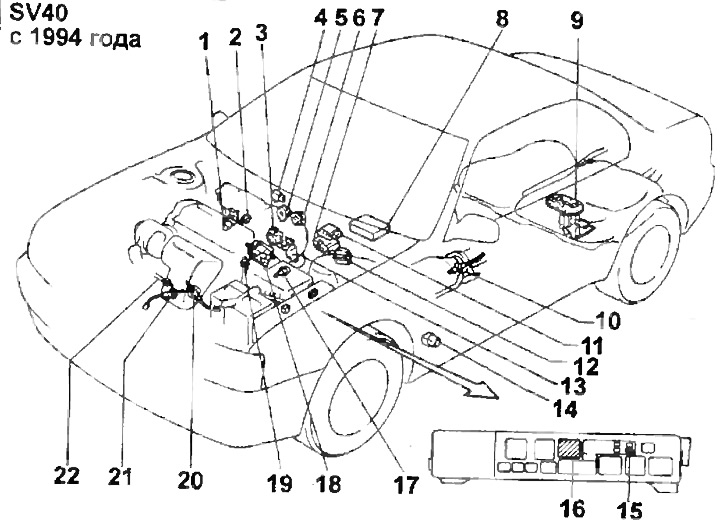
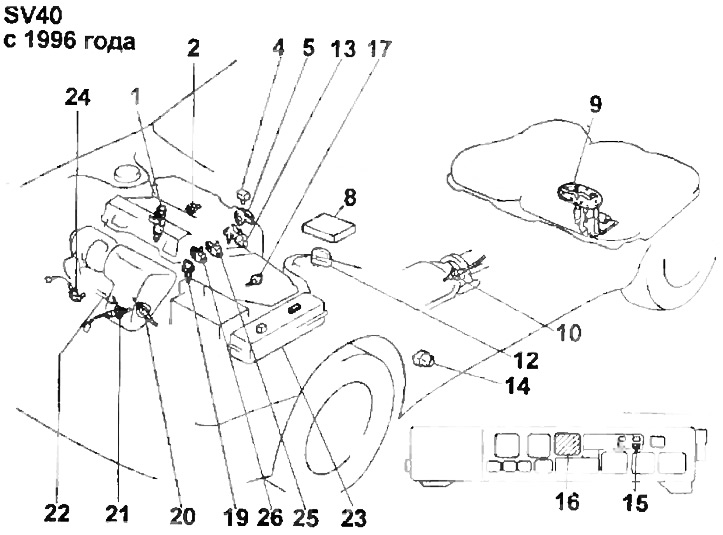


Location of components of the electronic fuel injection control system.
1 - nozzle,
2 - knock sensor,
3 - additional throttle valve servo drive,
4 - absolute pressure sensor,
5 - throttle position sensor,
6 - additional throttle position sensor,
7 - electronic control unit of the traction control system (TRC),
8 - electronic control unit,
9 - fuel pump,
10 - oxygen sensor (3S-FE, front wheel drive),
11 - switch,
12 - diagnostic connector,
13 - idle speed control valve,
14 - circuit breaker relay,
15 - injection system fuse,
16 - main relay of the injection system,
17 - intake air temperature sensor,
18 - Distributor,
19 - coolant temperature sensor,
20 - oxygen sensor (4S-FE, 3S-FE, 4WD),
21 - oxygen sensor (3S-FE, front wheel drive),
22 - exhaust gas temperature sensor (4S-FE, 3S-FE, 4WD),
23 - fuse and relay box,
24 - crankshaft position sensor,
25 - ignition coil No.2,
26 - ignition coil No.2.


4. Diagnostics.


The electronic control unit warns of a malfunction or abnormal operation via an indicator "CHECK ENGINE", displayed on the instrument panel. The malfunction is identified as a diagnostic code, which is stored by the electronic control unit. The diagnostic code can be deciphered by the number of blinks of the indicator light when the contacts "TEG" and "EG" are shorted. Diagnostic codes are discussed below.

5. Function "Fail-Safe" ("Get home").

In case of failure of any sensor, an emergency mode of operation is provided (to get to the nearest service station). At the same time, the control lamp on the instrument panel lights up "CHECK ENGINE".
This article is available at: russian, bulgarian, belarusian, ukrainian, serbian, croatian, romanian, polish, slovak, hungarian
The article material has been checked: Mitrofanova Elena
Share information:
◀ Previous
Camry Vista V40: Fuel injection (petrol)
Next ▶

 
Precautionary measures
Self-diagnosis system
Diagnosing faults using a road test
Troubleshooting with a Voltmeter
Electronic Fuel Injection Control System Test Procedure
Similar articles on other Toyota models

➥ EFI Fuel Injection System Schematic Toyota Corolla E80 (1983-1990)
➥ Description of the fuel injection system Toyota Corona T190 (1992-1997)
➥ Checking the fuel injection pump Toyota Carina T190 (1992-1996)
➥ Technical characteristics of the fuel injection system Toyota Cruiser 60/80 (1980-1997, petrol)
➥ Electronic Sequential Fuel Injection (SFI) System — General… Toyota Highlander 1 (2000-2007, petrol)
➥ Main Fuel Injection System (EFI) relay and fuel pump relay Toyota 4Runner N120 (1989-1995)
Link in different formats to this article
Comments and feedback from visitors
No comments yet


Add two numbers 25 + 44


Camry XV30 (2001-2006) 
  • User manual
  • Vehicle description
  • Keys, locks and alarms
  • Governing bodies
  • Salon equipment
  • Driving and operation
  • Maintenance
  • Power unit
  • 4-cylinder engine
  • Control system (I4)
  • Engine overhaul (I4)
  • 6-cylinder engine
  • Control system (V6)
  • Engine overhaul (V6)
  • Transmission
  • Clutch
  • Mechanical gearbox
  • Automatic gearbox
  • Drive mechanism
  • Chassis, running gear
  • Wheels and tires
  • Car suspension
  • Steering
  • Brake system
  • Body and interior
  • Exterior (external elements)
  • Doors, locks and windows
  • Air conditioning and heater
  • Electrical equipment
  • Equipment and devices
  • Power devices
  • Electrical circuits
Camry XV20 (1996-2001) 
  • General information
  • Controls and instruments
  • Driving and operation
  • Daily care
  • Maintenance
  • Power unit
  • 4-cylinder engine
  • 6-cylinder engine
  • Engine overhaul
  • Engine electrical equipment
  • Cooling system
  • Heating and ventilation
  • Fuel system
  • Exhaust system
  • Transmission
  • Mechanical gearbox
  • Automatic gearbox
  • Clutch
  • Chassis, running gear
  • Suspension and axle shafts
  • Steering
  • Brake system
  • Body and interior
  • Exterior (external elements)
  • Interior (internal elements)
  • Doors, locks and windows
  • Electrical equipment
  • Equipment and devices
  • Electrical circuits
Camry XV10 (1991-1996) 
  • General information
  • User manual
  • Maintenance
  • Power unit
  • 4-cylinder engine
  • 6-cylinder engine
  • Overhaul of engines
  • Cooling and heating
  • Fuel system
  • Engine electrical equipment
  • Control system
  • Transmission
  • Mechanical gearbox
  • Automatic gearbox
  • Clutch and drive shafts
  • Chassis, running gear
  • Brake system
  • Car suspension
  • Steering
  • Body and interior
  • Exterior (external elements)
  • Interior (internal elements)
  • Doors, locks and windows
  • Electrical equipment
  • Equipment and devices
  • Headlights and lighting
  • Electrical circuits
Camry Vista V40 (1994-1998) 
  • General information
  • User manual
  • Maintenance
  • Power unit
  • Petrol engines
  • Diesel engines
  • Engine overhaul
  • Cooling and lubrication system
  • Fuel system (diesel)
  • Fuel injection (petrol)
  • Engine electrical equipment
  • Transmission
  • Clutch and cardan
  • Automatic gearbox
  • Chassis, running gear
  • Front suspension
  • Rear suspension
  • Steering
  • Brake system
  • Body and interior
  • Body elements
  • Air conditioning and heater
  • SRS security system
  • Electrical equipment
  • Equipment and devices
  • Electrical circuits
ToyotaMan.ru © 2018–2026 • Mobile version • Interesting about Toyota • Administration • Sitemap: EN BG BY UA RS HR RO PL SK HU • Search system • Bookmark
Camry Vista-V40 • Camry XV10 • Camry XV20 • Camry XV30 • Corolla Verso-AR10 • Corolla E80 • Corona T190 • Carina T170 • Carina T190 • Land Cruiser J70 (diesel) • Land Cruiser J60 (petrol) • Land Cruiser J100 • Highlander XU20 (petrol) • 4Runner N120 • RAV4 XA10 • RAV4 XA20 • Duet M100 • Dyna Y50 •
We require cookies to enable some interactive features. Is that ok with you?