



Contents: Description ↓ Engine Malfunction Indicator Light…↓ Output of diagnostic codes (normal…↓ Form of diagnostic codes ↓ Output of diagnostic codes…↓ Clear diagnostic code ↓ Diagnostic indication ↓
Description
The electronic control unit has a built-in self-diagnostic system, which continuously monitors the engine condition using sensor signals. If a malfunction is detected, this system identifies it and informs the driver about it with a signal "CHECK ENGINE" (check the engine), which is illuminated by a control lamp located on the instrument panel. Self-diagnosis system of engines 3S-FE, 4S-Fi, 4S-FE, 3S-GE, 3S-GTE, 5S-FE (except for early models) has several operating modes: normal (current) self-diagnosis mode, testing mode and road test. When operating in normal self-diagnosis mode, the electronic control unit analyzes various signals (see below table of diagnostic codes) and identifies the failed system based on the output parameters recorded by the corresponding sensors or actuators. A warning light on the instrument panel informs the driver of the presence of a malfunction (however, not all codes are displayed on the dashboard). The signal switches off automatically immediately after the fault is corrected. However, the electronic unit stores (remembers) in its memory the fault codes (except code No.16) associated with the corresponding failures until the diagnostic system is cleared (does not "reset" the information) by disconnecting the "EFI" fuse with the ignition off.
The diagnostic code can be determined by the number of flashes of the "CHECK" indicator lamp with the "TE1" and "E1" terminals of the diagnostic connector closed. If there are 2 or more faults, their indication starts with the lowest code (having the lowest number) and then it continues in an ascending order.
In check mode (testing) systems, if there are any faults, the electronic control unit also lights the signal lamp on the instrument panel, additionally displaying codes of those faults that are not detected in the normal (current) self-diagnosis mode (except for codes No.42, 43 and 51). In this case, terminals "TE2" and "E1" of the diagnostic connector must be closed, as shown below.
In the test mode, even after the malfunction has been eliminated, its code is stored in the memory of the electronic control unit after the ignition is turned off (except for codes No.42, 43 and 51) similar to what occurs during current self-diagnostics. The choice of the type of self-diagnostics ("current" or "testing") is carried out by the corresponding short-circuiting of the terminals "TE1", "TE2" and "E1" of the diagnostic connector, as shown below.
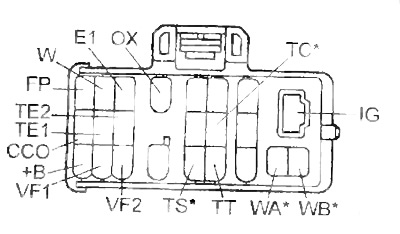
The test mode is used to search for faults that are difficult to determine in the normal (current) self-diagnosis mode (for example, a breach of contact).
Self-diagnosis during testing can be used by specialists subject to the appropriate procedure for connecting the terminals of the diagnostic connector and a certain sequence of operations. The use of a road test pursues the following goals: reproduction (simulation) of driving modes in which a given diagnostic code is detected and verification of the completeness of the repair work performed.
Engine Malfunction Indicator Light "CHECK ENGINE"
1. Malfunction indicator lamp "CHECK ENGINE" — a warning light signal, which is a light panel on the instrument panel, lights up when the ignition is on and the engine is not running.
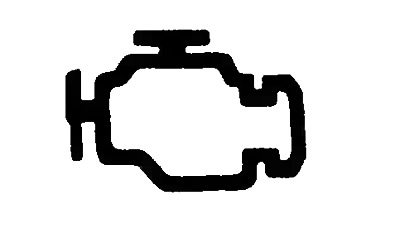
2. After starting the engine, the lamp "CHECK ENGINE" should go out. If the indicator lamp continues to light when the engine is running, this means that the diagnostic system is warning about the presence of malfunctions.
Output of diagnostic codes (normal self-diagnosis mode)
To obtain the output diagnostic code, the following procedures must be performed.
1. Check the initial conditions.
- a) Battery voltage is not less than 11 volts,
- b) The throttle valve is completely closed (the terminals of the throttle position sensor "IDL" are shorted),
- c) The gearbox control lever is in neutral position (the automatic transmission selector is in position "P").
- d) All additional equipment is in the OFF position.
- d) The engine is warmed up to normal operating temperature.
2. Turn on the ignition, but do not start the engine. The control lamp "CHECK ENGINE" must burn.
3. Short-circuit the terminals "TE1" and "E1" of the diagnostic connector, the malfunction indicator lamp should go out and start flashing.
Note: If the indicator lamp does not flash, the diagnostic connector terminals are not short-circuited.
4. Read the diagnostic code by the number of blinks (flashes) of the "CHECK" malfunction indicator lamp. (Diagnostic codes see below in the table).
The type of diagnostic code depends on the type of electronic control unit and the type of malfunction.
Form of diagnostic codes
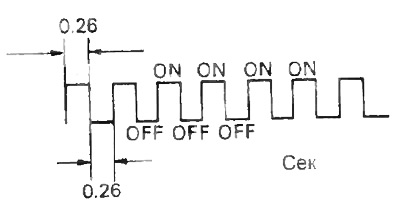
a) Normal operation of the system (absence of malfunction).
The indicator light comes on and goes out at intervals of 0.26 seconds.
b) Indication of fault code.
If there is a fault, the lamp flashes every 0.52 seconds. The first sequence of flashes corresponds to the first digit of the diagnostic code, which consists of two numbers. After a pause of 1.5 seconds, the second sequence of flashes is displayed, corresponding to the second digit of the code. If there are two or more fault codes, an interval of 2.5 seconds is set between them when displayed.
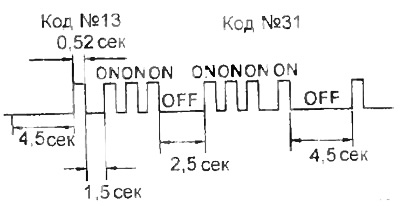
After all the codes have been output, there is a 4.5 second pause, and then they are all repeated while the "TE1" and "E1" terminals of the diagnostic connector are short-circuited.
Note: In case of several fault codes, their indication starts with the lower code and continues in ascending order.
c) Electronic control unit with a 2-stage algorithm for detecting faults.
The electronic control unit of these engines uses a two-stage algorithm for detecting a malfunction.
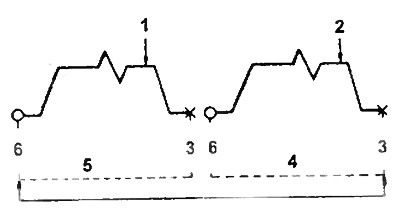
1 - fixing a fault for the first time (pre-memorization),
2 - fixing the fault for the second time (the control lamp lights up),
3 - ignition off,
4 - second cycle,
5 - first cycle,
6 - the ignition switch is on.
When recording codes "21" and "25", a two-stage algorithm is used. It consists in the fact that when a malfunction occurs for the first time, its code is temporarily recorded in the memory of the electronic control unit. If the same malfunction is recorded during the second test drive, then in this case the control lamp. The second test drive is repeated in the same mode. (However, between the first and second test drive cycles the ignition must be switched off).
During self-diagnosis in test mode (the second mode of the self-diagnostic system) the indicator lamp comes on at the first sign of a malfunction.
5. After completing diagnostics, disconnect the wire from the diagnostic connector.
Output of diagnostic codes (self-diagnosis in test mode)
Note:
- Compared with the normal self-diagnosis mode, the self-diagnosis in the test mode has additional capabilities in detecting faults.
- This allows you to identify faults in the electrical circuits of the starting system, the air conditioning system, and also in the electrical circuit of the neutral position indicator of the gear shift lever ("neutral switch").
- Moreover, self-diagnostics in test mode allows you to identify faults that are also recorded by regular self-diagnostics.
To obtain the output diagnostic code in the test mode, the following procedures must be performed.
1. Check the initial conditions.
a) Battery voltage is not less than 11 volts.
b) Throttle valve - fully closed.
c) The gearbox control lever is in neutral position (the automatic transmission selector is in position "P").
d) All additional equipment is switched off.
d) The engine is warmed up to normal operating temperature.
2. Turn off the ignition (OFF).
3. Short-circuit the "TE2" and "E1" terminals of the diagnostic connector using a suitable wire.
4. Turn on the ignition (ON) and the self-diagnostic system will function in test mode.
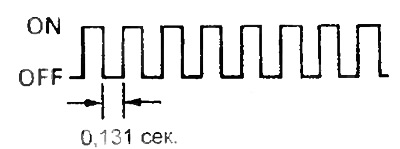
Note. Confirmation that the self-diagnostic system is operating in the testing mode is the blinking of the "CHECK" indicator lamp when the ignition is on. In this case, the time between the end and the beginning of successive pulses (flashes), i.e. the pulse duty cycle, is 0.131 s.
5. Start the engine and start moving the vehicle at a speed of 10 km/h or higher.
6. Simulate situations in which the customer describes the malfunction.
7. Using a suitable wire, short-circuit the "TE1" and "E1" contacts of the diagnostic connector.
8. Read diagnostic codes by the number of flashes of the "CHECK" indicator lamp.
9. After completing diagnostics, disconnect the wires from the diagnostic connector.
Note:
- The system will not enter test mode if contacts "TE2" and "E1" are shorted after the ignition is turned on.
- If you do not complete the 5th stage of the test cycle (road test), then the signals from the starting system (starter) and the vehicle speed will be recorded by the electronic unit as malfunctions, and the control lamp will display codes No.42 and No.43.
- If the automatic transmission control lever is in the positions: "D", "2", "L" or "R", or if the air conditioner is turned on (ON), or if the accelerator pedal is fully depressed, then code No.51 ("air conditioner on") is displayed, which, however, is not a sign of a malfunction.
Clear diagnostic code
1. After repairing the faulty unit, the diagnostic code is stored in the memory of the electronic control unit. Therefore, it must be deleted (erased) by disconnecting the EFI fuse of the injection system (with ignition off). The fuse is located in the distribution box. Trip time (not less than 10 sec) depends on the ambient temperature (the lower the temperature, the longer the fuse must be off).
Note:
- Erasing can also be done by disconnecting the negative (-) terminal of the battery. But in this case, other systems with "memory" (watches, etc.) will also be "cleaned out".
- If the diagnostic code is not erased, it will remain in the memory of the electronic control unit and will appear together with a new code in the event of a future malfunction and will be misleading.
- If it is necessary to disconnect (remove) the battery, you must first read the codes.
2. After the erase operation, it is necessary to perform a driving test and make sure that the "normal operation" code is displayed by the control lamp "CHECK ENGINE".
If the same diagnostic code is displayed again by the control lamp "CHECK ENGINE", this means that the repair work was not completed satisfactorily.
Diagnostic indication
1. The electronic control unit includes the following fault codes (see table below) and among them is the code for normal engine operation.
2. If 2 or more types of faults appear at the same time, the code with the lowest number is displayed first, and then in order of increasing numbers.
3. All fault codes recorded during the road cycle are stored in the memory of the electronic control unit from the moment of registration until the moment of erasure ("reset"), except for codes No.16, 42 43, 51.
4. After troubleshooting, trouble codes are not displayed by the indicator lamp "CHECK ENGINE", but will be stored in the memory of the electronic control unit, with the exception of the code numbers specified in the previous paragraph.