
Company Honda Company Ford Company Skoda Company Kia Company Mazda Company Mercedes Company Renault
English Русский
Български
Беларускі
Український
Српски
Hrvatski
Română
Polski
Slovenský
Magyar
Bookmark Articles Sitemap Contacts
ToyotaMan.ru


Camry Corolla Corona Carina Land Cruiser Highlander 4Runner RAV4 Others
Camry XV30 (2001-2006) Camry XV20 (1996-2001) Camry XV10 (1991-1996) Camry Vista V40 (1994-1998)

Jump starting with an additional battery [Toyota Camry XV20]

  • Main
  • Camry
  • XV20 (1996-2001)
  • General information
  • Driving and operation
  • Jump starting with an additional battery
0


If the booster battery is installed in another vehicle, make sure the vehicles do not touch. Turn off all unnecessary lights and accessories.

If necessary, remove all vent plugs from the booster and discharged batteries. Place a cloth over the open vents on the batteries. (This helps reduce the risk of explosion, injury and burns).


If the engine of the vehicle with the booster battery does not run, start it and let it run for a few minutes. When starting with the booster battery, the engine should run at approximately 2000 rpm with the accelerator pedal lightly depressed.

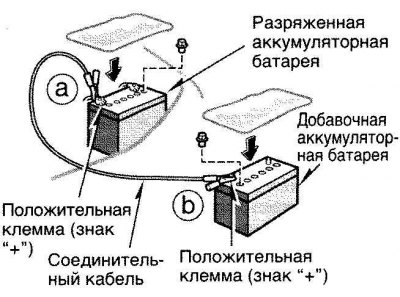
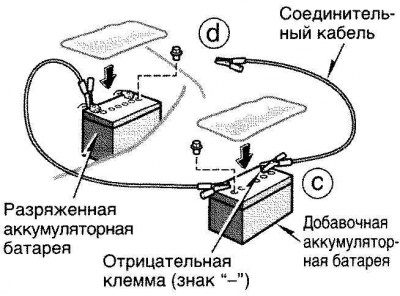
Connect the cables in the order a, b, c, d:
  • a. Connect the positive (red) jumper cable clamp to the positive (+) terminal on the dead battery.
  • b. Connect the clamp on the other end of the positive (red) jumper cable to the positive (+) terminal on the booster battery.
  • c. Connect the negative (black) jumper cable clamp to the negative (-) terminal on the booster battery.
  • d. Connect the clamp on the other end of the negative (black) cable to a solid, stationary, unpainted, metal point on the vehicle with the dead battery.

(Publication Reprinted from a web portal: toyotaman.ru)


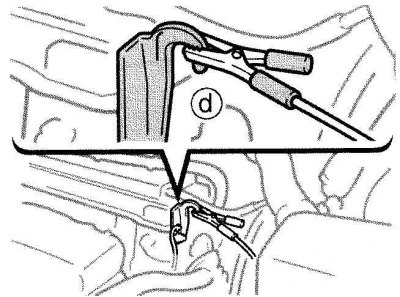
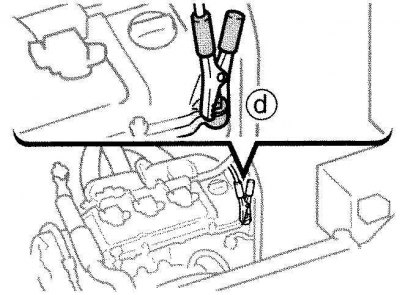
The recommended connection points are shown in the following figures.

Connection point for 5S-FE motor


Connection point for 1MZ-FE engine


Do not connect the cable to or near any part that moves when the engine is cranked. To avoid serious injury, do not lean over the battery when making connections or allow the jumper cables or clamps to touch anything other than the proper battery terminals and ground.

Start the engine in the normal way. Once started, it should run for a few minutes at approximately 2000 rpm with the accelerator pedal lightly depressed.

Carefully disconnect the cables in exactly the reverse order: negative cable, then positive cable.

Carefully dispose of fabrics covering batteries - they may contain sulfuric acid.


If the ventilation plugs were removed, then reinstall them all.

If the cause of the battery discharge is not identified (for example, the lights were left on), it needs to be checked.
This article is available at: russian, bulgarian, belarusian, ukrainian, serbian, croatian, romanian, polish, slovak, hungarian
The article material has been checked: Kolokoltsev Grigory
Share information:
◀ Previous
Camry XV20: Driving and operation
Next ▶

Vehicle and engine identification number
Precautions when packing luggage
Brake pad wear indicator
ABS warning light
Choosing the right fuel
If the engine stalls while driving
If the car engine overheats
If the tire is flat (wheel change)
If your vehicle needs towing
Some tips when buying a car
Similar articles on other Toyota models

➥ Starting from an additional battery Toyota 4Runner N120 (1989-1995)
➥ Starting the engine from an additional battery Toyota RAV 4 XA10 (1994-2000)
➥ Starting with an additional battery — the «KEY FREE» system Toyota Duet (1998-2004)
➥ Starting the engine from an auxiliary battery Toyota Corolla E80 (1983-1990)
➥ Starting from an external battery Toyota Highlander 1 (2000-2007, petrol)
➥ Additional door locking Toyota Corona T190 (1992-1997)
Link in different formats to this article
Comments and feedback from visitors
No comments yet


Add two numbers 42 + 36


Camry XV30 (2001-2006) 
  • User manual
  • Vehicle description
  • Keys, locks and alarms
  • Governing bodies
  • Salon equipment
  • Driving and operation
  • Maintenance
  • Power unit
  • 4-cylinder engine
  • Control system (I4)
  • Engine overhaul (I4)
  • 6-cylinder engine
  • Control system (V6)
  • Engine overhaul (V6)
  • Transmission
  • Clutch
  • Mechanical gearbox
  • Automatic gearbox
  • Drive mechanism
  • Chassis, running gear
  • Wheels and tires
  • Car suspension
  • Steering
  • Brake system
  • Body and interior
  • Exterior (external elements)
  • Doors, locks and windows
  • Air conditioning and heater
  • Electrical equipment
  • Equipment and devices
  • Power devices
  • Electrical circuits
Camry XV20 (1996-2001) 
  • General information
  • Controls and instruments
  • Driving and operation
  • Daily care
  • Maintenance
  • Power unit
  • 4-cylinder engine
  • 6-cylinder engine
  • Engine overhaul
  • Engine electrical equipment
  • Cooling system
  • Heating and ventilation
  • Fuel system
  • Exhaust system
  • Transmission
  • Mechanical gearbox
  • Automatic gearbox
  • Clutch
  • Chassis, running gear
  • Suspension and axle shafts
  • Steering
  • Brake system
  • Body and interior
  • Exterior (external elements)
  • Interior (internal elements)
  • Doors, locks and windows
  • Electrical equipment
  • Equipment and devices
  • Electrical circuits
Camry XV10 (1991-1996) 
  • General information
  • User manual
  • Maintenance
  • Power unit
  • 4-cylinder engine
  • 6-cylinder engine
  • Overhaul of engines
  • Cooling and heating
  • Fuel system
  • Engine electrical equipment
  • Control system
  • Transmission
  • Mechanical gearbox
  • Automatic gearbox
  • Clutch and drive shafts
  • Chassis, running gear
  • Brake system
  • Car suspension
  • Steering
  • Body and interior
  • Exterior (external elements)
  • Interior (internal elements)
  • Doors, locks and windows
  • Electrical equipment
  • Equipment and devices
  • Headlights and lighting
  • Electrical circuits
Camry Vista V40 (1994-1998) 
  • General information
  • User manual
  • Maintenance
  • Power unit
  • Petrol engines
  • Diesel engines
  • Engine overhaul
  • Cooling and lubrication system
  • Fuel system (diesel)
  • Fuel injection (petrol)
  • Engine electrical equipment
  • Transmission
  • Clutch and cardan
  • Automatic gearbox
  • Chassis, running gear
  • Front suspension
  • Rear suspension
  • Steering
  • Brake system
  • Body and interior
  • Body elements
  • Air conditioning and heater
  • SRS security system
  • Electrical equipment
  • Equipment and devices
  • Electrical circuits
ToyotaMan.ru © 2018–2026 • Mobile version • Interesting about Toyota • Administration • Sitemap: EN BG BY UA RS HR RO PL SK HU • Search system • Bookmark
Camry Vista-V40 • Camry XV10 • Camry XV20 • Camry XV30 • Corolla Verso-AR10 • Corolla E80 • Corona T190 • Carina T170 • Carina T190 • Land Cruiser J70 (diesel) • Land Cruiser J60 (petrol) • Land Cruiser J100 • Highlander XU20 (petrol) • 4Runner N120 • RAV4 XA10 • RAV4 XA20 • Duet M100 • Dyna Y50 •
We require cookies to enable some interactive features. Is that ok with you?