



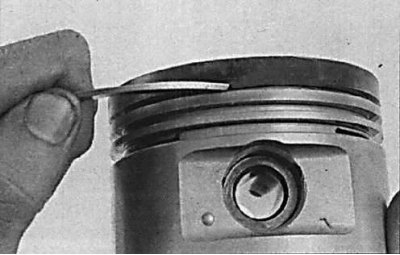
2. To remove piston rings from pistons, spread the piston ring and insert two or three old feeler gauge blades evenly around the circumference of the ring and slide the ring off the piston. Be careful not to scratch the piston with the ends of the ring. Rings are very fragile and can crack if spread too much. The working edges of piston rings are very sharp, so handle them very carefully to avoid cutting yourself. Keep each set of rings with the pistons for reinstallation.
3. Clean all traces of carbon from the top of the piston.
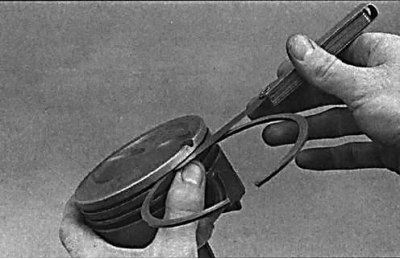
4. Remove carbon deposits from the piston ring grooves using an old piston ring.
5. After removing the deposits, clean the piston and connecting rod with a suitable solvent and wipe dry.
6. Carefully inspect each piston for cracks around the skirt and piston pin holes.
7. Check for wear on the piston skirt, bore in the piston head, and burn marks on the top of the piston.
8. Traces of pitting corrosion on the piston indicate that coolant has entered the combustion chamber. It is necessary to find the cause of coolant entering the combustion chamber and eliminate it.
9. Measure the piston diameter.
10. Determine the piston clearance in the cylinder by subtracting the piston diameter from the cylinder diameter and dividing by two.
(The publication is taken from the website: Toyotaman.ru)
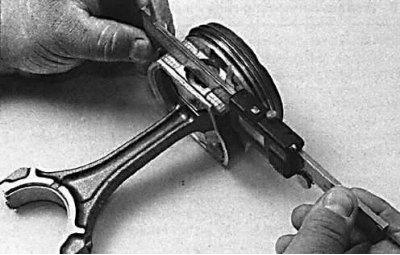
11. Check the piston ring clearance in the piston groove.