



Contents: Checking the wheel turning angles ↓ Checking and adjusting the alignment ↓ Checking the camber ↓
Attention:
- check and adjust the rear wheel alignment angles after checking and adjusting the front wheel alignment angles.
- raise the front wheels.
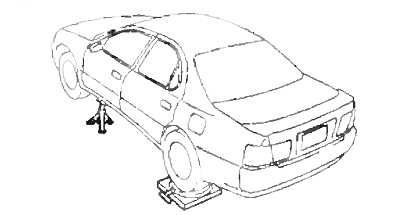
Checking the wheel turning angles
1. Place the vehicle on the stand and apply the parking brake.
2. Check the wheel angles. Inner and outer wheel, tire size:
- 185/70R14 — 5° ±45'
- 195/6GR14 — 4° 40' ±45'
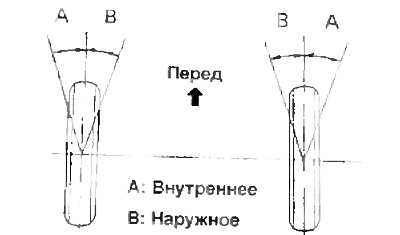
If the wheel turning angles differ from those specified, check and, if necessary, adjust the neutral (rectilinear) position see chapter "Steering".
Checking and adjusting the alignment
Check the toe-in value. Toe-in during check: B - A = 2 ±2 mm
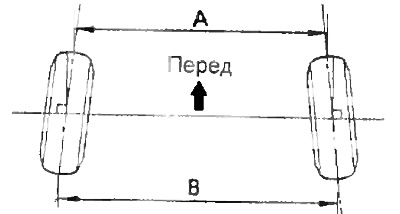
If the toe-in does not meet the specified conditions, then make adjustments.
a) Make sure that the lengths of the right and left steering rods are the same.
The difference in the lengths of the rods is no more than 1 mm
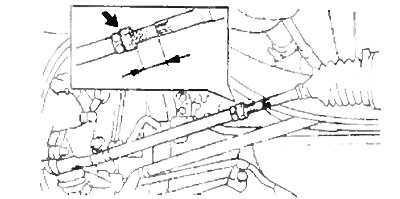
If the measurement difference exceeds the nominal value, perform the adjustments given below.
b) Remove the boot clamps. Loosen the locknuts of the steering rod ends.
c) Adjust the toe-in by turning the left and right steering rods the same number of turns.
Convergence during adjustment: B - A = 2±1 mm
Note: Try to set the toe value to the average value.
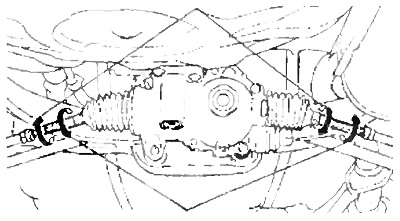
d) Tighten the tie rod end locknuts.
- Tightening torque - 57 Nm
e) Reinstall the covers and secure them with clamps.
Note: Make sure the covers are not twisted.
Checking the camber
Check that the rear wheel camber is within the specified value.
Nominal value:
- Models before 1996, 2WD models since 1996 (4WS) and models since 1996 4WD (ZS-T) - -0°30'±45'
- Models since 1996 2WD (2WS) — -1°05'±45'
- Models since 1996 4WD (3S-FE) - -0° 40' ±45'
Note: the camber, longitudinal and transverse tilt of the front wheel pivot axes are not adjustable, therefore if these values do not correspond to the specified conditions, it is necessary to check the condition and replace faulty suspension parts.