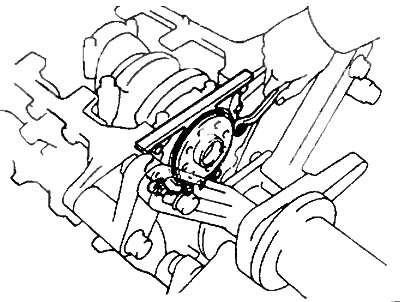
Note:
- Thoroughly clean all parts to be assembled.
- Before assembly, lubricate all parts that form rotating or sliding units with fresh engine oil.
- Replace all gaskets, O-rings and seals with new ones.
1. Install the main bearing shells.
Note (3S-FE, 4S-FE). The main bearing shells differ in width: 19.2 mm and 22.9 mm. The 22.9 mm wide shells correspond to the Nq3 main journal, and the 19.2 mm wide shells correspond to the other main journals.
The upper main bearing shells have a lubrication channel and lubrication holes.
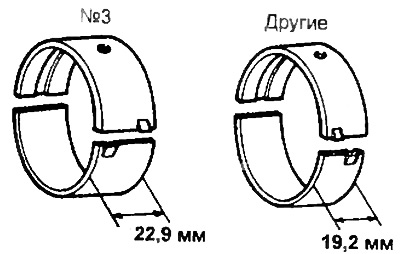
3S-FE, 4S-FE
a) Align the projections of the upper bearing shells with the recesses (indentations) cylinder block beds and insert the liners.
b) Align the projections of the lower bearing shells with the recesses (indentations) in the main bearing caps and install them.
Note: Each main bearing cap is numbered.
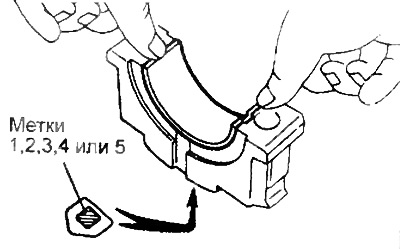
2. Install the upper thrust half rings into the bed of the main bearing block No.3, with the lubrication grooves facing outward.
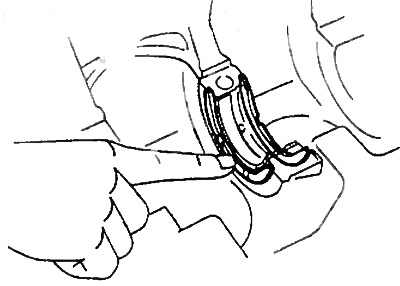
3. Place the crankshaft into the cylinder block.
4. Install the main bearing caps and thrust washers.
a) Install two thrust half rings on bearing cover No.3, orienting the oil grooves outward.
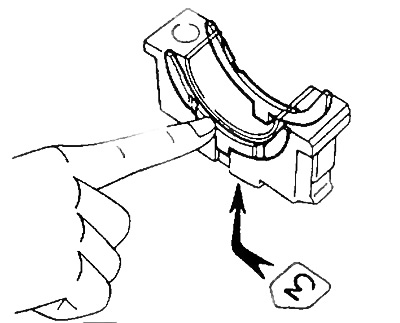
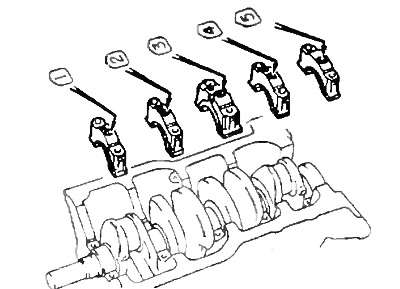
b) Install the five main bearing caps.
Note: Each bearing cap is numbered and marked "front".
c) Apply a thin layer of engine oil to the threads and under the heads of the main bearing cap bolts.
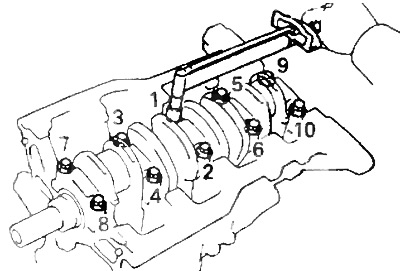
d) Install and tighten the main bearing cap bolts evenly in several passes, in the sequence shown in the figure.
Tightening torque:
- 3S-FE, 4S-FE — 58 Nm
- 3C-T — 103 Nm
d) After screwing in the bolt and using a wrench, check that the crankshaft rotates evenly and without jamming.
e) Using a dial indicator, measure the crankshaft axial clearance while moving the crankshaft with a screwdriver (see above).
If the axial clearance is greater than the maximum, replace the thrust half rings.
5. Install the piston and connecting rod assembly.
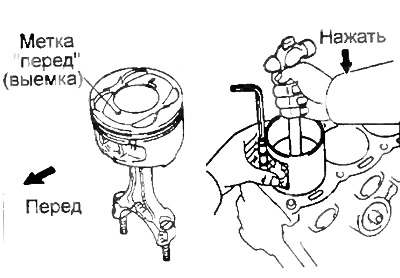
a) Place pieces of hose on the threaded portions of the connecting rod bolts to prevent damage to the crankshaft journals.
b) Using a ring compressor, install the piston assemblies into the cylinders according to their numbers, with the "front" marks on the pistons facing the front of the engine as shown in the illustration.
6. Install the lower connecting rod caps.
A. Install the lower connecting rod caps onto the connecting rods.
a) Check that the numbering of the connecting rod bearing caps and connecting rods matches,
b) Install the lower connecting rod caps so that the "front" marks face the front of the engine.
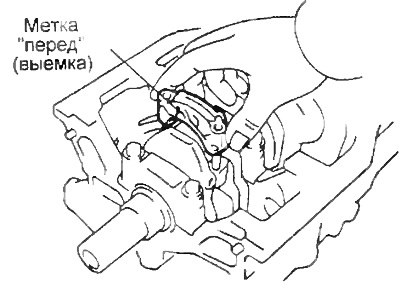
B. Install the nuts on the connecting rod bolts.
Note:
- The nuts are tightened in two stages.
- If any of the connecting rod bolts are broken or deformed, replace them.
a) Apply a layer of engine oil to the threads of the bolts, under the nuts of the connecting rod caps.
b) Perform the initial tightening of the connecting rod cap nuts evenly in several passes.
Tightening torque:
- ZS-T - 66 Nm
- 4S-FE — 54 Nm
- 3S-FE (1st stage) - 25 Nm
- 3S-FE (2nd stage) - turn 90°
c) Mark the bolts and nuts with paint as shown in the pictures.
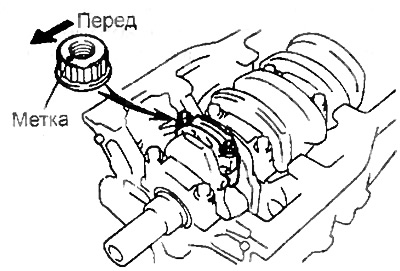
d) Tighten the nuts by 90° as shown in the figures.
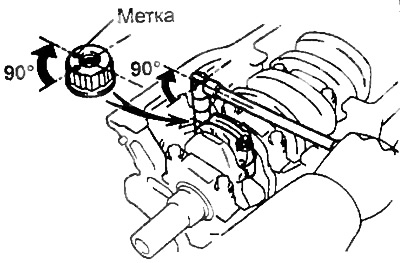
d) Make sure that the marks on the nuts are now positioned at 90° to the mark on the connecting rod bolts.
If any nut is not tightened to the specified torque, replace the bolt and nut.
(All engines)
e) Check that the crankshaft turns evenly and without jamming.
g) Using a dial indicator, measure the axial clearance when moving the connecting rod back and forth, (see above.)
If the axial clearance is greater than the maximum, replace the connecting rod assembly. If necessary, replace the crankshaft.
7. Install the new gasket and rear oil seal retainer by tightening the six bolts.
- Tightening torque - 13 Nm