



Contents: Removal ↓ Installation ↓
Removal
1. Raise the front of the car and place it on stands. Remove the front wheels.
2. Remove the fender protection panel, which is secured with three bolts.
3. Disconnect the steering rods from the left and right steering knuckles (see subsection 9.2.3.).
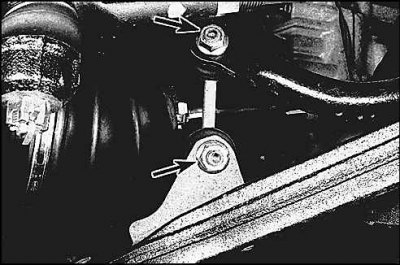
4. Disconnect the stabilizer rods from the rod by unscrewing the nuts (arrows). When turning the stud, secure it with a hex key. When removing the lever, unscrew the lower nut.
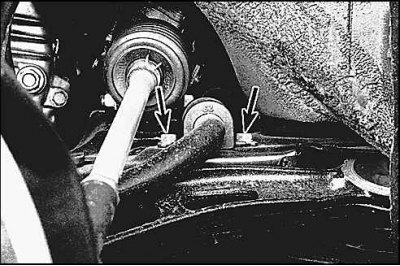
5. Loosen the bolts securing the stabilizer bushing clamps to the engine frame.
6. Remove the front section of the exhaust pipe.
7. Loosen the steering gear mounting bolts (see subsection 9.2.5.).
8. Remove the steering gear and take out the stabilizer bar from the left wheel side.
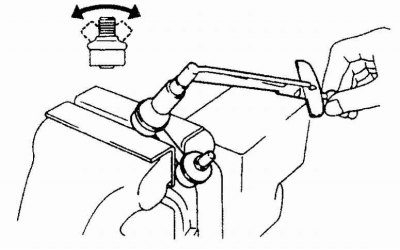
9. Remove the rubber bushings and check their condition. If damage is found on the bushings, replace the bushings. Check the condition of the stabilizer rod joints by shaking the ball joint from side to side 5-6 times. Then screw on the nut and turn it with a torque wrench (with a scale of several N·m) by 1 turn, making a turn in 2-4 seconds. When making the 5th turn, take the torque reading from the wrench, which should be between 0.04 and 0.87 N·m. Otherwise, replace the stabilizer rod.
10. Clean the area where the bushings fit on the rod from dirt and rust.
Installation
1. Lubricate the new bushings with vegetable cooking oil.
[Publication Reprinted from a web portal: toyotaman.ru]
Caution! Do not lubricate the bushings during assembly with mineral oil, petroleum-based oil, or brake fluid to avoid premature failure of the bushings.
2. The stabilizer is installed in the reverse order.