
Company Honda Company Ford Company Skoda Company Kia Company Mazda Company Mercedes Company Renault
English Русский
Български
Беларускі
Український
Српски
Hrvatski
Română
Polski
Slovenský
Magyar
Bookmark Articles Sitemap Contacts
ToyotaMan.ru


Camry Corolla Corona Carina Land Cruiser Highlander 4Runner RAV4 Others
Camry XV30 (2001-2006) Camry XV20 (1996-2001) Camry XV10 (1991-1996) Camry Vista V40 (1994-1998)

Driving a car with automatic transmission [Toyota Camry Vista-V40]

  • Main
  • Camry
  • Vista-V40 (1994-1998)
  • General information
  • User manual
  • Driving a car with automatic transmission
0
To control the automatic transmission, a selector is installed on the central console, to the driver's side. The selector is connected to the valve block by a cable, and can be used to set the range of gears used. To prevent damage to the automatic transmission when the wrong range is selected (for example, moving from "D" to "R" when moving forward), a lock is installed on the selector, only when pressed "dangerous" switching is possible. The lock helps to avoid a situation where one of the unacceptable ranges of movement can be engaged due to carelessness.

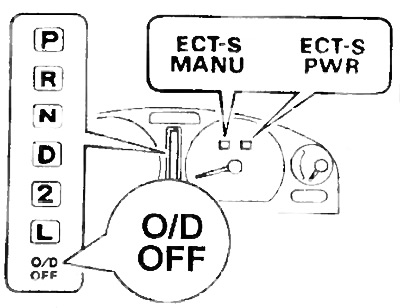
The selector has six positions "P", "N", "R", "D", "2" and "L".

Position "P"

Selected when the car is parked for a long time. In this position of the range selection lever, all controls in the gearbox are switched off, and its output shaft is blocked, the car cannot move. It is permissible to move the lever to this position only when the car has come to a complete stop. Moving the lever to the "P" position while driving will cause the gearbox to break down.

Position "R"

Reverse. The range selector lever can be moved to this position only when the vehicle is stationary. Moving the lever to the "R" position while moving forward can cause damage to the gearbox and other transmission components.

Position "N"

Corresponds to neutral. All control elements in the gearbox are switched off, which ensures the absence of a rigid kinematic connection between its driving and driven shafts. The output shaft locking mechanism is switched off, i.e. the car can move freely.


It is not recommended to move the range selector lever to the "N" position while coasting (by inertia). Never turn off the ignition when driving downhill. This practice is dangerous because you can lose control of the car.

Position "D"

The main driving mode. It provides automatic switching from first to fourth (A350E — fifth) gear. It is recommended to use it in normal driving conditions.

Position "2"

Only first and second gears are allowed. Recommended for use on winding mountain roads, for example. Shifting to third and fourth gears is prohibited. Engine braking mode is effectively used in this range

Position "L"

Only first gear is allowed. This range allows for maximum engine braking. It is recommended for driving on steep descents, ascents and off-road.

The information was taken from a web portal: Toyotaman.ru

"O/D" mode

Permission to use the fourth overdrive gear is carried out using a special "O/D" button located on the selector. If it is in the depressed position and the range selection lever is set to the "D" position, then switching to the overdrive gear is allowed. Otherwise, switching to the fourth overdrive gear is prohibited. The state of the control system in this case is reflected by the "O/D OFF" indicator. If the use of the overdrive gear is permitted, the indicator does not light, and when prohibited, it lights up. This mode is used when driving at high speed on expressways. If possible, do not use this mode in the city, especially on a winter road - this excludes the overdrive gear from operation and allows more efficient use of the engine braking mode. Do not turn on the "O/D" mode when the car is fully loaded. If frequent switching 3-4 occurs, to prevent increased wear of the automatic transmission parts, turn off the O/D mode.


Special programs


The control system has several programs: "sport", "POWER", economical "NORMAL", winter "SNOW" or "MANU".

The control program is selected using the automatic transmission operation selection switch located on the instrument cluster. When a program is selected, the corresponding indicator lights up.


"Sports" program


This program is set to use the engine power (switch "POWER") to the maximum. Therefore, upshifts occur in the area of maximum engine speed, at which the engine develops maximum power.

The car, in this case, accelerates with significantly greater acceleration.

When this program is selected, the "ECT-S PWR" indicator lights up on the instrument cluster.

"Economical" program


The program is set to provide movement with minimum fuel consumption. In this case, upshifts occur approximately when the engine speed reaches average values, which corresponds to the minimum on the fuel consumption characteristic. The movement of the car in this case is smooth and calm.

"Winter" program (models since 1996.) This is a special program for starting off on a slippery road. The essence is that starting off occurs from the second or third gear (and then the switching occurs according to a special algorithm laid down by the manufacturer). Normally, gear changes occur at low engine speeds in the same way as in economy mode. To activate this program, there is a special switch that has the designation "SNOW".


The program "MANU"


The program is designed to make winter driving easier. If you select position "2", the car will start from second gear - this allows you to start moving without wheel slippage.

The "MANU" switch is used to activate this program. When this program is selected, the indicator lights up on the instrument cluster.
This article is available at: russian, bulgarian, belarusian, ukrainian, serbian, croatian, romanian, polish, slovak, hungarian
The article material has been checked: Mitrofanova Elena
Share information:
◀ Previous
Camry Vista V40: User manual
Next ▶

4WS system
Traction Control (TRC)
Anti-lock braking system (ABS)
Control and measuring instruments and controls
Garage jack and lift paw mounting points
Features of the transmission of 4WD models
Tips for driving in different conditions
Towing a car
Starting the engine
Engine Stop (Turbocharged Models)
Similar articles on other Toyota models

➥ Driving with an automatic transmission Toyota Corolla E80 (1983-1990)
➥ Driving a car with automatic transmission Toyota Corona T190 (1992-1997)
➥ Driving a car with automatic transmission Toyota Carina T190 (1992-1996)
➥ Automatic transmission in block with driving axle Toyota Highlander 1 (2000-2007, petrol)
➥ Driving a car with automatic transmission Toyota Duet (1998-2004)
➥ Automatic transmission fluid level Toyota Cruiser 60/80 (1980-1997, petrol)
Link in different formats to this article
Comments and feedback from visitors
No comments yet


Add two numbers 30 + 14


Camry XV30 (2001-2006) 
  • User manual
  • Vehicle description
  • Keys, locks and alarms
  • Governing bodies
  • Salon equipment
  • Driving and operation
  • Maintenance
  • Power unit
  • 4-cylinder engine
  • Control system (I4)
  • Engine overhaul (I4)
  • 6-cylinder engine
  • Control system (V6)
  • Engine overhaul (V6)
  • Transmission
  • Clutch
  • Mechanical gearbox
  • Automatic gearbox
  • Drive mechanism
  • Chassis, running gear
  • Wheels and tires
  • Car suspension
  • Steering
  • Brake system
  • Body and interior
  • Exterior (external elements)
  • Doors, locks and windows
  • Air conditioning and heater
  • Electrical equipment
  • Equipment and devices
  • Power devices
  • Electrical circuits
Camry XV20 (1996-2001) 
  • General information
  • Controls and instruments
  • Driving and operation
  • Daily care
  • Maintenance
  • Power unit
  • 4-cylinder engine
  • 6-cylinder engine
  • Engine overhaul
  • Engine electrical equipment
  • Cooling system
  • Heating and ventilation
  • Fuel system
  • Exhaust system
  • Transmission
  • Mechanical gearbox
  • Automatic gearbox
  • Clutch
  • Chassis, running gear
  • Suspension and axle shafts
  • Steering
  • Brake system
  • Body and interior
  • Exterior (external elements)
  • Interior (internal elements)
  • Doors, locks and windows
  • Electrical equipment
  • Equipment and devices
  • Electrical circuits
Camry XV10 (1991-1996) 
  • General information
  • User manual
  • Maintenance
  • Power unit
  • 4-cylinder engine
  • 6-cylinder engine
  • Overhaul of engines
  • Cooling and heating
  • Fuel system
  • Engine electrical equipment
  • Control system
  • Transmission
  • Mechanical gearbox
  • Automatic gearbox
  • Clutch and drive shafts
  • Chassis, running gear
  • Brake system
  • Car suspension
  • Steering
  • Body and interior
  • Exterior (external elements)
  • Interior (internal elements)
  • Doors, locks and windows
  • Electrical equipment
  • Equipment and devices
  • Headlights and lighting
  • Electrical circuits
Camry Vista V40 (1994-1998) 
  • General information
  • User manual
  • Maintenance
  • Power unit
  • Petrol engines
  • Diesel engines
  • Engine overhaul
  • Cooling and lubrication system
  • Fuel system (diesel)
  • Fuel injection (petrol)
  • Engine electrical equipment
  • Transmission
  • Clutch and cardan
  • Automatic gearbox
  • Chassis, running gear
  • Front suspension
  • Rear suspension
  • Steering
  • Brake system
  • Body and interior
  • Body elements
  • Air conditioning and heater
  • SRS security system
  • Electrical equipment
  • Equipment and devices
  • Electrical circuits
ToyotaMan.ru © 2018–2026 • Mobile version • Interesting about Toyota • Administration • Sitemap: EN BG BY UA RS HR RO PL SK HU • Search system • Bookmark
Camry Vista-V40 • Camry XV10 • Camry XV20 • Camry XV30 • Corolla Verso-AR10 • Corolla E80 • Corona T190 • Carina T170 • Carina T190 • Land Cruiser J70 (diesel) • Land Cruiser J60 (petrol) • Land Cruiser J100 • Highlander XU20 (petrol) • 4Runner N120 • RAV4 XA10 • RAV4 XA20 • Duet M100 • Dyna Y50 •
We require cookies to enable some interactive features. Is that ok with you?