



Contents: On-car checks ↓ Removal and installation a…↓ Checking the turbocharger ↓ Checking the actuator ↓
On-car checks
1. Check the intake and exhaust system.
a) Check for leaks and blockages between the air filter and the air duct, and between the air duct and the cylinder head. Replace faulty components if necessary. Eliminate any leaks in the connections.
2. Check the status of the systems and the absence of:
- deformation of parts:
- foreign objects in the channels;
- cracks.
3. Check the boost pressure.
a) Warm up the engine.
b) Install a pressure gauge in the gap of the hose connected to the intake manifold.
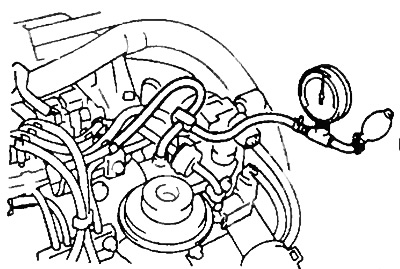
c) Disengage the clutch and press the accelerator pedal sharply. Measure the boost pressure at a crankshaft speed of 5100-5200 rpm.
(Publication Reprinted from a web portal: ToyotaMAN)
- Pressure - 0.53-0.67 bar
If the pressure is less than the specified value, check the tightness of the intake and exhaust systems. If the systems are normal, replace the turbocharger. If the pressure is greater than the specified value, check the condition of the vacuum hose of the bypass valve drive. If the hose is normal, replace the turbocharger.
4. Check the rotation of the compressor wheel.
Removal and installation a turbocharger
Note: the turbocharger is installed in the reverse order of removal. The tightening torques of the nuts and bolts are shown in the figure "Removing and installing the turbocharger". Use new gaskets when installing.
1. Drain the coolant from the engine.
2. Disconnect the wiring harness.
3. Disconnect the vacuum tubes.
4. Disconnect the air tube.
5. Remove the heat shields.
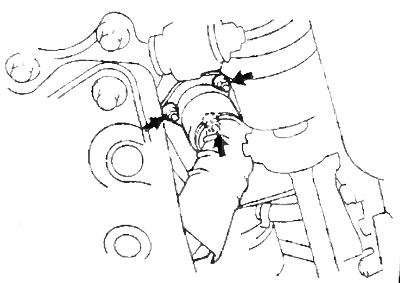
6. Remove the turbocharger bracket by unscrewing the three bolts.
7. Unscrew the three bolts and remove the exhaust pipe.
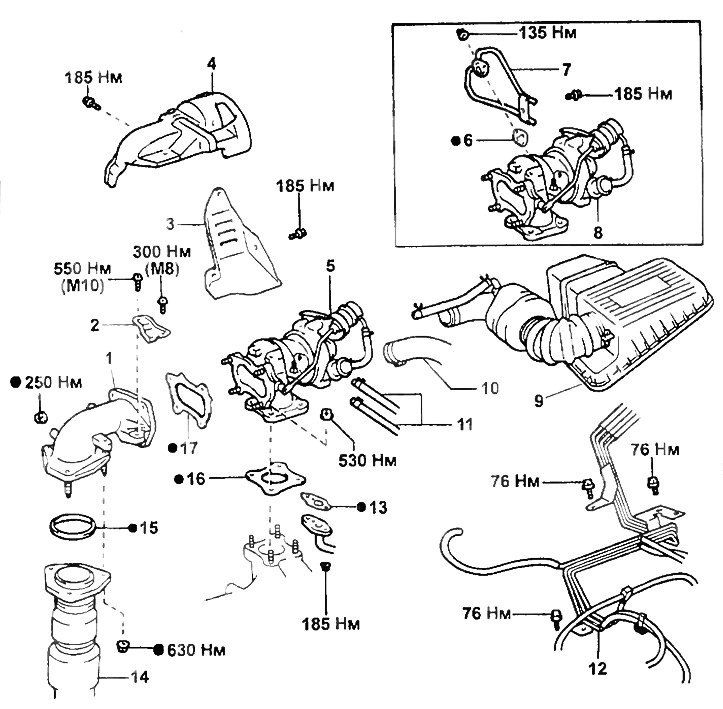
Removing and installing a turbocharger.
1 - outlet pipe,
2 - turbocharger bracket,
3 - heat shield No.2,
4 - heat shield No.1,
5-, 8 - turbocharger assembly,
6-, 13-, 15-, 16-, 17 - gasket,
7 - coolant supply pipes,
9 - air filter cover with resonator,
10 - air hose No.1,
11 - coolant supply hoses,
12 - vacuum tubes,
14 - inlet pipe.
8. Remove the two bolts and the turbocharger bracket. Remove the outlet pipe by removing the four bolts
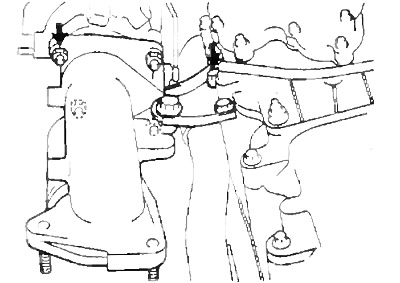
9. Loosen the two bolts and disconnect the oil drain pipe.
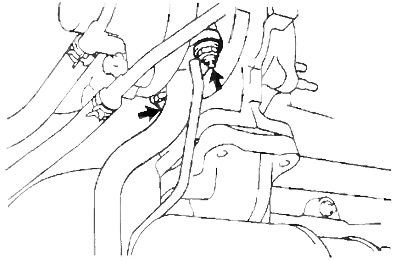
10. Disconnect the coolant supply hoses and air hose No.1.
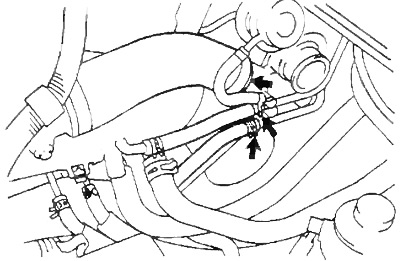
11. Unscrew the four nuts, remove the turbocharger assembly and gasket.
12. Unscrew the two nuts, disconnect the coolant supply pipes and remove the gasket.
Checking the turbocharger
1. Check the rotation of the wheels. Make sure that the wheels rotate smoothly.
If the wheel does not rotate or rotates with resistance, replace the turbocharger.
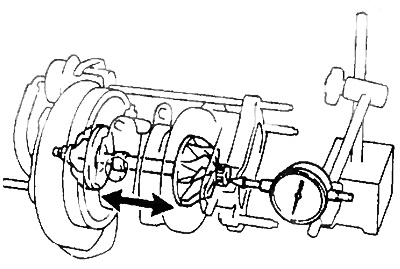
2. Check the axial clearance of the compressor shaft.
Install a dial indicator on the compressor side, move the turbine wheel by hand, and measure the axial clearance.
- Axial clearance - no more than 0.11 mm
If the axial clearance is outside the permissible limits, replace the turbocharger.
3. Check the radial clearance of the compressor shaft.
a) Install the indicator on the compressor shaft through the turbocharger oil drain hole.
b) Move the shaft in the radial direction and measure the radial clearance.
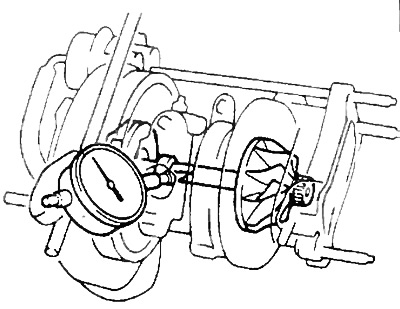
- Radial clearance - no more than 0.16 mm
If the radial clearance is outside the permissible limits, replace the turbocharger.
4. Check the operation of the actuator drive
a) Disconnect the actuator diaphragm hose
b) Create a pressure of approximately 0.92-0.97 bar above the diaphragm: the actuator stem should move and the valve should open.
Warning: Never apply more than 1.4 bar pressure to the diaphragm.
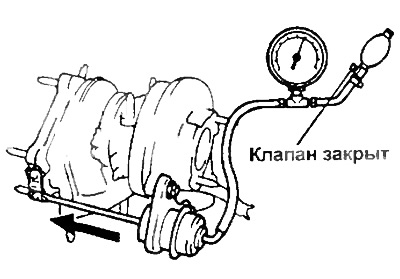
Checking the actuator
1. If necessary, remove the actuator.
a) Disconnect the air hose.
b) Unscrew the two bolts securing the actuator to the turbocharger housing.
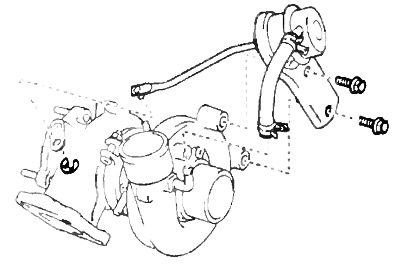
c) Remove the retaining ring securing the stem to the valve and remove the actuator.
2. Adjust the stroke of the actuator rod.
Note: adjustment is carried out on the installed actuator.
a) Install a dial indicator and apply 0.88 bar pressure to the actuator and measure the stroke of the rod.
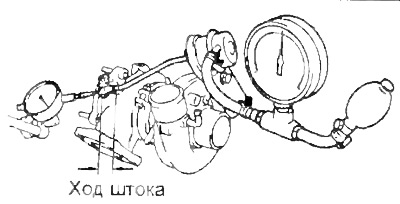
b) Based on the measured value of the piston rod stroke, select the required washer thickness from the table below.
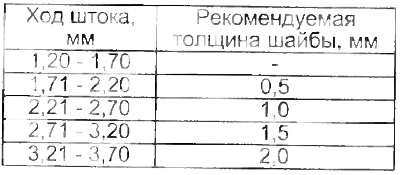
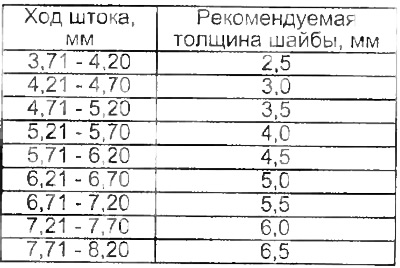
Note:
- To obtain the required thickness, you can use a set of washers of different thicknesses (0.5; 1,0; 2,0; 3.0 mm).
- Use the same set of washers of different thicknesses between the actuator and the housing
- If the required washer thickness is more than 3.5 mm, replace the actuator mounting bolts.
c) If necessary, install new washers and bolts, apply pressure to 1.09 bar.
- Tightening torque - 19 Nm
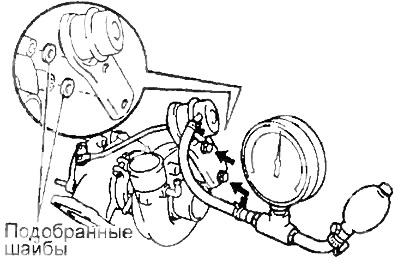
d) Apply 0.88 bar pressure to the actuator and recheck the stroke of the piston rod.
- Nominal value - 1.20 - 1.70 mm
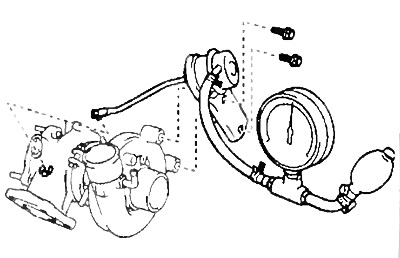
Replace washers if necessary.
4. Connect the air hose.
5. Check the boost pressure (see "On-vehicle checks").