
Check on the engine
1. Check valve operation.
A) Initial conditions:
- the engine is warmed up to normal operating temperature,
- idle speed is correctly adjusted,
- the shift lever or automatic transmission selector is in the neutral position.
b) Short-circuit the terminals with a jumper "TAG" And "E1" diagnostic socket.
V) Start the engine and check that after the speed has been held at 900-1500 rpm for 5 seconds, it has again decreased to the level of the rated idle speed. If not, check for slack in the throttle cable, idle speed control valve, wiring, and ECM.
G) Remove the jumper from the diagnostic socket.
d) Check idle speed.
2. Check the resistance of the valve winding.
A) Disconnect the valve connector.
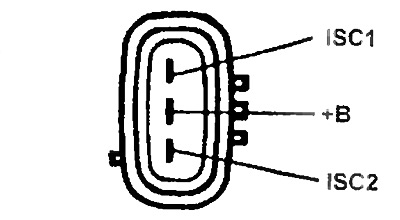
b) Using an ohmmeter, measure the resistance between the terminal "+V" and conclusions "ISC1" And "ISC2" connector.
- Rated resistance value (at 20°C): - 19 - 23 Ohm
If the resistance value is out of range, replace the valve.
V) Connect valve connector
3. Checking the functioning of the valve.
A) Connect the connecting wire from the positive (+) battery terminals to terminal "+V", A (-) connecting wire to terminal "ISC1" valve connector and check that the valve actuator is closed.
b) Connect the connecting wire from the positive (+) battery terminals to terminal "+V", A (-) connecting wire to outlet "ISC2" valve connector and check that the valve actuator is open.
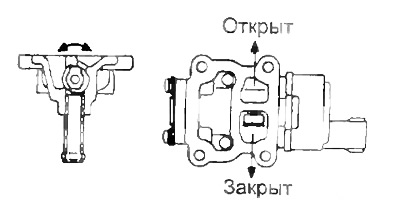
If the valve function is not as described, flush the valve first and repeat the test procedures. If necessary, disassemble the valve and eliminate the cause of the jam, otherwise replace the valve.