



Contents: Windshield wiper blades ↓ Checking the free play and…↓ Checking and servicing the battery ↓ Charging the battery ↓ Checking and replacing the drive belt ↓ Checking the tightness of hoses and…↓ Checking the cooling system ↓ Changing the tire installation…↓
Windshield wiper blades
Check the efficiency of your windshield wipers regularly. Wipe dirty windshield wipers with a soft cloth and a special cleaner.
It is necessary to replace brushes whose rubber strip has hardened, cracked or become coated with silicone.
1. Lift the wiper arm away from the windshield.
Checking the free play and installation height of the clutch pedal
Clutch pedal free play and height adjustment elements
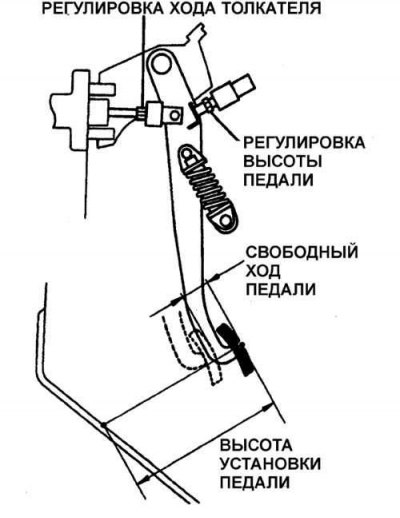
1. Place a steel ruler near the clutch pedal and measure the height of the clutch pedal. Press the clutch pedal until you feel a noticeable resistance and measure the free travel of the clutch pedal.
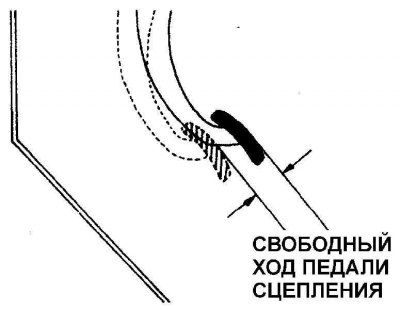
2. Loosen the lock nut on the end of the clutch pushrod.
3. By turning the clutch pusher, set the free travel of the clutch pedal within the required limits.
4. Tighten the lock nut.
5. After adjusting the clutch pedal free play, check the pedal installation height.
6. If the clutch pedal height is not as specified, loosen the lock nut and turn the stop bolt until the clutch pedal height is as specified. Tighten the lock nut.
Checking and servicing the battery
Warning! The electrolyte in the battery is a poisonous and corrosive acid. Therefore, avoid getting the electrolyte in your eyes, on your skin, on painted surfaces, etc. If the electrolyte spills, rinse the area with plenty of cold water. If the electrolyte gets in your eyes, consult a doctor immediately after rinsing your eyes with water.
Warning: When the battery is in operation, hydrogen gas is formed, so never smoke or handle open flames or sparking substances in the immediate vicinity of the battery.
Caution! Always disconnect the negative battery cable before working on electrical equipment. This will prevent unintentional short circuits.
Caution: Never disconnect the battery cables while the engine is running.
Caution: Always disconnect the battery cables when charging the battery using an external charger.
Caution! Always disconnect the wires from the battery and the wires from the generator when repairing the vehicle using electric welding devices.
Attention! If the radio has an anti-theft code by disconnecting the battery, check that you have the connection codes.
Caution! On models from 1993 onwards, the airbag system is disabled if the battery is disconnected for an extended period of time. If the airbag warning light comes on and remains on after the battery is reconnected, contact a specialist workshop to restore the system to working order.
Tools and materials needed for battery maintenance
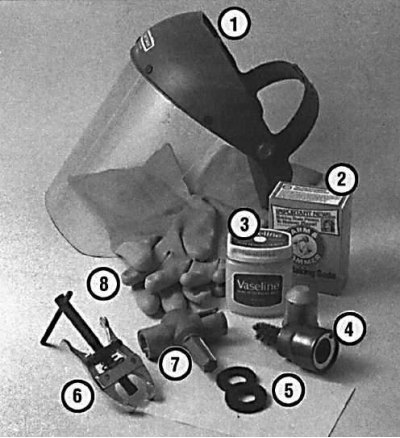
1 - a shield to prevent electrolyte from getting on your face; 2 – soda. Soda diluted in water is necessary to neutralize spilled electrolyte; 3 – Vaseline. Used to protect battery terminals from corrosion; 4 – wire brush. Necessary for removing traces of corrosion from battery terminals and wires; 5 – plastic washers. Installed on the battery under the wire terminals; 6 – Puller. Used to remove terminals from the battery; 7 – a type of wire brush used to clean battery terminals; 8 – rubber gloves that must be used when working with electrolyte
Removal the battery cable terminal
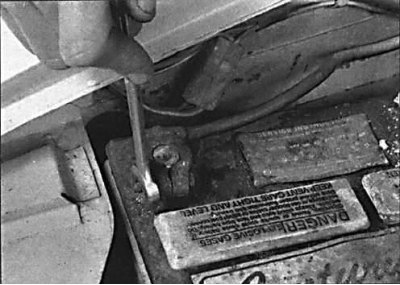
1. Before you begin servicing your battery, gather all the necessary tools and materials together.
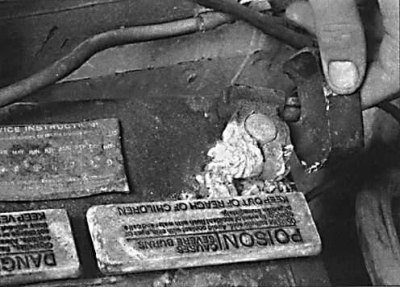 | 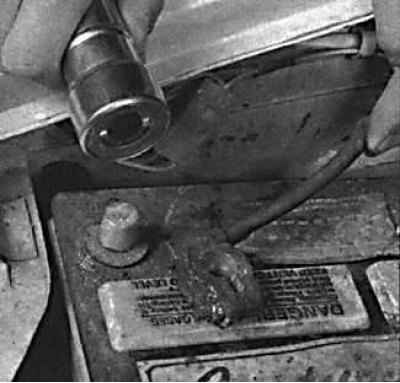 |
2. Cleanliness of the battery and especially its upper surface is especially important, since the layer of dirt that accumulates on it easily forms conductive paths that lead to self-discharge of the battery. Cleanliness is important not only for a serviced battery, but also for a maintenance-free battery, which, despite its name, is not completely maintenance-free.
3. Using a wire brush, clean the battery terminals and wire terminals. If necessary, wash the terminals with a solution of baking soda and warm water. Be careful not to let the baking soda solution get into the battery cells.
|  |
4. Clean the battery terminals until a light, shiny metal appears.
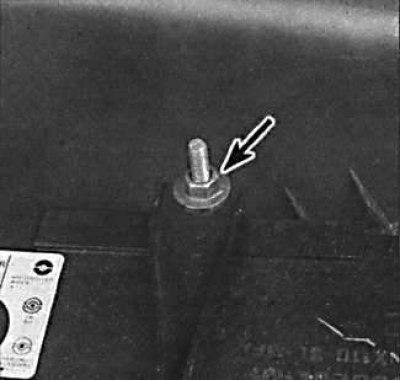
5. Check that the battery mounting nuts are securely tightened. Do not overtighten the nuts, as this may damage the battery case.
6. Before connecting the battery clamps, lubricate the terminals with acid-free petroleum jelly and anti-corrosion compound.
Charging the battery
Under normal use, the battery does not require recharging from external sources. Only if the battery is not in use for a long time does it require recharging every 6 weeks. Recharging may also be required when using the car mainly for short trips in the dark. Otherwise, the need to recharge the battery indicates a faulty battery or its charging circuit. When charging the battery, the temperature of the electrolyte in the battery should not exceed 38°C. If the battery becomes hot or there is vigorous gas evolution in the electrolyte, then charging should be stopped. Charging should be done with a constant current equal to 1/20 of the battery capacity. The end of charging is indicated by intensive gas emission from the battery and the fact that the density of the electrolyte does not change over the last 3 hours of charging.
Checking and replacing the drive belt
Examination
The drive belts are located on the right side of the engine.
Depending on the vehicle's configuration and the engine installed in it, several drive belts are used. One belt is used to transmit torque from the crankshaft to the generator and air conditioning compressor. If the vehicle is equipped with power steering, a separate belt is used to drive the power steering pump.
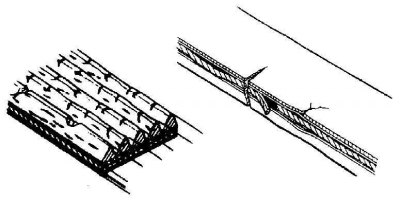
1. Open the cover that covers the belts and check the condition of the belts for cracks, delamination and oiling. Replace the belt if necessary.
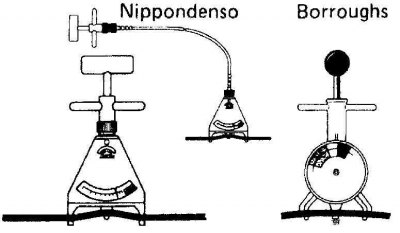
2. To check the drive belt tension, use special tools from Nippondenso or Burroughs. The tension for a new belt and a used belt is different. A used belt is one that has been running on the engine for more than 5 minutes.
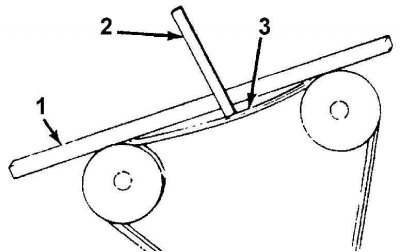
3. In the absence of special tools, the tension of the drive belt must be adjusted so that when pressing with the thumb on the long branch of the belt, the deflection is approximately 5 mm if the distance between the central pulleys is about 250 mm, or 10 mm if the distance between the central pulleys is about 350 mm (1 - ruler, 2 - ruler, 3 - belt deflection).
Adjustment
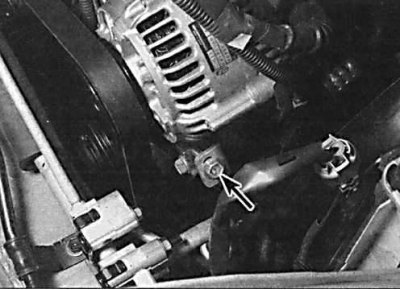
1. To adjust the tension of the alternator and air conditioner compressor drive belt, loosen the alternator pivot bolt, loosen the alternator clamp bolt, and turn the adjusting bolt to adjust the tension of the drive belt.
2. Adjust the tension of the power steering pump drive belt using the adjusting bolt that moves the pump away from the engine.
Replacement
1. Loosen the drive belt and remove it from the pulleys. If the power steering pump drive belt needs to be replaced, the alternator and air conditioning compressor drive belts must first be removed.
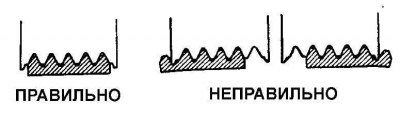
2. Install the drive belts on the pulleys. The belts should be positioned exactly in the center of the pulleys. Adjust the tension of the drive belts.
Checking the tightness of hoses and leakage of liquids
Cooling system hose defects
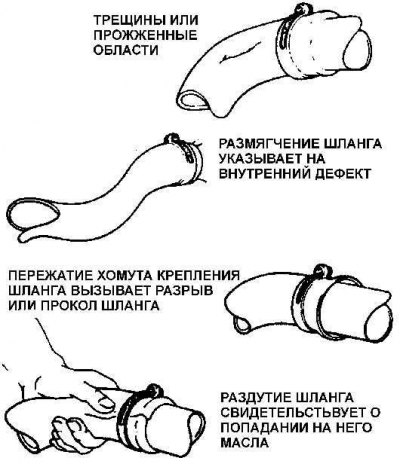
A cooling system leak is usually detected by a white or rust-colored coating in the area adjacent to the leak.
1. Carefully inspect the radiator and coolant hoses along their entire length. Replace hoses that have cracks, breaks, or signs of aging. Cracks are easier to spot if the hose is pinched. Pay special attention to the clamps that attach the hoses to the cooling system components. Hose clamps that have been tightened too much can cause the hose to rupture or puncture, resulting in leaks in the cooling system.
2. Inspect all components of the cooling system (hoses, connector surfaces, etc.) for leaks. If any problems of this nature are found with system components, replace that component or gasket.
Fuel hoses
A fuel leak is difficult to pinpoint until the leak is significant and therefore easily visible. Fuel tends to evaporate quickly once it comes into contact with air, especially in a hot engine bay. Small droplets may disappear before you can pinpoint the leak. If you suspect a fuel leak in the engine bay area, then cool the engine and run it while it is cold with the hood open. Metal components tend to shrink when cold, and rubber hoses tend to weaken, so any leaks will be more obvious as the engine warms up from cold starting.
Carefully inspect all rubber hoses and metal fuel lines coming from the fuel tank. Check for loose connections, worn hoses, kinked fuel lines, and other damage. Pay special attention to vent pipes and hoses, which often twist around the filler hose and can become blocked, making the tank difficult to fill. Follow the fuel supply and return hoses to the front of the vehicle, carefully inspecting them all over for signs of damage or corrosion.
Unidentified liquid leaks
If there are signs that there is a leak of some kind of fluid, but you cannot identify the type of fluid or the exact source, then you should leave the car for a long time and put a large piece of paper or rag under the car. This will help to find the place of the leak and also help to identify the leaking fluid by color. But keep in mind that some leaks may only appear when the engine is running.
Vacuum hoses
Although the brake system is hydraulic, the brake booster increases the force applied to the brake pedal by using the vacuum in the intake manifold created by the engine. The vacuum is transmitted to the booster through a large-section hose. Any leakage in this hose will reduce the effectiveness of the brake system.
A leak in a vacuum hose means that air is being sucked into the hose instead of being forced out of the hose, making the leak very difficult to detect. The method of detection is to use an old vacuum hose as a kind of stethoscope. Hold one end of the hose close to your ear and use the other end to probe the area around the suspected leak. When the end of the hose is directly over the leak, a hissing sound will be clearly audible through the additional hose. It is important to avoid contact with hot and moving parts, as the engine must be running when testing. Replace any leaky vacuum hoses found.
Checking the cooling system
1. Remove the radiator cap. To do this, turn the cap counterclockwise until it locks for the first time. Wait until the residual pressure in the cooling system is released, then press the cap down and in this position turn it counterclockwise and remove the cap.
2. Check the condition of the cooling system hoses. Replace the hoses if there are any defects. It is advisable to replace the hoses, regardless of their condition, every two years.
3. Coolant leaks are usually identified by a white coating.
4. Wash or blow out the outer surface of the radiator.
Changing the tire installation position
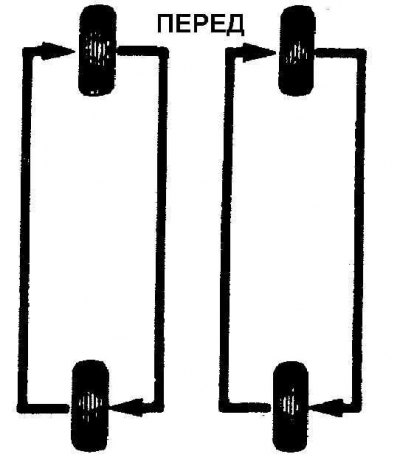
Wheel rotation diagram
Tires should be rotated at regular intervals or when the tread on one of the tires becomes worn.
Inspect the condition of the brakes every time you remove a wheel.