



Contents: Checking the brake system ↓ Replacing the air filter ↓ Checking the fuel system ↓ Checking the oil level in the main…↓ Checking the suspension and steering ↓ Checking the drive shaft protective…↓
Checking the brake system
Inspect brakes at recommended intervals and whenever wheels are removed.
Symptoms that indicate potential brake problems include: vehicle pulling to one side when braking, noise when braking, increased brake pedal travel, pulsation in pedal force, brake fluid leakage, especially along the sidewall of the tire.
1. Raise the relevant part of the car and secure it on stands. Remove the wheel.
Replacing the air filter
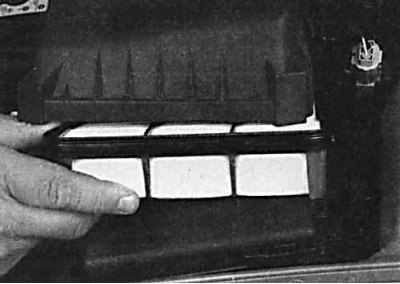
The air filter is located inside the casing on the left side of the engine compartment.
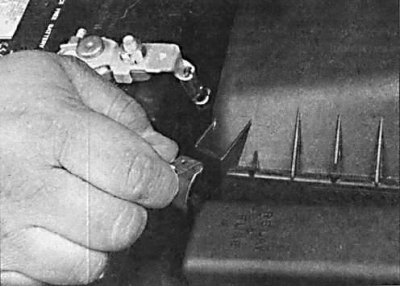 |  |
1. To remove the air filter, release the four clips holding the two halves of the air filter housing together.
2. Remove the air filter cover and take out the filter element.
3. Install a new filter element and perform all actions in the reverse order of removal.
Checking the fuel system
If you smell fuel while driving or parked, inspect the fuel system immediately.
1. Inspect the filler neck, supply and return lines, make sure the connections are securely tightened.
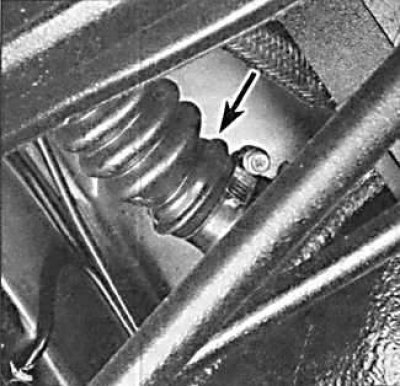
2. Inspect the fastening of the filler neck. Sometimes the clamps fastening the rubber hoses from the neck to the fuel tank become loose.
Checking the oil level in the main gear
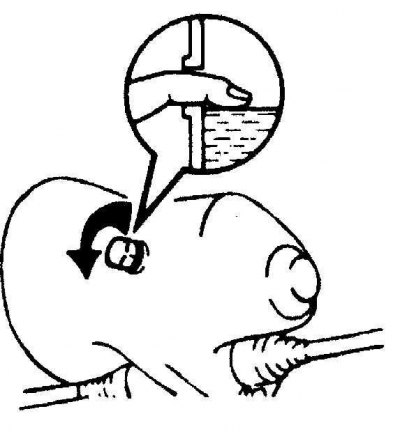
Location of the plug and checking the oil level of the main gear with a manual transmission
The final drive is lubricated separately from the automatic transmission.
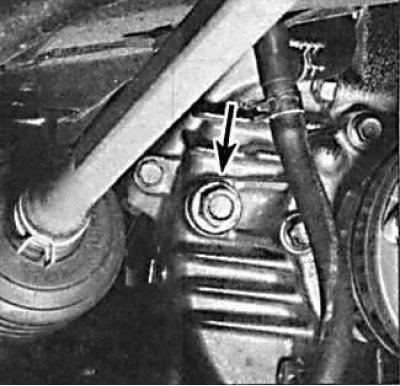
1. Unscrew the oil filler plug in the final drive.
2. The oil level should reach the bottom edge of the hole for the oil level plug. If necessary, add oil with a syringe until the oil starts to flow out. Install the plug and tighten it to the required torque.
Checking the suspension and steering
The car is on the ground
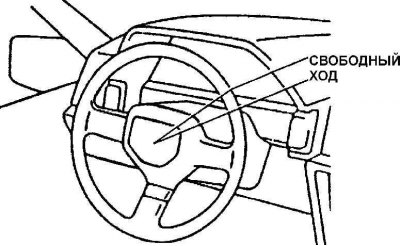
Steering wheel free play is the angle that the steering wheel must be turned before the front wheels of the vehicle begin to turn.
1. Set the front wheels to drive straight ahead. Check the steering wheel free play. If the free play exceeds the allowable limits, the wheel bearings, steering shaft joints, ball joints and steering gear may be worn.
2. Excessive vehicle roll, increased body vibration on uneven roads, and rocking on turns indicate damage to the steering and suspension.
3. To check the shock absorbers, rock the car by pressing on each of the four corners of the car. If the body does not return to its original position in one or two strokes, it is necessary to replace the shock absorber.
4. Check the position of the body relative to the ground. If there is a roll to the side or forward or backward, most likely the springs are sagging or the suspension parts are worn out.
On a raised car
1. Inspect the condition of the steering shaft joints, the presence of leaks from the steering mechanism, the integrity of the protective covers and seals.
2. Check the wheel play by holding the wheel in your hands at 12 and 6 o'clock and attempting to rock it vertically. Very little play is acceptable, but if the play is significant, further testing is necessary to determine the source. Continue rocking the wheel while an assistant applies the foot brake. If the play is eliminated or significantly reduced, the hub bearings are likely damaged. If play is still significant with the brake applied, there is wear in the suspension joints and mounts.
3. Now take the wheel at the 9 and 3 o'clock positions and try to rock it horizontally. The presence of play in the horizontal plane can be caused by wear in the hub bearings or the ball joints of the steering rod. If the inner or outer ball joint is worn, the play will be obvious.
4. Using a large screwdriver as a lever, check for wear in the suspension mounting bushings between the suspension components and the point of application.
Checking the drive shaft protective cover
1. Raise and secure the vehicle securely on stands.
2. Turn the steering wheel all the way to the right or left and spin the front wheel.
The text is taken from the specified website [www.ToyotaMan.ru]
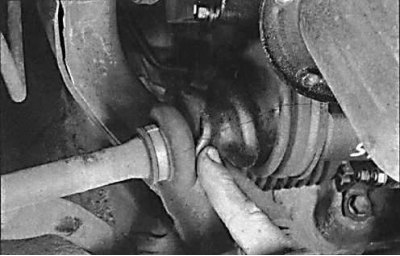
3. Inspect the rubber CV joint boots by squeezing them to open the folds.
4. Check the protective covers for cracks that could allow grease to leak out, or water and dirt to get in. Also check the condition of the mounting clamps.
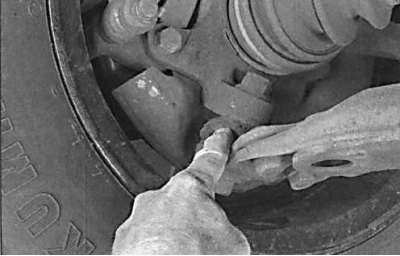
5. Inspect the inner constant velocity joint boots and the other side housings. If any damage is found, the boot must be replaced immediately.
6. At the same time, check the general condition of the constant velocity joints by holding the shaft and simultaneously trying to turn the wheel.
7. Try again while holding the inner joint and turning the shaft. Any noticeable play indicates wear in the constant velocity joint, wear in the shaft grooves, or a loose shaft lock nut.