
Company Honda Company Ford Company Skoda Company Kia Company Mazda Company Mercedes Company Renault
English Русский
Български
Беларускі
Український
Српски
Hrvatski
Română
Polski
Slovenský
Magyar
Bookmark Articles Sitemap Contacts
ToyotaMan.ru


Camry Corolla Corona Carina Land Cruiser Highlander 4Runner RAV4 Others
Camry XV30 (2001-2006) Camry XV20 (1996-2001) Camry XV10 (1991-1996) Camry Vista V40 (1994-1998)

Every 5,000 km or 3 months [Toyota Camry XV10]

  • Main
  • Camry
  • XV10 (1991-1996)
  • General information
  • Maintenance
  • Every 5,000 km or 3 months
0
Contents: Checking the Power Steering Fluid…↓ Checking the oil level in an…↓ Oil and oil filter change ↓

Checking the Power Steering Fluid Level


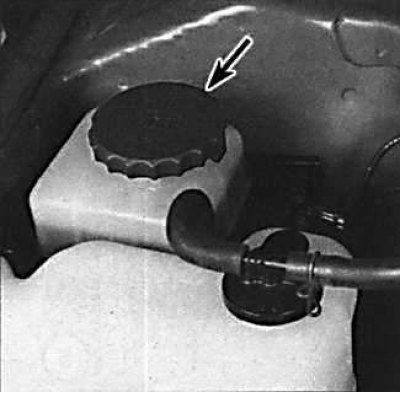
Location of the power steering fluid reservoir


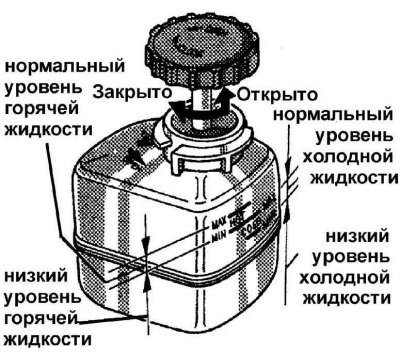
Power steering fluid reservoir level on cold and hot engine


When checking the level, the wheels must be positioned in a straight-line motion position.

The power steering fluid reservoir is made of transparent material and the fluid level can be checked visually.

If frequent fluid top-up is required, check the power steering system for leaks.

Constantly pay attention to the color of the coolant. If the color of the coolant changes to brown or rusty, it is necessary to drain the coolant and flush the cooling system.


Checking the oil level in an automatic transmission


Caution: Never allow the oil level to exceed the upper mark.


Automatic transmission oil dipstick
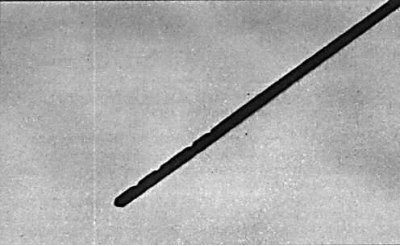


Automatic transmission oil dipstick location
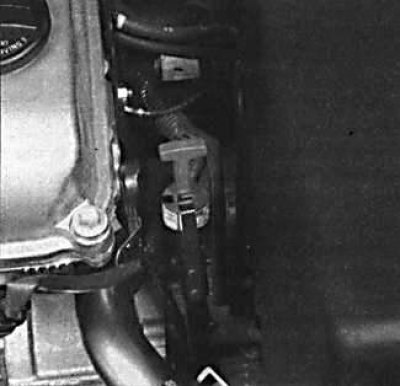


If the gearbox is cold, the oil level should be between the two lower marks, and if the gearbox is hot, between the two upper marks.

The oil level in the automatic transmission is an important performance indicator. Neither low nor high oil levels are allowed.

1. Take the vehicle for a short drive to warm the transmission to normal temperature.

2. Place the car on a flat horizontal surface. With the engine idling and the hand and foot brakes engaged, move the selector handle through all positions and return to the starting position (Park). In this position of the selector and the engine idling, remove the dipstick to measure the oil level and simultaneously assess the condition of the oil using the level mark.


3. Wipe the dipstick and reinstall it.

4. Remove the dipstick again and measure the oil level. If the transmission is cold, the oil level should be between the two lower marks on the dipstick. If the transmission is at normal operating temperature, the oil level should be between the two upper marks on the dipstick.

5. If the oil level is low, add oil through the dipstick hole. The distance between the marks corresponds to approximately 1 liter of oil. Add oil in small portions. If the oil is black or brown, the oil should be replaced. If you doubt the quality of the oil, compare a sample of fresh oil and the oil in the gearbox.

Oil and oil filter change


Caution: If metal shavings are present in used engine oil, this usually indicates wear of the main or connecting rod bearings of the crankshaft.


Tools needed to change oil and oil filter
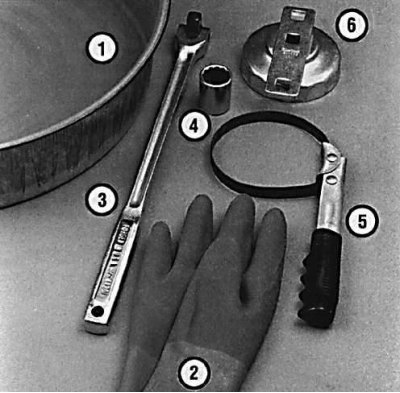


1 – flat wide container for draining oil; 2 – rubber gloves to prevent hot oil from getting on your hands; 3 – extended wrench handle; 4 – key for unscrewing the oil drain plug; 5 – special key for unscrewing the oil filter; 6 – a special key for unscrewing the oil filter, installed on the rear part of the filter


Lubricating the new oil filter O-ring with engine oil
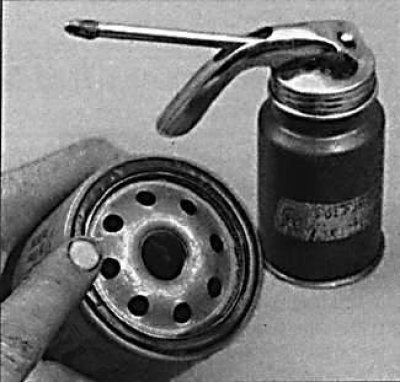


Periodic oil and filter changes are the most important preventative maintenance procedures. As engine oil ages, it becomes thin and contaminated, leading to premature engine wear.

Before starting this operation, gather all the necessary tools and materials together. It is necessary that the engine is warm so that the oil flows better along with the bulk of the contaminants.

1. Raise the front of the vehicle and support it on stands.
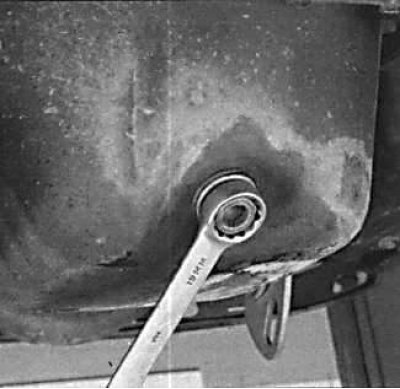


2. Loosen the drain plug about half a turn. Place a container to collect the oil under the drain plug and unscrew the plug completely. If necessary, apply pressure to the plug while unscrewing to prevent the oil from leaking prematurely. 3. When the oil has completely drained, wipe off the area around the drain hole with a rag and screw the drain plug back on securely.
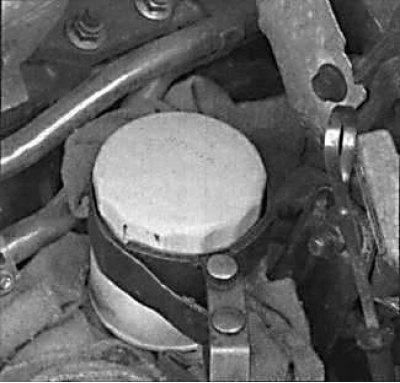


4. Place a container under the oil filter to collect the drained oil and use the special tool to loosen the filter, then unscrew it by hand.

5. Wipe away all traces of oil and dirt around the filter mounting area. Check to see if the rubber seal is still on the cylinder block. If it is, remove it.

6. Screw the oil filter in by hand until the rubber gasket touches the engine, then screw the filter in by hand by 3/4 of a turn.

7. Place the vehicle on a level, horizontal surface.

8. Fill with fresh engine oil through the oil filler neck.

9. Close the oil filler cap, start the engine and let it run for a few minutes. Check for oil leaks around the filter and the drain plug on the oil pan. Note that the oil pressure warning light may stay on for a few seconds as the oil fills all the passages and oil reservoirs in the engine.

10. Turn off the engine and wait a few minutes for the oil to drain into the pan. Check the oil level and top up if necessary.
This article is available at: russian, bulgarian, belarusian, ukrainian, serbian, croatian, romanian, polish, slovak, hungarian
The article material has been checked: Mitrofanova Elena
Share information:
◀ Previous
Camry XV10: Maintenance
Next ▶

Every 400 km or weekly
Maintenance intervals
Maintenance Specifications
Every 10,000 km or 6 months
Every 25,000 km or 12 months
Every 50,000 km or 24 months
Every 100,000 km or 48 months
Similar articles on other Toyota models

➥ Replacement of engine oil and oil filter (every 5000 km or… Toyota Highlander 1 (2000-2007, petrol)
➥ Brake condition check (every 24,000 km or 12 months) Toyota RAV 4 XA10 (1994-2000)
Link in different formats to this article
Comments and feedback from visitors
No comments yet


Add two numbers 33 + 29


Camry XV30 (2001-2006) 
  • User manual
  • Vehicle description
  • Keys, locks and alarms
  • Governing bodies
  • Salon equipment
  • Driving and operation
  • Maintenance
  • Power unit
  • 4-cylinder engine
  • Control system (I4)
  • Engine overhaul (I4)
  • 6-cylinder engine
  • Control system (V6)
  • Engine overhaul (V6)
  • Transmission
  • Clutch
  • Mechanical gearbox
  • Automatic gearbox
  • Drive mechanism
  • Chassis, running gear
  • Wheels and tires
  • Car suspension
  • Steering
  • Brake system
  • Body and interior
  • Exterior (external elements)
  • Doors, locks and windows
  • Air conditioning and heater
  • Electrical equipment
  • Equipment and devices
  • Power devices
  • Electrical circuits
Camry XV20 (1996-2001) 
  • General information
  • Controls and instruments
  • Driving and operation
  • Daily care
  • Maintenance
  • Power unit
  • 4-cylinder engine
  • 6-cylinder engine
  • Engine overhaul
  • Engine electrical equipment
  • Cooling system
  • Heating and ventilation
  • Fuel system
  • Exhaust system
  • Transmission
  • Mechanical gearbox
  • Automatic gearbox
  • Clutch
  • Chassis, running gear
  • Suspension and axle shafts
  • Steering
  • Brake system
  • Body and interior
  • Exterior (external elements)
  • Interior (internal elements)
  • Doors, locks and windows
  • Electrical equipment
  • Equipment and devices
  • Electrical circuits
Camry XV10 (1991-1996) 
  • General information
  • User manual
  • Maintenance
  • Power unit
  • 4-cylinder engine
  • 6-cylinder engine
  • Overhaul of engines
  • Cooling and heating
  • Fuel system
  • Engine electrical equipment
  • Control system
  • Transmission
  • Mechanical gearbox
  • Automatic gearbox
  • Clutch and drive shafts
  • Chassis, running gear
  • Brake system
  • Car suspension
  • Steering
  • Body and interior
  • Exterior (external elements)
  • Interior (internal elements)
  • Doors, locks and windows
  • Electrical equipment
  • Equipment and devices
  • Headlights and lighting
  • Electrical circuits
Camry Vista V40 (1994-1998) 
  • General information
  • User manual
  • Maintenance
  • Power unit
  • Petrol engines
  • Diesel engines
  • Engine overhaul
  • Cooling and lubrication system
  • Fuel system (diesel)
  • Fuel injection (petrol)
  • Engine electrical equipment
  • Transmission
  • Clutch and cardan
  • Automatic gearbox
  • Chassis, running gear
  • Front suspension
  • Rear suspension
  • Steering
  • Brake system
  • Body and interior
  • Body elements
  • Air conditioning and heater
  • SRS security system
  • Electrical equipment
  • Equipment and devices
  • Electrical circuits
ToyotaMan.ru © 2018–2026 • Mobile version • Interesting about Toyota • Administration • Sitemap: EN BG BY UA RS HR RO PL SK HU • Search system • Bookmark
Camry Vista-V40 • Camry XV10 • Camry XV20 • Camry XV30 • Corolla Verso-AR10 • Corolla E80 • Corona T190 • Carina T170 • Carina T190 • Land Cruiser J70 (diesel) • Land Cruiser J60 (petrol) • Land Cruiser J100 • Highlander XU20 (petrol) • 4Runner N120 • RAV4 XA10 • RAV4 XA20 • Duet M100 • Dyna Y50 •
We require cookies to enable some interactive features. Is that ok with you?