
Company Honda Company Ford Company Skoda Company Kia Company Mazda Company Mercedes Company Renault
English Русский
Български
Беларускі
Український
Српски
Hrvatski
Română
Polski
Slovenský
Magyar
Bookmark Articles Sitemap Contacts
ToyotaMan.ru


Camry Corolla Corona Carina Land Cruiser Highlander 4Runner RAV4 Others
Camry XV30 (2001-2006) Camry XV20 (1996-2001) Camry XV10 (1991-1996) Camry Vista V40 (1994-1998)

Exhaust Gas Oxygen Sensor [Toyota Camry XV20]

  • Main
  • Camry
  • XV20 (1996-2001)
  • Power unit
  • Exhaust system
  • Exhaust Gas Oxygen Sensor
0
Contents: Examination ↓ Replacement ↓

Oxygen sensor
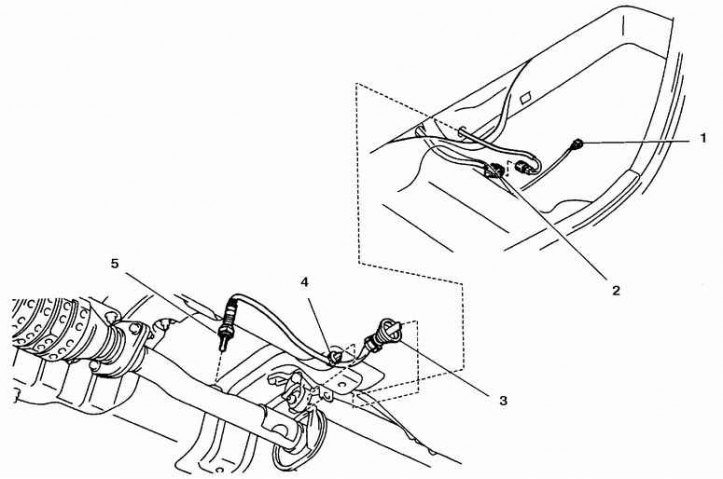


1. Seat connector; 2. Secondary sensor connector; 3. Cover; 4. Clamp; 5. First sensor


The oxygen sensor is designed to generate a signal, based on which the computer determines the oxygen content in the exhaust gases and maintains the stoichiometric composition of the combustible mixture (14.7 parts air to 1 part gasoline) by changing the duration of fuel injection. A low-level signal (0.1 V) from the sensor corresponds to a lean mixture, and a high-level signal (0.9 V) to a rich mixture.

The vehicles in question are equipped with 2 oxygen sensors - at the input and output of the catalytic converter. If the sensor temperature is below 340°C, there is no signal from the sensor and until the engine warms up, the sensor-computer system operates in the open-loop mode. If after the engine warms up the signal does not exceed 0.45 V at speeds above 1500 rpm, the open-loop mode is maintained, and for processing, instead of the signal from the sensor, the default data stored in the computer memory is used.

Attention! When checking the sensor, it is prohibited to disconnect the flexible conductor from it, twist the wiring, and also subject the sensor to sharp mechanical impacts. It is prohibited to use solvents to clean the sensor.


Examination
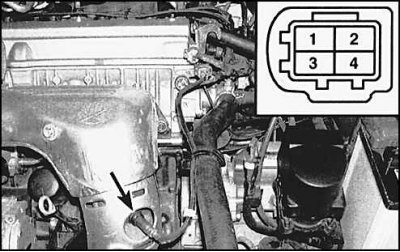


1. Insert the voltmeter needle probes into the sensor connector, to terminals 3 (positive terminal of the voltmeter) and 4 (negative terminal) - in a 4-cylinder engine. Raise the front of the car. To access the second sensor connector, you will need to remove the front seat.

2. Start the engine and monitor the voltmeter readings as the engine warms up. On a cold engine, the voltage should be 0.1–0.2 V. On a warm engine, the voltage should begin to fluctuate within 0.1–0.9 V (closed loop mode is activated). If the closed loop mode does not turn on, or turns on with a long delay, replace the sensor.
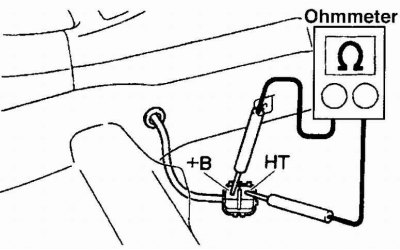


3. Check the serviceability of the sensor heater by measuring the resistance between the HT and B+ terminals of the connector, which should be 11–16 Ohms.


(Publication Reprinted from a web portal: «ToyotaMan.ru»)

4. Check for battery voltage between the B+ terminal on the computer side of the connector and ground (the ignition must be on).

Replacement


1. Run the engine for 1-2 minutes. Disconnect the battery from the ground and lift the car.

2. Carefully disconnect the connector from the sensor and unscrew the sensor using a notched open-end wrench.
This article is available at: russian, bulgarian, belarusian, ukrainian, serbian, croatian, romanian, polish, slovak, hungarian
The article material has been checked: Kolokoltsev Grigory
Share information:
◀ Previous
Camry XV20: Exhaust system
Next ▶

Power steering pressure contact sensor — checking and replacing
Camshaft Rotation Sensor — Checking and Replacing
Crankshaft speed sensor — checking and replacement
Coolant Temperature Sensor (ECT Sensor)
Intake Air Temperature Sensor (IAT Sensor)
Knock Sensor — Checking and Replacing
Vehicle Speed Sensor — Checking and Replacing
Idle Air Control Valve (IAC valve)
Suction Channel Selection System (ACIS system)
Crankcase ventilation system
Similar articles on other Toyota models

➥ Removal and installation the oxygen sensor (lambda probe) Toyota Corolla E80 (1983-1990)
➥ Oxygen sensor — check Toyota Corona T190 (1992-1997)
➥ Oxygen sensor Toyota Carina T190 (1992-1996)
➥ Oxygen sensor and air/fuel ratio sensor — general… Toyota RAV 4 XA20 (2000-2005)
➥ Checking the exhaust system Toyota Cruiser 60/80 (1980-1997, petrol)
➥ Checking the exhaust system (every 24,000 km or 18 months) Toyota Highlander 1 (2000-2007, petrol)
Link in different formats to this article
Comments and feedback from visitors
No comments yet


Add two numbers 16 + 30


Camry XV30 (2001-2006) 
  • User manual
  • Vehicle description
  • Keys, locks and alarms
  • Governing bodies
  • Salon equipment
  • Driving and operation
  • Maintenance
  • Power unit
  • 4-cylinder engine
  • Control system (I4)
  • Engine overhaul (I4)
  • 6-cylinder engine
  • Control system (V6)
  • Engine overhaul (V6)
  • Transmission
  • Clutch
  • Mechanical gearbox
  • Automatic gearbox
  • Drive mechanism
  • Chassis, running gear
  • Wheels and tires
  • Car suspension
  • Steering
  • Brake system
  • Body and interior
  • Exterior (external elements)
  • Doors, locks and windows
  • Air conditioning and heater
  • Electrical equipment
  • Equipment and devices
  • Power devices
  • Electrical circuits
Camry XV20 (1996-2001) 
  • General information
  • Controls and instruments
  • Driving and operation
  • Daily care
  • Maintenance
  • Power unit
  • 4-cylinder engine
  • 6-cylinder engine
  • Engine overhaul
  • Engine electrical equipment
  • Cooling system
  • Heating and ventilation
  • Fuel system
  • Exhaust system
  • Transmission
  • Mechanical gearbox
  • Automatic gearbox
  • Clutch
  • Chassis, running gear
  • Suspension and axle shafts
  • Steering
  • Brake system
  • Body and interior
  • Exterior (external elements)
  • Interior (internal elements)
  • Doors, locks and windows
  • Electrical equipment
  • Equipment and devices
  • Electrical circuits
Camry XV10 (1991-1996) 
  • General information
  • User manual
  • Maintenance
  • Power unit
  • 4-cylinder engine
  • 6-cylinder engine
  • Overhaul of engines
  • Cooling and heating
  • Fuel system
  • Engine electrical equipment
  • Control system
  • Transmission
  • Mechanical gearbox
  • Automatic gearbox
  • Clutch and drive shafts
  • Chassis, running gear
  • Brake system
  • Car suspension
  • Steering
  • Body and interior
  • Exterior (external elements)
  • Interior (internal elements)
  • Doors, locks and windows
  • Electrical equipment
  • Equipment and devices
  • Headlights and lighting
  • Electrical circuits
Camry Vista V40 (1994-1998) 
  • General information
  • User manual
  • Maintenance
  • Power unit
  • Petrol engines
  • Diesel engines
  • Engine overhaul
  • Cooling and lubrication system
  • Fuel system (diesel)
  • Fuel injection (petrol)
  • Engine electrical equipment
  • Transmission
  • Clutch and cardan
  • Automatic gearbox
  • Chassis, running gear
  • Front suspension
  • Rear suspension
  • Steering
  • Brake system
  • Body and interior
  • Body elements
  • Air conditioning and heater
  • SRS security system
  • Electrical equipment
  • Equipment and devices
  • Electrical circuits
ToyotaMan.ru © 2018–2026 • Mobile version • Interesting about Toyota • Administration • Sitemap: EN BG BY UA RS HR RO PL SK HU • Search system • Bookmark
Camry Vista-V40 • Camry XV10 • Camry XV20 • Camry XV30 • Corolla Verso-AR10 • Corolla E80 • Corona T190 • Carina T170 • Carina T190 • Land Cruiser J70 (diesel) • Land Cruiser J60 (petrol) • Land Cruiser J100 • Highlander XU20 (petrol) • 4Runner N120 • RAV4 XA10 • RAV4 XA20 • Duet M100 • Dyna Y50 •
We require cookies to enable some interactive features. Is that ok with you?