
Company Honda Company Ford Company Skoda Company Kia Company Mazda Company Mercedes Company Renault
English Русский
Български
Беларускі
Український
Српски
Hrvatski
Română
Polski
Slovenský
Magyar
Bookmark Articles Sitemap Contacts
ToyotaMan.ru


Camry Corolla Corona Carina Land Cruiser Highlander 4Runner RAV4 Others
Camry XV30 (2001-2006) Camry XV20 (1996-2001) Camry XV10 (1991-1996) Camry Vista V40 (1994-1998)

Replacing rear brake pads, removing, disassembling and installing rear caliper [Toyota Camry XV30]

  • Main
  • Camry
  • XV30 (2001-2006)
  • Chassis, running gear
  • Brake system
  • Replacing rear brake pads, removing, disassembling and installing rear caliper
0
Contents: Visual inspection of pad thickness ↓ Checking brake pads ↓ Measuring the thickness of the brake…↓ Measuring Brake Disc Runout ↓ Assembly ↓
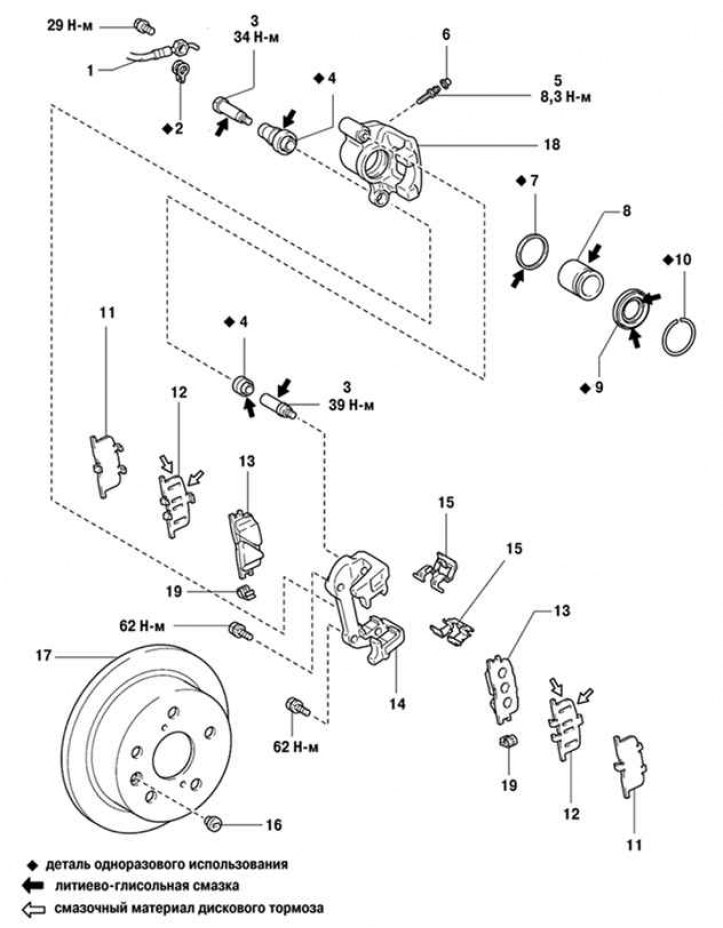

Fig. 6.47. Disc brake mechanisms of the rear wheels of the Camry: 1 – flexible hose; 2 – gasket; 3 – guide pin; 4 – anther; 5 – bleed nipple; 6 – protective cap of the bleed nipple; 7 – oil seal; 8 – piston; 9 – piston dust cover


The disc brakes of the rear wheels of the Camry are shown in Figure 6.47.

Visual inspection of pad thickness


Check the thickness of the pads. To do this, lift the car, remove the wheel and look through the inspection hole in the cylinder body.
  • Minimum thickness of brake pads: 1mm.
  • Wear limit: 2.0 mm.

Drain the brake fluid.

Remove the front wheel and temporarily secure the wheel rim with two nuts.

Loosen the bolt and disconnect the brake hose bracket.
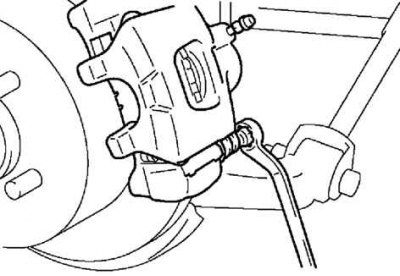


Fig. 6.48. Loosening the caliper mounting bolts


Holding the guide pins, unscrew the caliper mounting bolts (Fig. 6.48).
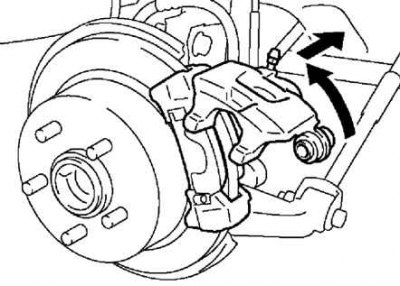


Fig. 6.49. Raising the caliper


Raise the caliper and secure it with wire (Fig. 6.49).

Remove two anti-squeal springs, two brake pads, two anti-squeal pads holding the plate liners.

Note: Anti-squeak springs and retaining inserts can be reused only if they are sufficiently elastic and free of deformation, cracks, rust or other defects.
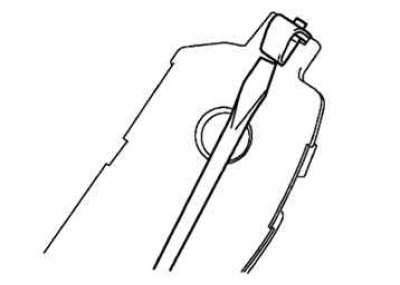


Fig. 6.50. Removing the brake pad wear indicators


Using a thin-bladed screwdriver, remove the brake pad wear indicators (Fig. 6.50).

Loosen the mounting bolt and remove the caliper cover from the bracket.

Remove the two brake pads with anti-squeal linings and the two retaining plate liners.
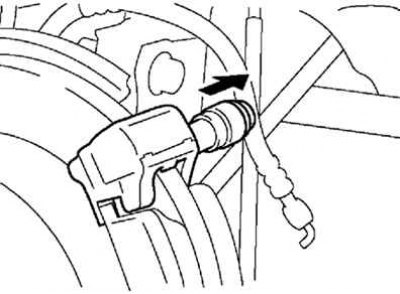


Fig. 6.51. Removing the guide pins from the caliper housing


Remove the guide pin (Fig. 6.51).
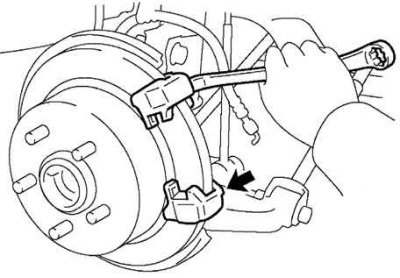


Fig. 6.52. Removing the caliper housing


Unscrew 2 bolts and remove the caliper housing from the brake disc (Fig. 6.52).
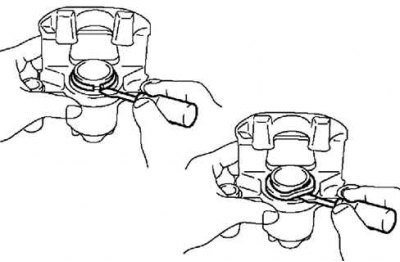


Fig. 6.53. Removing the brake cylinder boot


Using a screwdriver, remove the brake cylinder boot spring ring and boot (Fig. 6.53).

Place a rag between the piston and the cylinder.
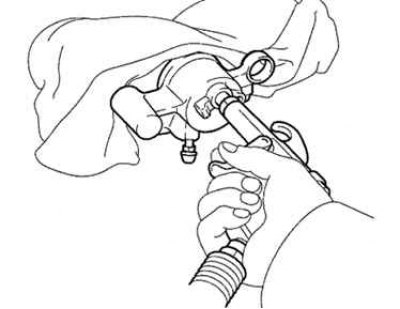


Fig. 6.54. Removing the piston from the cylinder


Using compressed air, remove the piston from the cylinder (Fig. 6.54).

Checking brake pads
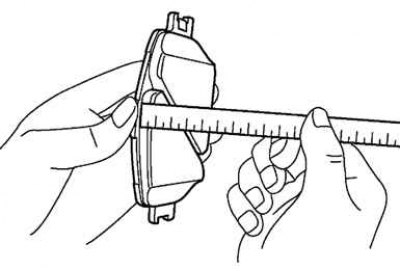


Fig. 6.55. Measuring the thickness of brake shoe linings


Measure the thickness of the brake shoe linings with a ruler (Fig. 6.55).
  • Standard thickness: 11 mm.
  • Minimum thickness: 1.0 mm.

Measuring the thickness of the brake disc
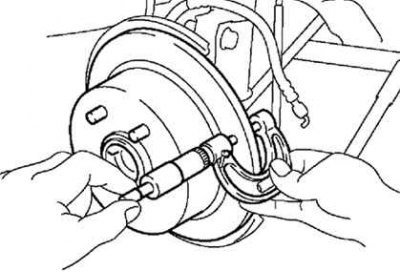


Fig. 6.56. Measuring the thickness of the brake disc


Using a micrometer, measure the thickness of the brake disc (Fig. 6.56).
  • Standard thickness: 12 mm
  • Minimum thickness: 10.5 mm

Replace the disc if the disc thickness is less than the minimum allowable.

Measuring Brake Disc Runout
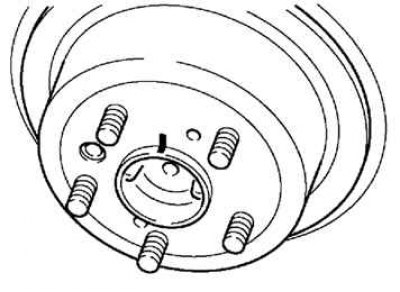


Fig. 6.57. Applying marks to the hub axle sleeve and brake disc


Apply marks to the brake disc and wheel hub axle bushing (Fig. 6.57).

Secure the brake disc to the wheel hub using wheel nuts (in 2 or more places).
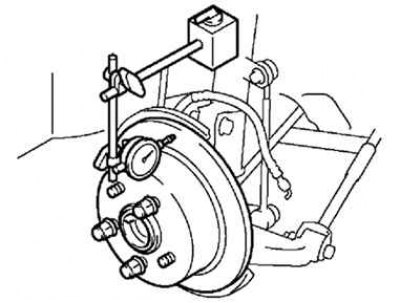


Fig. 6.58. Checking the disc runout using an indicator


Check the runout with an indicator (Fig. 6.58).

Measurement point:
  • at a distance of 10 mm from the outer edge of the disc.
  • maximum runout: 0.15 mm or less.

Caution: Before taking measurements, make sure that the axial play is 0 mm.


If the runout is significant, find the point of minimum runout by successively shifting the installation position of the brake disc on the hub by one hole.

Assembly
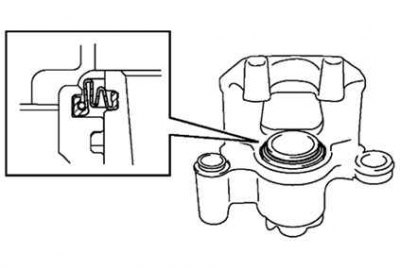


Fig. 6.59. Installing the spring ring and brake cylinder boot


Using a screwdriver, install the brake cylinder boot spring ring and boot (Fig. 6.59).


When installing the spring ring, be careful not to damage the cover.

Install the guide pins.

Tightening torque: 39 Nm.

Using a socket wrench (8mm) and a hammer, install the guide pin dust boots.

Pre-lubricate the dust boots with lithium grease.

Install the caliper housing mounting bolts.

Tightening torque: 62 Nm.
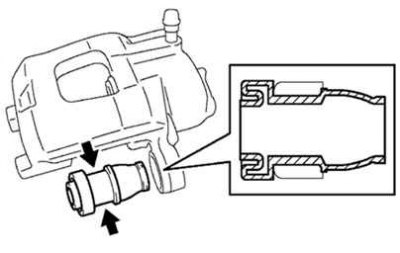


Fig. 6.60. Installing the dust cover into the caliper cover


Install the guide pin boot into the caliper cover, after lubricating it with lithium grease (Fig. 6.60).

Install the guide pin into the caliper cover.
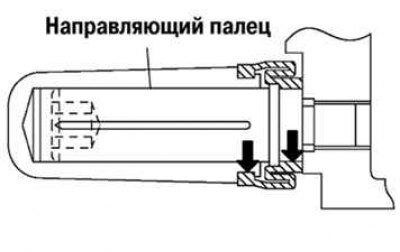


Fig. 6.61. Guide pin installation diagram


Lubricate the pin with lithium grease and, being careful not to damage the boot, insert it as shown in Figure 6.61.

Install a new set of brake pads.


Install the caliper cover.

Carry out the rest of the assembly in the reverse order of removal.

Install the rear wheels.

Check the brake fluid level.
This article is available at: russian, bulgarian, belarusian, ukrainian, serbian, croatian, romanian, polish, slovak, hungarian
The article material has been checked: Evdokimov Evgeniy
Share information:
◀ Previous
Camry XV30: Brake system
Next ▶

Replacing the front brake pads, removing, disassembling and installing the…
Checking, removing and installing the brake booster
Checking and installing the master brake cylinder
Disassembling the master brake cylinder
Removal the master brake cylinder
Disassembly, inspection and assembly of the parking brake mechanism
Removal and installation the front wheel speed sensor
Removal and installation the pressure modulator
Removal and installation the brake pedal
Possible malfunctions of the brake system
Similar articles on other Toyota models

➥ Disassembling the rear shock absorber. Removing and… Toyota Corolla E80 (1983-1990)
➥ Disassembling the rear disc brake caliper Toyota Carina T190 (1992-1996)
➥ Replacing disc brake pads (front or rear) Toyota Cruiser 60/80 (1980-1997, petrol)
➥ Replacing rear brake pads Toyota RAV 4 XA10 (1994-2000)
➥ Replacing the output shaft seal (rear wheel drive) (A540N) Toyota Corona T190 (1992-1997)
➥ Rear Brake Wheel Cylinder — Removal and Installation Toyota 4Runner N120 (1989-1995)
Link in different formats to this article
Comments and feedback from visitors
No comments yet


Add two numbers 16 + 45


Camry XV30 (2001-2006) 
  • User manual
  • Vehicle description
  • Keys, locks and alarms
  • Governing bodies
  • Salon equipment
  • Driving and operation
  • Maintenance
  • Power unit
  • 4-cylinder engine
  • Control system (I4)
  • Engine overhaul (I4)
  • 6-cylinder engine
  • Control system (V6)
  • Engine overhaul (V6)
  • Transmission
  • Clutch
  • Mechanical gearbox
  • Automatic gearbox
  • Drive mechanism
  • Chassis, running gear
  • Wheels and tires
  • Car suspension
  • Steering
  • Brake system
  • Body and interior
  • Exterior (external elements)
  • Doors, locks and windows
  • Air conditioning and heater
  • Electrical equipment
  • Equipment and devices
  • Power devices
  • Electrical circuits
Camry XV20 (1996-2001) 
  • General information
  • Controls and instruments
  • Driving and operation
  • Daily care
  • Maintenance
  • Power unit
  • 4-cylinder engine
  • 6-cylinder engine
  • Engine overhaul
  • Engine electrical equipment
  • Cooling system
  • Heating and ventilation
  • Fuel system
  • Exhaust system
  • Transmission
  • Mechanical gearbox
  • Automatic gearbox
  • Clutch
  • Chassis, running gear
  • Suspension and axle shafts
  • Steering
  • Brake system
  • Body and interior
  • Exterior (external elements)
  • Interior (internal elements)
  • Doors, locks and windows
  • Electrical equipment
  • Equipment and devices
  • Electrical circuits
Camry XV10 (1991-1996) 
  • General information
  • User manual
  • Maintenance
  • Power unit
  • 4-cylinder engine
  • 6-cylinder engine
  • Overhaul of engines
  • Cooling and heating
  • Fuel system
  • Engine electrical equipment
  • Control system
  • Transmission
  • Mechanical gearbox
  • Automatic gearbox
  • Clutch and drive shafts
  • Chassis, running gear
  • Brake system
  • Car suspension
  • Steering
  • Body and interior
  • Exterior (external elements)
  • Interior (internal elements)
  • Doors, locks and windows
  • Electrical equipment
  • Equipment and devices
  • Headlights and lighting
  • Electrical circuits
Camry Vista V40 (1994-1998) 
  • General information
  • User manual
  • Maintenance
  • Power unit
  • Petrol engines
  • Diesel engines
  • Engine overhaul
  • Cooling and lubrication system
  • Fuel system (diesel)
  • Fuel injection (petrol)
  • Engine electrical equipment
  • Transmission
  • Clutch and cardan
  • Automatic gearbox
  • Chassis, running gear
  • Front suspension
  • Rear suspension
  • Steering
  • Brake system
  • Body and interior
  • Body elements
  • Air conditioning and heater
  • SRS security system
  • Electrical equipment
  • Equipment and devices
  • Electrical circuits
ToyotaMan.ru © 2018–2026 • Mobile version • Interesting about Toyota • Administration • Sitemap: EN BG BY UA RS HR RO PL SK HU • Search system • Bookmark
Camry Vista-V40 • Camry XV10 • Camry XV20 • Camry XV30 • Corolla Verso-AR10 • Corolla E80 • Corona T190 • Carina T170 • Carina T190 • Land Cruiser J70 (diesel) • Land Cruiser J60 (petrol) • Land Cruiser J100 • Highlander XU20 (petrol) • 4Runner N120 • RAV4 XA10 • RAV4 XA20 • Duet M100 • Dyna Y50 •
We require cookies to enable some interactive features. Is that ok with you?