



Clutch
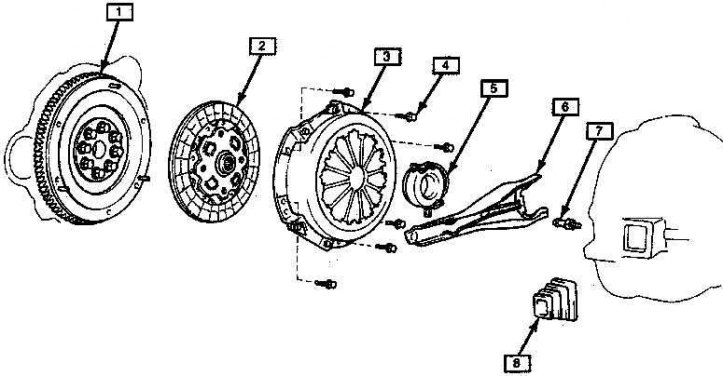
1 – flywheel; 2 – clutch disc; 3 – pressure plate; 4 – bolts; 5 – thrust bearing; 6 – clutch release fork; 7 – stud with ball end; 8 – protective cover
The clutch is designed for short-term disconnection of the engine and gearbox when shifting gears and braking and their smooth connection when the car starts moving, as well as to protect transmission parts from dynamic loads.
The torque from the gearbox to the wheels is transmitted through drive shafts, which consist of two constant velocity joints and a shaft.
The publication is taken from the website: TOYOTAMAN
The clutch consists of a clutch disc, a clutch drive with a pressure plate and a clutch release mechanism.
The clutch disc is installed between the flywheel and the clutch pressure plate and moves along the splines of the input shaft of the gearbox.
The clutch master assembly is bolted to the flywheel. Torque during engine operation is transmitted from the crankshaft through the flywheel and clutch disc, which is clamped between the flywheel and the pressure plate, to the primary shaft of the gearbox.
To disconnect the engine from the gearbox, it is necessary to move the pressure plate away from the clutch disc. This is achieved using a hydraulic drive, which consists of a master cylinder, a slave cylinder, and hoses. Pressing the clutch pedal moves the piston in the master cylinder and compresses the fluid, which is transmitted through the hose to the slave cylinder. Under pressure, the piston of the slave cylinder moves and activates the clutch release fork. The clutch release fork moves the pressure bearing, which acts on the spring of the pressure plate and moves the pressure plate away from the clutch disc.