



Note (A540H): In case of simultaneous failure of two speed sensors (front and rear output shafts of the gearbox) the fault code will not appear and the self-diagnosis system will not work. However, in the selector position "D", movement will be possible only in first gear, regardless of the speed of the car.
Code 42 (A140E): Vehicle Speed Sensor Circuit
1. Check the operation of the speedometer (see section "Electrical equipment"). Replace the faulty speedometer.
2. Measure the voltage between the terminals "SPD" and "E1" of the automatic transmission control unit connector and the engine. If the voltage corresponds to the nominal value, replace the control unit.
3. Check the vehicle speed sensor. Replace the faulty sensor.
4. Check the instrument cluster. Replace the faulty instrument cluster.
5. Check the wiring harness between the control unit and the instrument cluster.
Code 44 (A540H): Gearbox Rear Output Shaft Speed Sensor Circuit
1. Measure the conductivity between the terminals "RR+" and "RR-" connectors of the automatic transmission and engine control unit. If there is conductivity, then replace the automatic transmission and engine control unit.
2. Check the gearbox rear output shaft speed sensor. Replace the faulty sensor.
3. Check the wiring harness between the control unit and the speed sensor.
Code 61: Transmission Front Output Shaft Speed Sensor Circuit
1. Measure the conductivity between the terminals "FR+" and "FR-" connectors of the automatic transmission and engine control unit. If there is conductivity, then replace the automatic transmission and engine control unit.
2. Check the front output shaft speed sensor of the gearbox. Replace the faulty sensor.
3. Check the wiring harness between the control unit and the speed sensor.
Code 62: Solenoid Valve Circuit #1
1. Measure the resistance of the electromagnetic valve #1 on the automatic transmission and engine control unit connector. If the resistance matches the nominal value, replace the automatic transmission and engine control unit.
2. Remove the oil pan and measure the resistance between the connector of the solenoid valve Ne1 and the ground. If the resistance does not correspond to the nominal value, replace the solenoid valve No.1.
- Nominal resistance - 11 - 15 Ohm
3. Check the wiring harness between solenoid valve No.1 and the automatic transmission control unit and the engine.
Code 63: Solenoid Valve Circuit #2
The text is quoted from the source website (ToyotaMAN)
1. Measure the resistance of electromagnetic valve No.2 on the automatic transmission and engine control unit connector. If the resistance corresponds to the nominal value, replace the automatic transmission and engine control unit.
2. Remove the oil pan and measure the resistance between the connector of the solenoid valve N92 and the ground. If the resistance is not within the nominal value, replace valve No.2.
- Nominal resistance - 11 - 15 Ohm
3. Check the wiring harness between the solenoid valve No.2 and the automatic transmission control unit and the engine.
Code 64: Torque Converter Lockup Clutch Control Solenoid Circuit
1. Measure the resistance of the electromagnetic valve on the automatic transmission and engine control unit connector. If the resistance is normal, replace the automatic transmission and engine control unit.
2. Remove the oil pan and measure the resistance between the connector of the solenoid valve controlling the lock-up clutch of the torque converter and the "ground". If the resistance is not normal, replace the solenoid valve of the lock-up clutch.
- Nominal resistance - 11-15 Ohm
3. Check the wiring between the solenoid valve and the automatic transmission control unit and the engine.
Code 73 (A540H): Interaxle Differential Locking Solenoid Valve Circuit
1. Measure the resistance of the electromagnetic valve on the automatic transmission control unit connector and the engine. If the resistance corresponds to the nominal value, replace the automatic transmission control unit.
2. Remove the oil pan and measure the resistance between the solenoid valve connector and ground. If the resistance is not within the nominal value, replace the solenoid valve.
- Nominal resistance - 11-15 Ohm
3. Check the wiring harness between the solenoid valve and the automatic transmission control unit and the engine.
Resetting fault codes
1. After repair, clear the memory of the automatic transmission and engine control unit from the fault codes stored there. To do this, remove the "EFI" fuse for 10 or more seconds, depending on the ambient temperature (the lower the temperature, the longer) with the ignition off.
Attention:
- - To reset the fault codes, disconnect the negative battery terminal for a while. This will erase the memory contents of the control units of other systems.
- - To reset fault codes, disconnect the automatic transmission and engine control unit connector.
- - If the fault code has not been reset, it will be stored in the control unit memory and will appear during subsequent diagnostics.
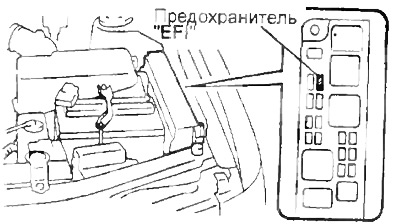
2. After resetting the codes, check that the flashing of the upshift indicator should correspond to the normal state of the gearbox.
Checking gear shifting
Note: This test helps determine whether the problem is electrical or mechanical in the transmission.
1. Disconnect the solenoid valve block connector.
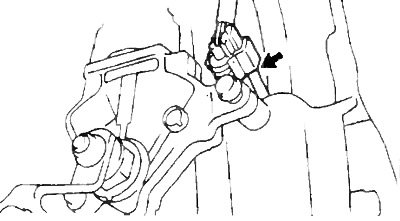
A140E
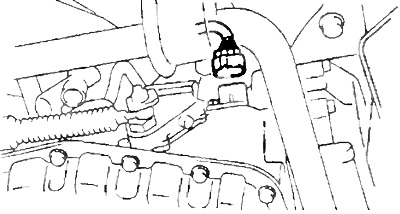
A540H
2. Gear changes should be performed in accordance with the table "Transmission operating modes in the case of normal operation of solenoid valves (solenoids) and the failure of one or two of them."
Table. Gearbox operating modes in case of normal operation of electromagnetic valves (solenoids) and the failure of one or two of them
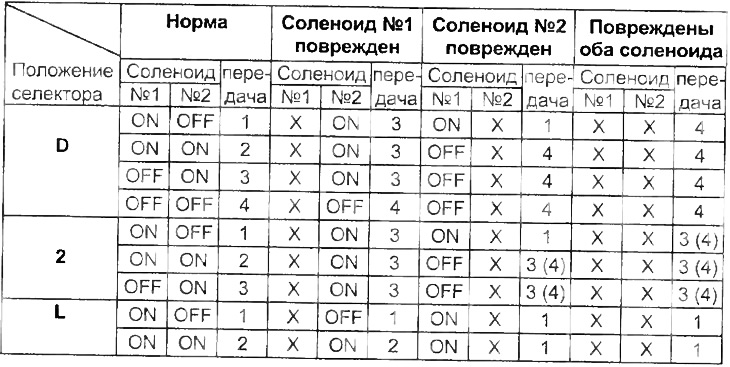
Note: "PH" marks indicate a malfunction. () - for A540N.
Note:
- If it is difficult to determine the gear engaged on the "L", "2" and "D" ranges, perform the following test:
- While driving, move the selector to positions "L", "2" and "0". The gear shift should correspond to the position of the lever.
- If there is a deviation during the shifting process, then the fault is in the gearbox itself.
3. Connect the solenoid valve block connector.
4. Clear fault codes.
Checking the voltage at the "TT" terminal
1. Checking the signal from the throttle position sensor.
a) Turn on the ignition. Do not start the engine.
b) Connect the voltmeter to the diagnostic connector terminals "TT" and "E1".
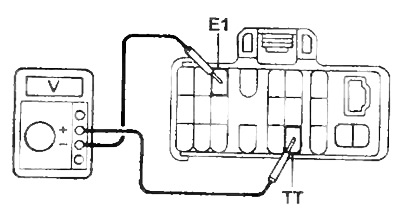
Note: Use a voltmeter with an internal resistance of at least 10 kOhm/V.
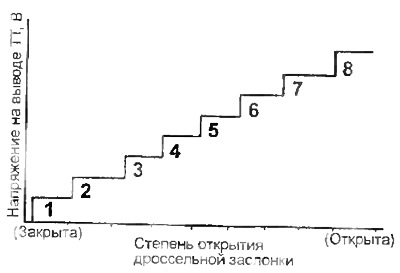
c) While pressing the accelerator pedal smoothly, check the voltage change. If the voltage does not change as shown in the figure, the sensor or its circuit is faulty.
2. Checking the brake light switch circuit.
a) Press the accelerator pedal all the way down. The voltage on the "TT" contact should be the specified value.
- Voltage - 8V
b) Press the brake pedal and check the voltage at the "TT" contact.
Voltage:
- brake pedal pressed - 0.5 V
- brake pedal released - 7.6-8.7 V
c) If there is a deviation from the specified voltages, then there is a malfunction in the brake light switch circuit.
3. Checking the moments of step-up switching.
a) Warm up the engine to a coolant temperature of 80°C.
b) Set the overdrive switch to the "ON" position.
c) Set the selector to position "D".
d) During road tests (speed about 10 km/h) check the voltage change at the "TT" terminal during upshifting.
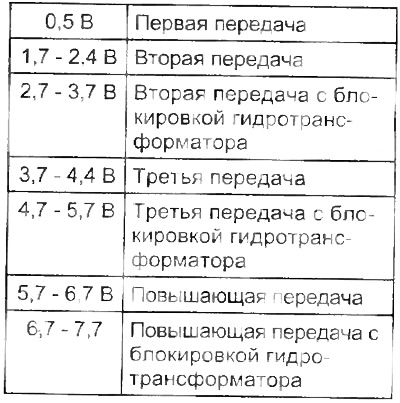
Note: Shifting to the next gear can be determined by a slight jolt or change in engine speed.
d) If the voltage at the "CT" terminal does not correspond to the specified one, then check the "CT" terminal circuit.