



Note: Before starting the test, warm up the automatic transmission fluid to a temperature of 50-80°C.
Test on "D" range
Move the selector to the "D" range and press the accelerator pedal all the way down.
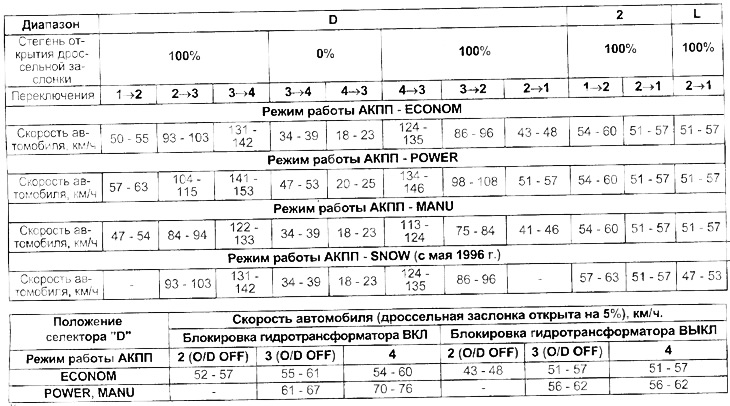
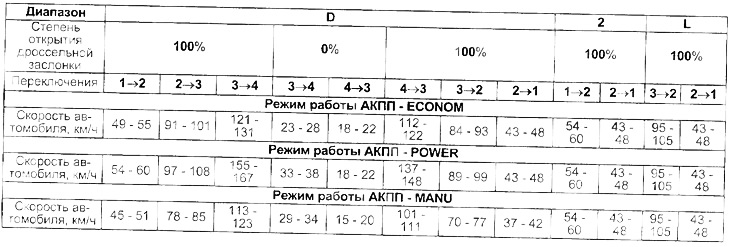
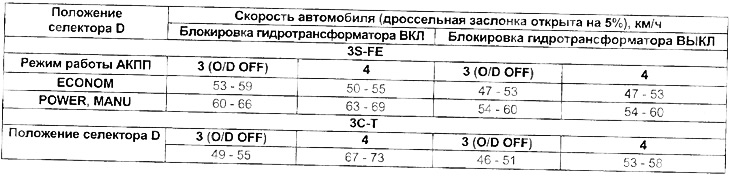
1. Check for switching 1->2, 2->3 and 3->4 and the correspondence of the switching moments to the values given in the table "Switching moments".
Note:
- There will be no upshift if the engine coolant temperature is less than 50°C and there is a difference of 10 km/h between the set speed (in the constant speed control system (cruise control)) and the speed of the vehicle.
- The torque converter lock-up will not engage when the brake pedal is depressed and the coolant temperature is below 50°C.
Analysis of results.
a) No switching 1->2:
- the speed controller is faulty.
- switch valve 1 is faulty>2.
b) No switching 2->3:
- switch valve 2 is faulty>3.
c) The switching moments do not correspond to those given in the table:
- the throttle valve control cable is not adjusted,
- throttle valve, switching valve 1- are faulty>2, switching valve 2->3, switching valve 3->4 etc.
2. In the same way, check for the absence of jolts and slipping of the friction control elements when switching 1->2, 2->3 and 3->4. Analysis of results.
If you feel strong jolts when shifting:
- the pressure in the main line is too high,
- the hydraulic accumulator is faulty,
- check valve defect.
3. While driving in third or fourth gear, in the "D" range, check for any extraneous noise or vibration.
Caution: This check must be carried out very carefully, since the appearance of noise and vibration may be caused by imbalance of the propeller shaft, differential, transformer, etc.
4. Check the operation of the forced downshift (kick-down), 2->1, 3->2, 4->3 and the correspondence of the switching moments to the values given in the table "Switching moments".
Analysis of results.
If the downshift speed limits do not match the table, then:
- the throttle valve control cable is not adjusted,
- throttle valve, switching valve 1- are faulty>2, switching valve 2->3 etc.
5. Check for any jerking or slipping when forced downshifting.
6. While driving in third gear of the "D" range at a speed of 60 km/h, release the accelerator pedal and move the selector to the "L" position. Determine the speed at which the 2-1 shift occurred and compare it with the value given in the "Shift Moments" table.
Table. Switching moments.
A140E (3S-FE)
¹: at the lowest speed,
²: Upshifting is prohibited (O/D OFF).
Table. Switching moments (end).
A140L
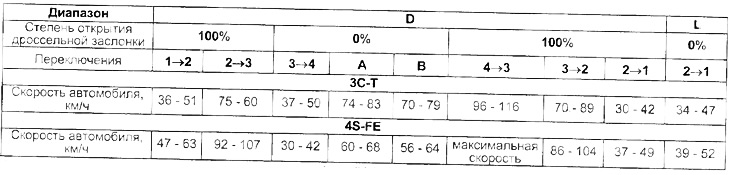
(): The kick-down switch is in the ON position.
A: Torque converter lock-up ON.
B: Torque converter lockup OFF.
A540N (3S-FE)
A540N (ZS-T)

Checking the operation of the torque converter lock-up
1. When driving in upshift at a steady speed, locking should occur at approximately 75 km/h.
2. Lightly press the accelerator pedal: the rotation speed should not change abruptly. If there is a abrupt change, there is no locking.
Check on range "2"
Move the selector to position "2" and press the accelerator pedal all the way down.
1. While driving in second gear of range "2", release the throttle pedal and check the engine braking effect. If there is no engine braking, then the brake providing the engine braking mode in second gear is faulty.
2. Check the noise and vibration levels during upshifting and downshifting.
Testing on the "L" range
1. When driving in the "L" range, there should be no upshifts - the car should only move in first gear.
2. When the load is dropped (releasing the accelerator pedal) the engine braking mode should occur. If there is no engine braking, then the first gear and reverse gear brakes are faulty.
3. Check the level of noise and vibration when accelerating and decelerating the vehicle.
Test on the "R" range
Move the selector to the "R" position, press the accelerator pedal all the way down. Check for slippage of the friction controls.
Check in the "P" range
Place the vehicle on a slope (at least 5°), move the selector to position "P" and release the parking brake. The output shaft locking mechanism lock should hold the vehicle in place.