



Removal
1. Remove the gearbox.
2. Remove the clutch cover and disc.
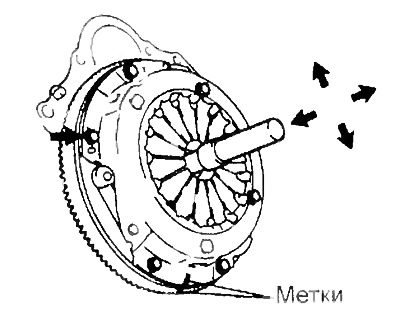
a) Apply marks to the clutch housing and flywheel.
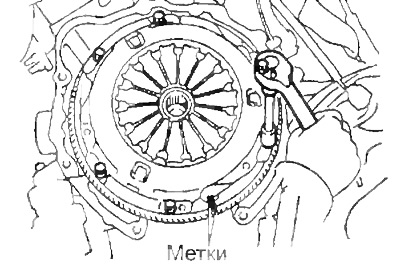
b) Loosen each bolt one turn at a time to ensure uniform release of the spring preload.
c) Remove all mounting bolts and remove the clutch housing and clutch disc.
Caution: Do not drop the clutch disc when removing.
3. Remove the bearing and clutch release fork.
a) Remove the bearing and the clutch release fork assembly, and then remove the bearing from the fork.
b) Remove the cover.
4. If necessary, unscrew the fork support from the clutch housing.
Examination
1. Check the clutch disc for wear and damage.
Using a caliper, measure the depth of the rivet heads from the surface of the overlay.
- Minimum depth - 0.3 mm
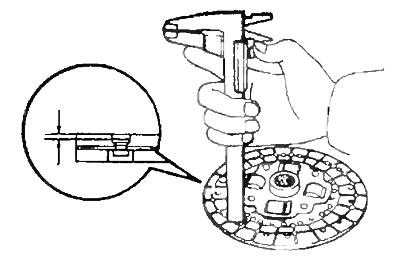
If the depth is less than the permissible value, repair or replace the clutch disc.
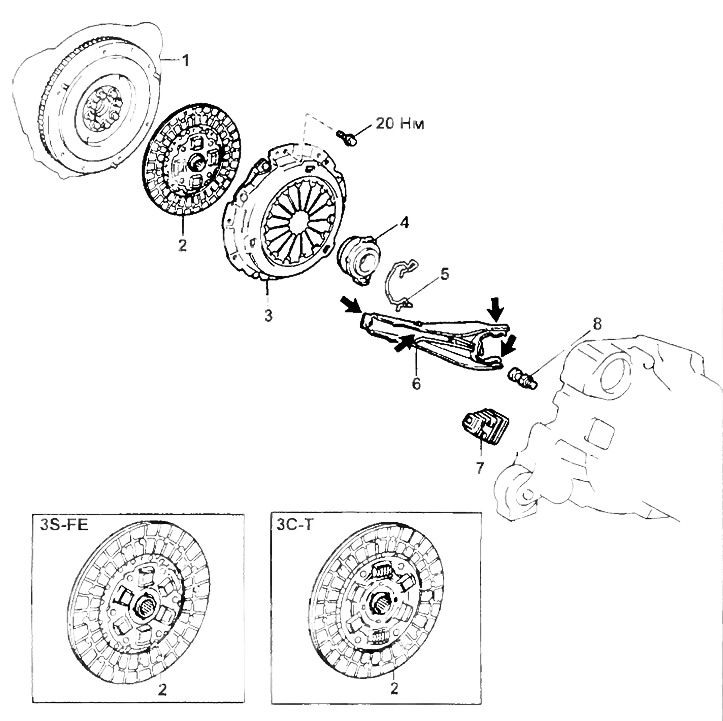
Clutch housing and disc.
1 - flywheel,
2 - clutch disc,
3 - clutch housing,
4 - clutch release bearing,
5 - spring,
6 - clutch release fork,
7 - case,
8 - clutch release fork support.
2. Using a dial indicator, check the disc runout.
- Maximum runout - 0.8 mm
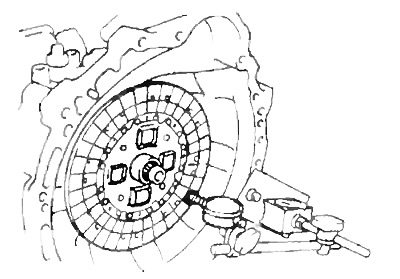
If the maximum runout exceeds the permissible value, replace the disc.
3. Using a caliper, measure the depth and width of the wear groove of the diaphragm spring petals.
Maximum permissible wear:
- by depth (A) - 0.5 mm
- by width (B) - 6.0 mm
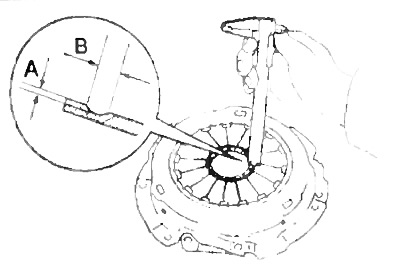
If wear exceeds the maximum permissible value, replace the clutch housing.
4. Using a dial indicator, check the flywheel runout.
- Maximum runout - 0.1 mm
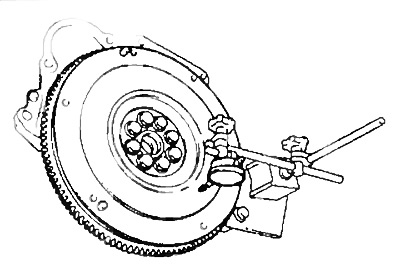
If the maximum runout exceeds the permissible value, then grind or replace the flywheel.
5. Check the clutch release bearing. Rotate the bearing by hand, applying force to it in the axial direction.
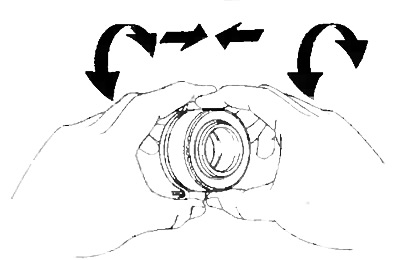
If the bearing is sticking or is difficult to turn, replace the bearing.
Note: The release bearing is lubricated for life and does not require cleaning or lubrication.
Installation
1. Install the clutch disc and clutch housing onto the flywheel.
a) Using a drift, install the clutch disc onto the flywheel.
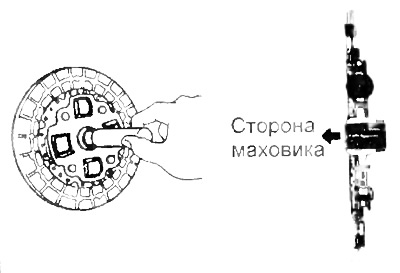
b) Align the marks on the clutch housing and flywheel made during disassembly.
c) Temporarily tighten the bolts.
d) Do not remove the mandrel until the bolts are fully tightened.
- Tightening torque - 19 Nm
Note: Tighten the bolts evenly in several passes in a crisscross pattern.
2. Check the relative position of the ends of the diaphragm spring petals using a special tool.
- Maximum deviation from plane - 0.5 mm
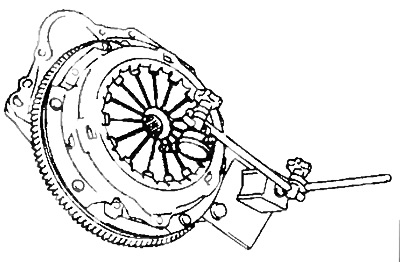
If the deviation exceeds the permissible value, adjust it using a special tool.
3. Install the fork support into the clutch housing (if it was removed).
a) (E59F) Clean the threads of the support with solvent to remove any remaining adhesive sealant. Apply adhesive sealant to the last three threads of the support.
b) Install and tighten the support.
Tightening torque:
- S50, S51 — 40 Nm
- E59F — 48 Nm
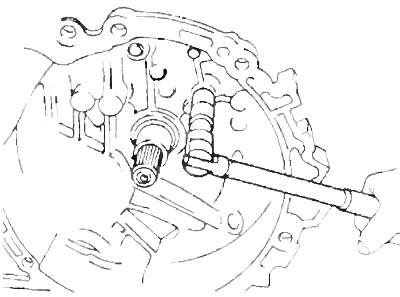
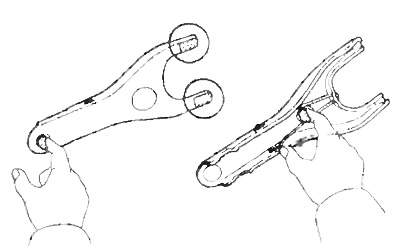
4. Apply grease to the surface of the following parts:
- at the contact points of the fork and the clutch release bearing;
- at the point of contact between the clutch release fork and the slave cylinder rod;
- at the point of contact between the support and the clutch release fork.
- - on the splines of the primary shaft of the gearbox.
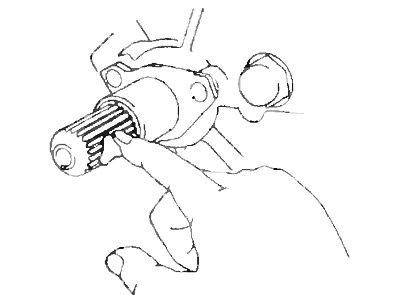
5. Connect the bearing and the clutch release fork. Then install them on the gearbox.
6. Install the gearbox.