



Typical ignition system of the vehicles under consideration
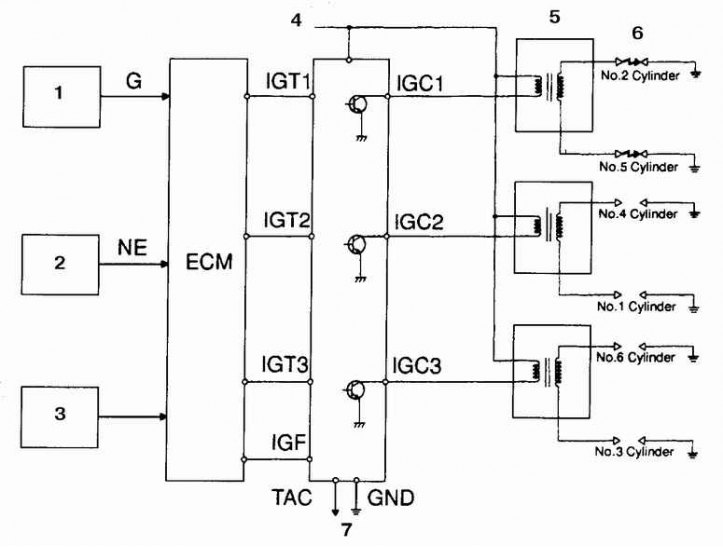
1. Camshaft rotation sensor; 2. Crankshaft rotation sensor; 3. Other sensors; 4. From the battery; 5. Ignition coil; 6. Candle
The vehicles in question are equipped with a distributorless ignition system (the so-called DIS system), in which one coil is used for two cylinders.
The DIS system uses dual-spark ignition. The spark appears simultaneously in two cylinders, the piston of one performs a compression stroke, and the other – an exhaust stroke. Moreover, in the first of these cylinders, the power of the spark discharge is much greater than the power of the discharge in the second, in which the spark is used only for the afterburning of the remains of the unburned combustible mixture. In V6 engines, the spark is created in pairs of cylinders 1-4, 2-5, 3-6, and in 4-cylinder engines – 1-4 and 3-2.
The DIS ignition system includes camshaft and crankshaft rotation sensors, a processor (PCM module), coils and an electronic module. The processor generates identification signals for each cylinder, which trigger the electronic module, which switches the ignition coils. The processor unit automatically adjusts the ignition timing in response to signals from various sensors in the vehicle. The electronic module distributes the signals to the appropriate coils and sets the delay time before switching the coil in accordance with the current in the primary circuit.
On V6 engines, the spark plugs on the left cylinder head are inserted directly into the connectors on the coils, and the spark plugs on the right cylinder head are connected to the coils with wires. On 4-cylinder engines, the coils are mounted next to the cylinder head, the spark plugs are connected to the coils with wires. The electronic module is mounted on V6 engines next to the brake master cylinder, under the relay mounting block, on 4-cylinder engines the module is permanently built into the coil housing and is replaced together with the coils.
Caution! If the engine fails to start, do not leave the ignition on for more than 10 minutes.
Connect the tachometer according to the manufacturer's instructions. Some tachometers are not compatible with the vehicle's electrical system. Consult your car service before purchasing a tachometer.
Do not allow the ignition coil terminals to come into contact with ground.
It is prohibited to disconnect the battery from the ground when the engine is running.
Always ensure that the electronic ignition unit is securely connected to ground.
Examination
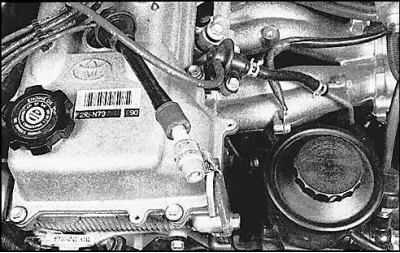
If the engine does not start, and the starter turns the crankshaft, then disconnect the wire from the spark plug of the left cylinder and connect it to a test spark gap. The spark gap must be specially designed for checking the DIS system.
Start the engine and check for spark.
If a spark is observed, remove the spark plugs and check their condition.
Caution: On a V6 engine, connect to the wires leading to the rear cylinder head to test.
If there is no spark or the sparking is unstable, check the voltage from the battery on each coil. If there is voltage, check the resistance of the coil windings.
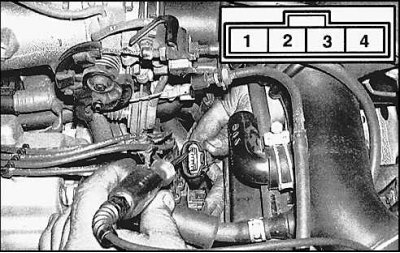
To check the voltage at the coil on a 4-cylinder engine, disconnect the connector, turn on the ignition and connect a voltmeter to terminal 1 of the connector (the test is performed on a non-running engine).
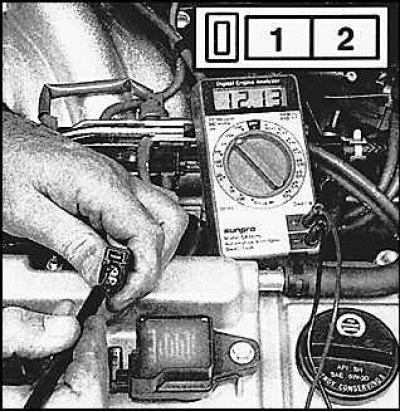
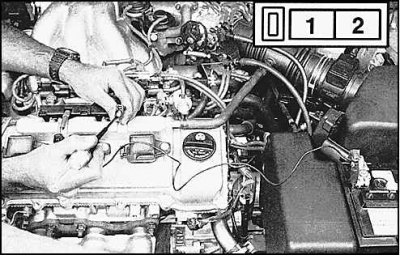
To check the voltage at the coil on a V6 engine, disconnect the connector, turn on the ignition and connect a voltmeter to terminal 1 of the connector (the test is performed on a non-running engine).
Check the shaft rotation sensors (see subsection 7.2.10., subsection 7.2.11.).
Check the signal from the processor on the coils (on a 4-cylinder engine) or from the electronic unit (on V6 engine).
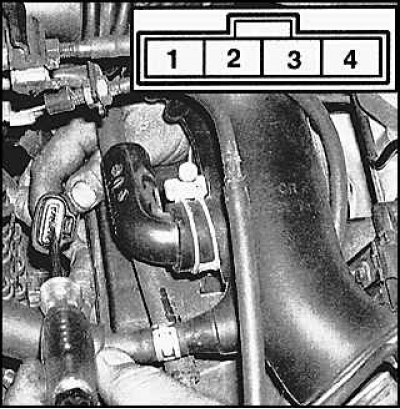
To do this, on a 4-cylinder engine, check for the presence of 5 V voltage at terminal 3 of the coil connector with the ignition on.
Also check for fluctuating voltage of 0.1-4.0 V at pin 2 of the connector (to do this, the assistant must turn on the starter). If the voltage at the coil connectors does not correspond to these standards, then replace or repair the processor unit, otherwise 5 replace the coil with the electronic unit.
The material is republished from an online website www.toyotaman.ru
On a 6-cylinder engine, the presence of a signal is checked by connecting a 12 V LED to pin 2 of the connector, which should blink when the starter is turned on. If there is no blinking, then check the electronic ignition unit (see subsection 3.4.8.).