Contents: Checking the anchor ↓ Checking the collector ↓ Stator check ↓ Checking the brushes ↓ Checking the brush springs ↓ Checking the brush holder ↓ Checking the overrunning clutch and…↓ Checking bearings ↓ Checking the traction relay ↓
Checking the anchor
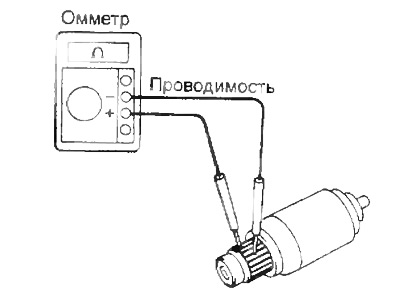
1. Check for loose armature winding.
Using an ohmmeter, check for continuity between the collector lamellas. If there is no continuity, replace the anchor.
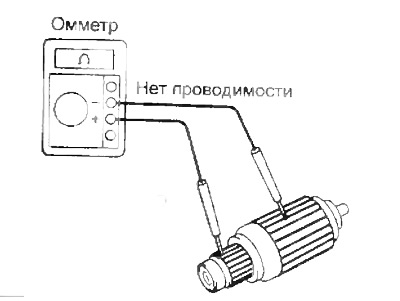
2. Check for short circuit of the armature winding to ground.
Using an ohmmeter, check for continuity between the commutator and the armature core.
If continuity is present, replace the anchor.
Checking the collector
1. Check the working surface of the manifold for contamination and traces of carbon deposits.
If the surface is dirty or has traces of carbon deposits, sand it with sandpaper (No. 400) or turn it on a lathe.
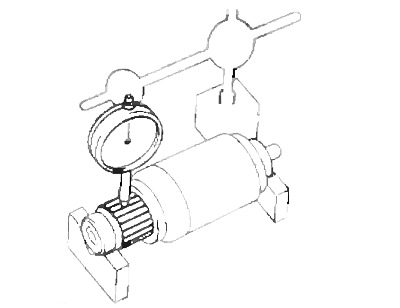
2. Check the collector runout
a) Install the manifold on the test bench.
b) Using an indicator, measure the commutator runout.
- Maximum runout - 0.05 mm
If the runout is greater than the maximum allowable value, turn the commutator on a lathe.
3. Measure the diameter of the manifold
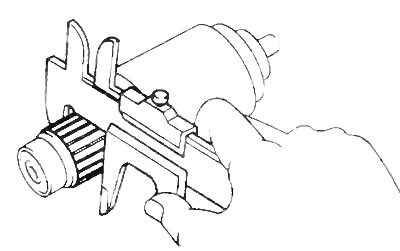
Using a caliper, measure the diameter of the manifold*.
3S-FE, 4S-FE:
- Nominal diameter - 30 mm
- Minimum diameter - 29 mm
ZS-T:
Nominal diameter:
- starter 1.4 kW - 30.0 mm
- starter 2.0 and 2.2 kW - 35.0 mm
The material is reprinted from an online resource [www.ToyotaMAN.ru]
Minimum diameter:
- starter 1.4 kW - 29.0 mm
- starter 2.0 and 2.2 kW - 34.0 mm
If the diameter is less than the minimum allowable, replace the anchor.
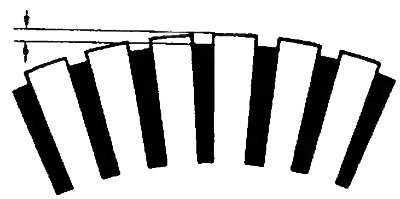
Check the depth of the groove between the collector lamellas.
Check for foreign particles in the grooves between the slats.
Nominal diameter:
3S-FE, 4S-FE — 0.6 mm
ZS-T:
- starter 1.4 kW - 0.5-0.8 mm
- starter 2.0 and 2.2 kW - 0.7 - 0.9 mm
Minimum diameter - 0.2 mm
If the value is less than the minimum allowable, process the grooves with a hacksaw.
Stator check
1. Check for breakage in the excitation winding.
Using an ohmmeter, check for continuity between the brush terminal and the excitation winding terminal.
If there is no conductivity, replace the stator.
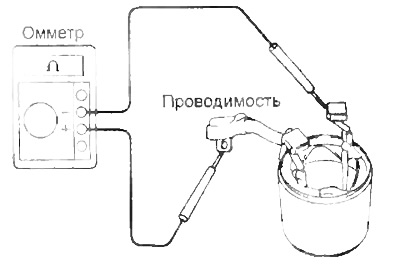
Starter 1.4 kW
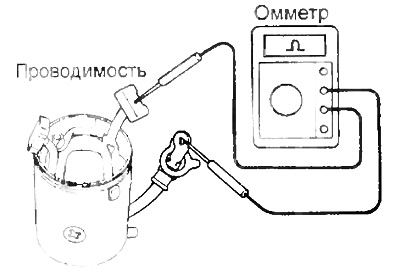
Starter 2.2 kW
2. Check for short circuit of the excitation winding to ground.
Using an ohmmeter, check for continuity between the excitation winding terminal and the stator.
If there is continuity, replace the stator.
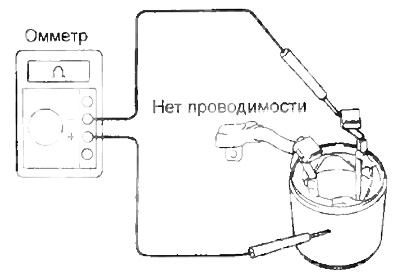
Starter 1.4 kW
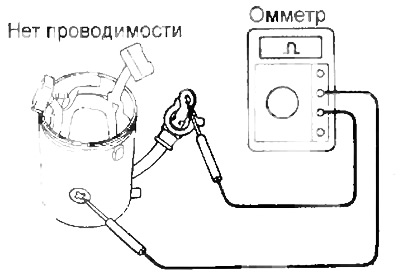
Starter 2.2 kW
Checking the brushes
1. Using a vernier caliper, measure the length of the brush.
Nominal length:
- 3S-FE, 4S-FE — 13.5 mm
ZS-T:
- starter 1.4 kW - 15.5 mm
- starter 2.0 and 2.2 kW - 15.0 mm
Minimum length:
- 3S-FE, 4S-FE — 8.5 mm
ZS-T:
- starter 1.4 kW - 10.0 mm
- starter 2.2 kW - 9.5 mm
If the length is less than the minimum allowable, replace the brush holder and stator.
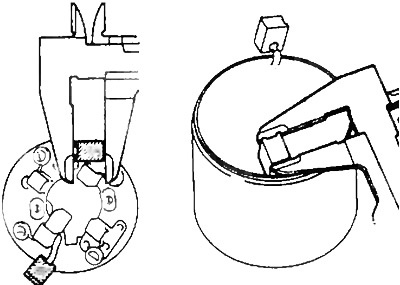
Checking the brush springs
Using a spring balance, measure the tension of the brush springs at the moment they break away from the brush.
Nominal tension:
- 3S-FE, 4S-FE — 18-24 N
ZS-T:
- starter 1.4 kW - 15-18 N
- starter 2.0 and 2.2 kW - 26-32 N
If the spring tension value is not within the described range, replace the spring.
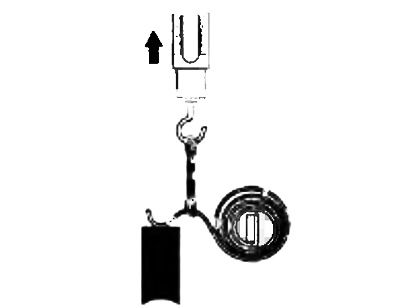
Checking the brush holder
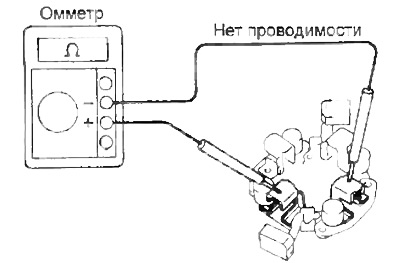
Check the insulation of the brush holder. Using an ohmmeter, check for continuity between the positive and negative brush holders.
If there is conductivity, repair or replace the brush holder.
Checking the overrunning clutch and gears
1. Inspect the working surfaces of the teeth of the drive and intermediate gears and the overrunning clutch gear for excessive wear or chips.
If there is wear or damage, replace the gears.
If there are any scoring or chips on the surfaces of the overrunning clutch gear teeth, check the working surfaces of the flywheel ring gear teeth.
2. Check the overrunning clutch.
Check that the drive gear rotates clockwise freely and does not rotate counterclockwise.
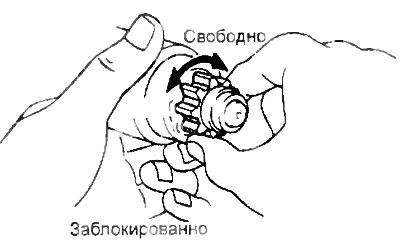
If the conditions are not met, replace the overrunning clutch.
Checking bearings
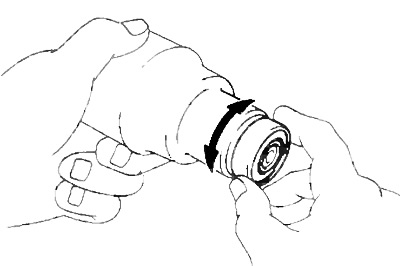
1. Check the front bearing Rotate the bearing by hand while simultaneously applying axial force towards the center of the anchor.
If there is excessive resistance or binding, replace the bearing.
2. Replace the front bearing if necessary.
a) Using a puller, remove the bearing.
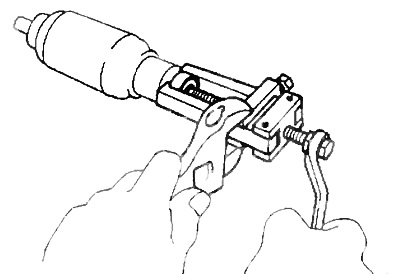
b) (Starter 1.4 and 2.0 kW) Using a press, press in the new bearing.
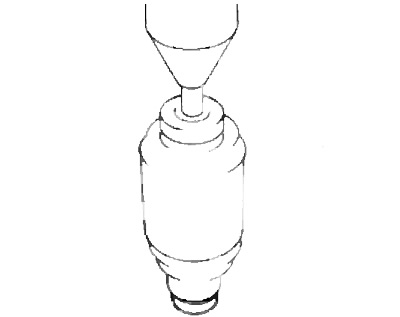
v) (Starter 2.2 kW) Using a 10mm nut and a press, press in the new bearing.
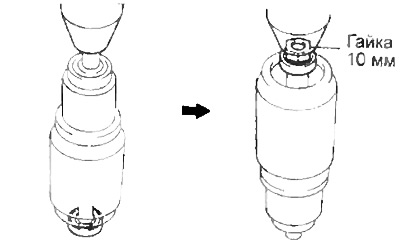
g) (Starter 2.2 kW) Using a punch, square up the anchor shaft.
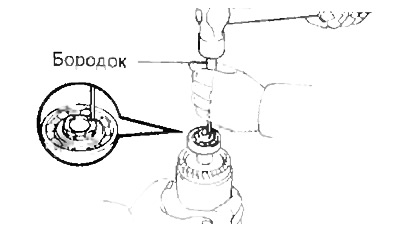
3. Check the rear bearing.
Rotate the bearing by hand while simultaneously applying axial force towards the center of the anchor.
If there is excessive resistance or binding, replace the bearing.
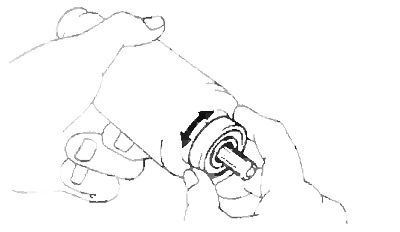
4. If necessary, replace the rear bearing
a) Using a puller, remove the bearing
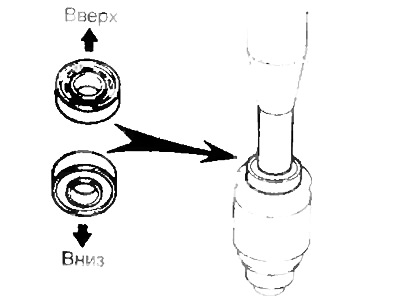
b) Using a mandrel and press, press in the new bearing.
Note: Make sure you install the bearing in the correct direction.
Checking the traction relay
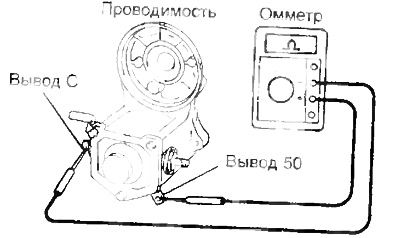
1. Check for breakage in the pull-in winding.
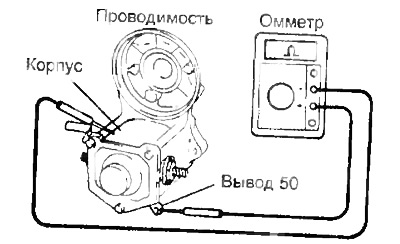
Using an ohmmeter, check for continuity between terminals "50" and "C".
If there is no continuity, replace the traction relay.
2. Check for breakage in the holding winding.
Using an ohmmeter, check that there is conductivity between terminal "50" and the relay body.
If there is no continuity, replace the traction relay.