



Contents: Removal ↓ Installation ↓
Caution: Read the entire engine removal section before removing the engine.
Caution: Since the vehicle is equipped with an air bag that may deploy if work is performed with the battery connected, it is necessary to disconnect the battery and wait at least 90 seconds to allow the capacitor in the air bag control system to discharge.
Warning! If your radio has an anti-theft code, check that you have the connection codes before disconnecting the battery.
Caution! On models from 1993 onwards, the airbag system is disabled if the battery is disconnected for an extended period of time. If the airbag warning light comes on and remains on after the battery is reconnected, contact a specialist workshop to restore the system to working order.
Removal
1. Relieve pressure in the fuel system.
2. Remove the ground cable from the battery.
3. Remove the battery and battery tray.
4. Remove the protective covering on the fenders and hood and remove the hood.
5. Remove the air filter housing.
6. Raise the vehicle and secure it on stands. Drain the coolant from the cooling system and the engine oil. Remove the drive belts.
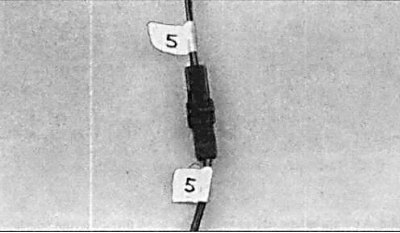
7. Label and then disconnect all vacuum lines, hoses, electrical connectors, ground straps, and fuel lines.
8. Remove the windshield washer fluid reservoir and expansion tank.
9. Remove the radiator fans, shroud and radiator.
10. Disconnect the coolant supply hoses to the heater.
11. Relieve any residual pressure in the fuel tank by removing the filler cap, then disconnect the fuel lines from the engine and plug them.
12. Disconnect the throttle control cable and transmission control rod.
13. Remove the wiring harness from the mounting brackets to the front and left side of the engine and transmission.
14. On vehicles with power steering, remove the power steering pump mounting bolts and move it to the side without disconnecting the hoses.
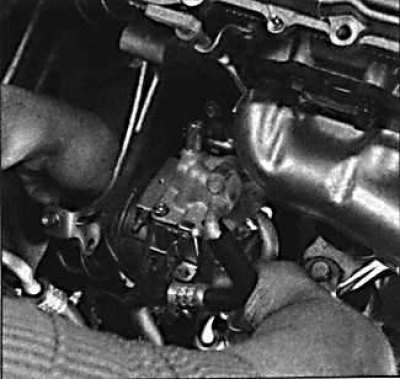
15. On models with air conditioning, unscrew the air conditioning compressor mounting bolts and move it to the side without disconnecting the hoses and use soft wire to tie it to the body.
16. Disconnect the exhaust outlet pipe from the manifold.
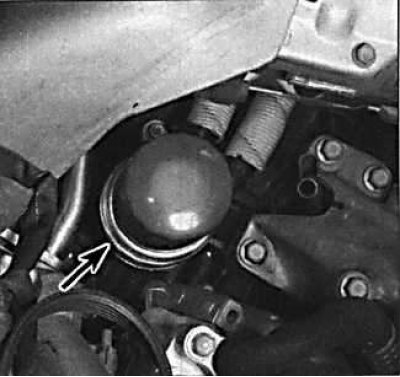
17. On four-cylinder models equipped with an oil cooler installed between the oil filter and the engine block, remove the oil filter and disconnect the hoses from the oil cooler.
(The original text is posted on: ToyotaMan.ru)
18. Attach the engine to the lifting gear and lift the engine until the top of the engine is supported by the lifting gear.
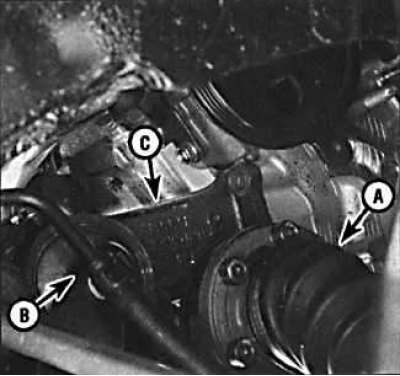
19. Remove the right powertrain mount. To remove the right powertrain mount, remove the joint (A), unscrew the tie bolt (B), and remove the powertrain mount (C).
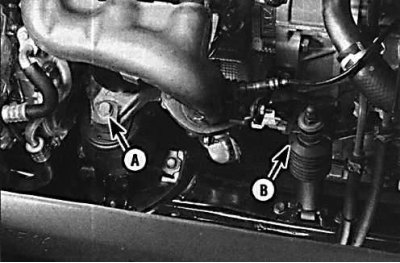
20. Remove the bolt securing the powertrain mount (A) to the body on the radiator side.
21. On models with an automatic transmission, remove the torque converter shield plate from the front of the transmission. Disconnect the torque converter from the drive plate and move it into the transmission case.
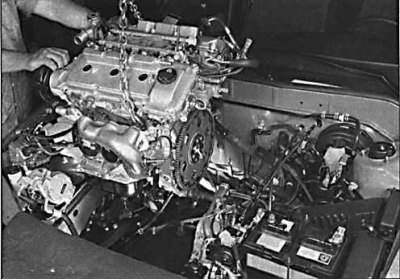
22. Remove the transmission-to-engine mounting bolts and separate the engine from the transmission, leaving the torque converter in the transmission housing. If the engine is removed together with the transmission, do not remove the transmission-to-engine mounting bolts, but disconnect the drive shafts, wires, hoses, gear shift cable, and speedometer cable from the transmission.
23. Check that nothing other than the engine mounts connects the engine and gearbox to the vehicle body.
24. Support the gearbox with a jack through a wooden block. Unscrew the bolts securing the power unit supports.
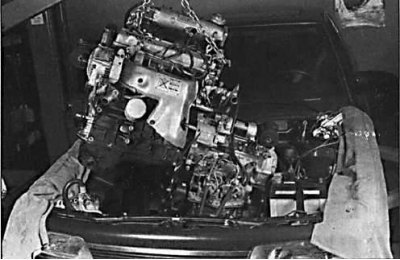 |  |
25. Slowly lift the power unit out of the engine compartment.
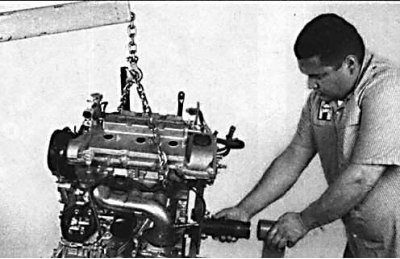
26. Move the engine away from the vehicle and lower it onto wooden blocks on the floor, or remove the flywheel/drive plate and mount the engine on a dedicated engine stand.
Installation
Caution! Do not use bolts to align the transmission to the engine. This may cause cracking or damage to major engine components.
1. Check the condition of the engine and gearbox mounts. If they are worn or damaged, replace them.
2. On models with manual transmission, check the condition of the clutch. On models with automatic transmission, check the condition of the sealing ring and bushing.
3. On manual transmission models, apply a small amount of high-temperature grease to the bearing at the end of the crankshaft. On automatic transmission models, apply high-temperature grease to the nose of the converter.
4. Carefully install the gearbox onto the engine.
5. Use bolts to secure the gearbox to the engine, tightening them to the required torque.
6. Using a lifting device, lower the engine together with the gearbox into the engine compartment. When installing the power unit, if necessary, tilt and rotate it so that it is installed in place without causing damage.
7. Install the powertrain suspension mounting bolts and tighten them to the specified torque.
8. Install previously removed parts and reconnect all connections in the reverse order of removal.
9. Fill the engine with coolant, engine oil and, if necessary, add oil to the power steering reservoir.
10. Start the engine and check its operation. Turn off the engine and check the level of all fluids.