Contents: Checking the power steering fluid…↓ Bleeding the power steering system ↓ Checking the working fluid pressure ↓ Pump of the working fluid cooling…↓ Checking the electromagnetic valve…↓ Checking the connectors of the…↓
Checking the power steering fluid level
Note: The cooling system shares a common reservoir with the power steering system.
1. Place the vehicle on a level, horizontal surface.
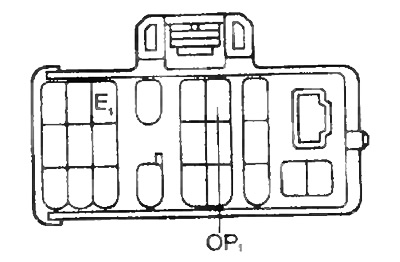
2. Short-circuit the terminals "OP₁" - "E₁" of the diagnostic connector. Set the rotation speed to 2000 rpm and warm up the working fluid.
- Working fluid temperature - 70-90°C
3. Make sure there is no foaming or emulsification of the liquid.
4. Measure the fluid level with the engine on and off.
- Maximum increase in liquid level is 5 mm
5. Check the fluid level and top up if necessary.
Note: if the working fluid is warm, the fluid level is in the "HOT" range on the tank or dipstick; if it is cold, it is in the "COLD" range.
Bleeding the power steering system
1. Check the level of the working fluid in the tank
2. Raise the front of the vehicle and support it on stands.
Note: Be careful not to spill the liquid from the tank.
3. Start the engine and set the idle speed. Short-circuit the terminals "OP₁" - "E₁" of the diagnostic connector, turn on the fan.
4. Turn off the engine.
5. Check for foaming or emulsification of the fluid. If foaming or emulsification is present, check for leaks in the system
6. Check the working fluid level.
Checking the working fluid pressure
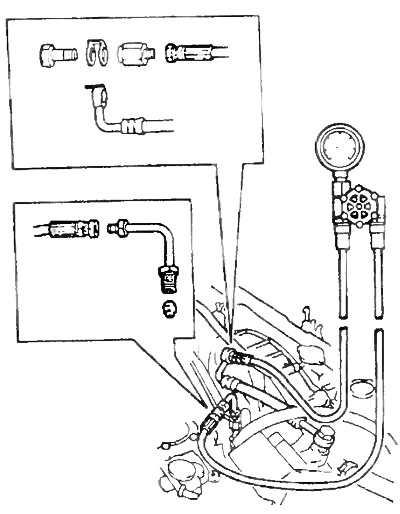
1. Disconnect the coolant pump discharge line.
2. Connect the pressure gauge as shown in the figure.
Caution: When connecting, the pressure gauge tap must be fully open.
3. Bleed the power steering system.
4. Check the working fluid pressure.
a) Short-circuit the terminals "OP₁" - "E₁" of the diagnostic connector.
b) Measure the working fluid pressure at engine idle speed.
- System pressure - 1500-2800 kPa (at a working fluid temperature of 70 - 90°C)
c) Make sure that the pressure drops when you remove the jumper "OP₁" - "E₁"
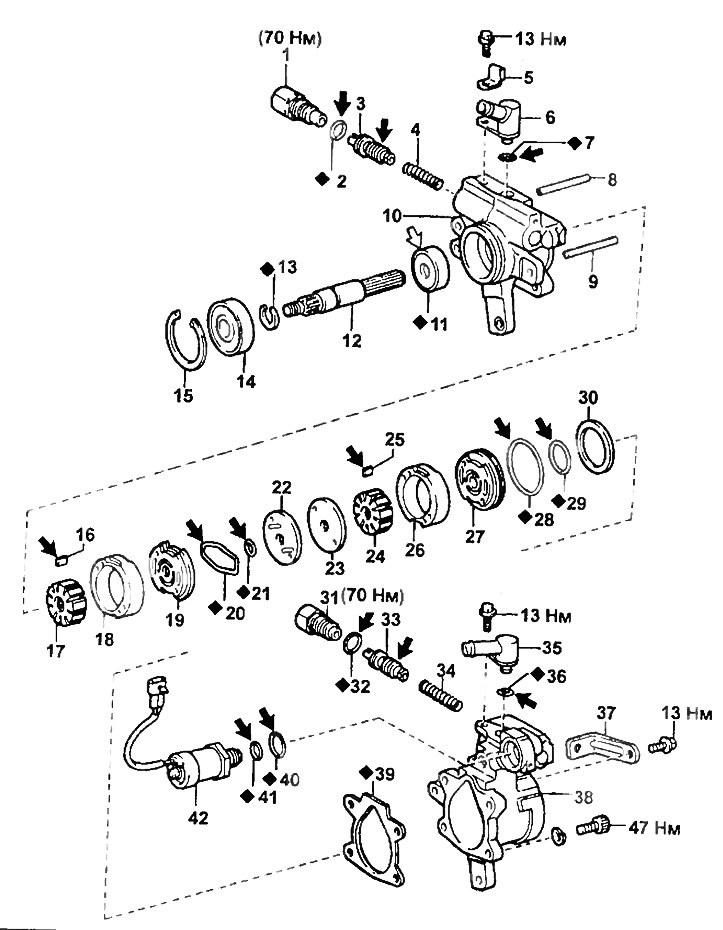
Power steering pump (ZS-T).
1, 31 - discharge pipeline nipple,
2, 7, 21, 28, 29, 32, 36, 40, 41 - O-ring seal,
3, 33 - flow regulator,
4, 34 - spring,
5 - holder,
6, 35 - return pipeline nipple,
8, 9 - pin,
10 - housing cover,
11 - oil seal,
12 - pump shaft,
13,15 - retaining ring,
16, 25 - blade,
17, 24 - rotor,
18, 26 - stator ring,
19 - front disc,
20 - gasket,
22 - plate No.1,
23 - plate No.2,
27 - rear disc,
30 - spacer,
37 - adjustment bracket,
38 - pump body,
39 - gasket,
42 - electromagnetic valve.
Note: when assembling, apply the following to the parts indicated by the arrows:
- white arrow - consistent lubricant,
- black arrow - power steering fluid.
Pump of the working fluid cooling system
(The text is quoted from the source website TOYOTAMAN.ru)
Removal
1. Remove the lower engine cover.
2. Drain the coolant.
3. Remove the coolant expansion tank.
a) Disconnect the expansion tank hose.
b) Unscrew the two bolts and remove the tank.
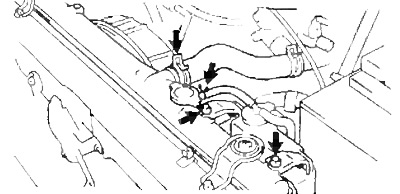
4. Disconnect the coolant inlet pipe from the radiator.
5. Disconnect the return line of the cooling system.
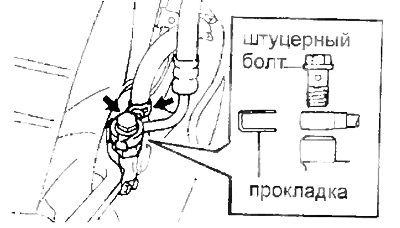
6. Loosen the union bolt and disconnect the cooling system pressure line. Remove the gasket.
7. Remove the fan assembly with the pump.
a) Disconnect the return hose of the power steering fluid cooling system pump.
b) Unscrew the four bolts and remove the fan assembly.
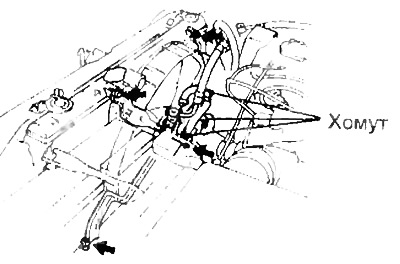
Note: Bend the hose as shown in the figure.
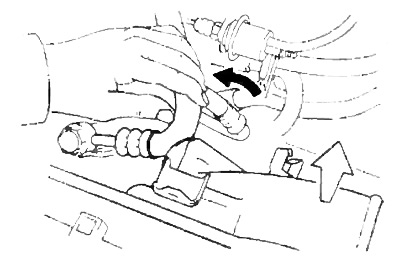
8. Remove the protective cover from the fan.
9. Remove the fan.
Please note: the fan mounting nut has a left-hand thread.
10. Unscrew the three bolts and remove the power steering fluid cooling system pump.
Installation
1. Attach the pump to the fan mounting bracket.
- Tightening torque - 6.5 Nm
2. Connect the fan to the pump shaft.
- Tightening torque - 15 Nm
Please note: the fan mounting nut has a left-hand thread.
3. Attach the protective cover to the fan.
- Tightening torque - 5 Nm
4. Install the fan assembly.
Note: Bend the hose as shown in the figure.
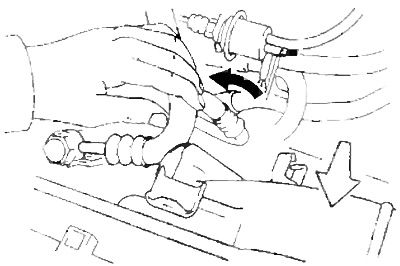
b) Tighten the four fan mounting bolts.
- Tightening torque - 5 Nm
c) Install the clamp on the return line.
5. Install a new gasket on the discharge line.
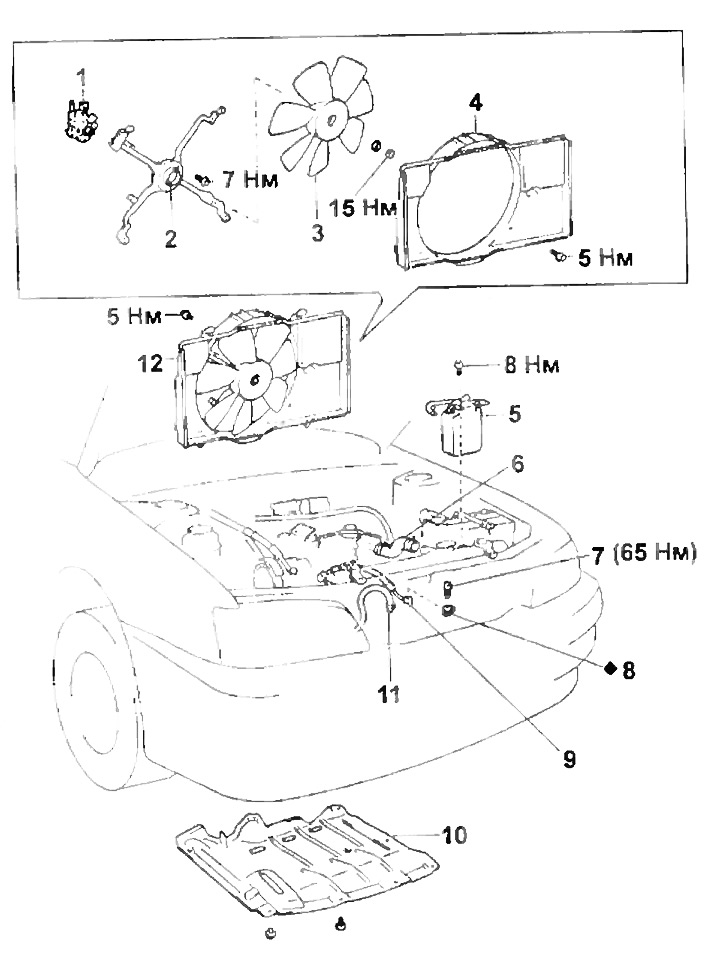
Removing the coolant system pump.
1 - pump,
2 - fan mounting bracket,
3 - fan,
4 - fan casing,
5 - coolant expansion tank,
6 - coolant inlet pipe,
7 - union bolt,
8 - gasket,
9 - pressure line of the working fluid cooling system,
10 - lower engine protective cover,
11 - return pipeline of the working fluid cooling system,
12 - fan assembly.
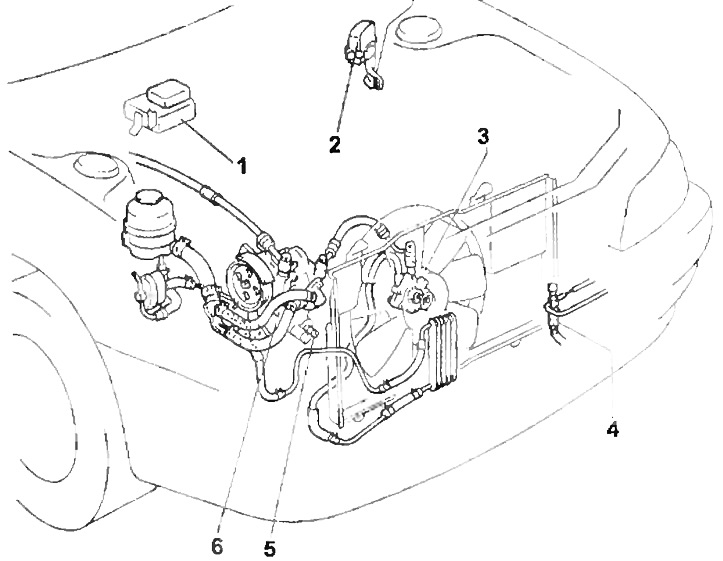
Power steering fluid cooling system.
1 - electronic control unit of the air conditioner fan,
2 - diagnostic connector,
3 - pump of the working fluid cooling system,
4 - air conditioner pressure switch,
5 - coolant temperature sensor,
6 - electromagnetic valve.
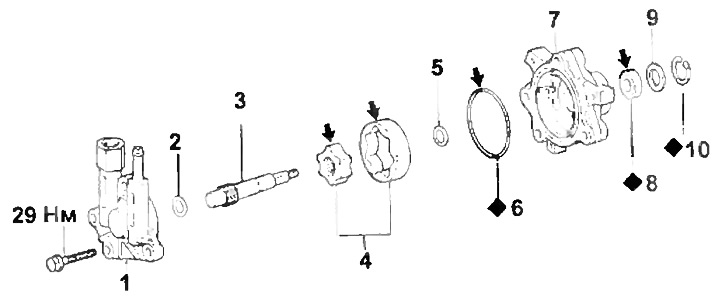
Pump for the working fluid cooling system.
1 - cover,
2, 5, 9 - spacer,
3 - pump shaft,
4 - driving and driven gear of the pump,
6 - O-ring seal,
7 - pump body,
8 - oil seal,
10 - retaining ring.
Note: When assembling, apply power steering fluid to the parts indicated by arrows.
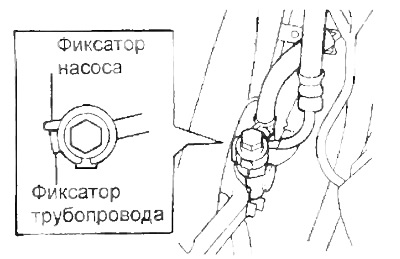
Connect the coolant pressure pipe as shown in the figure. Tighten the union bolt.
- Tightening torque - 65 Nm
6. Connect the return line of the cooling system.
7. Connect the coolant inlet pipe.
8. Install the coolant expansion tank.
a) Install the tank and tighten the two bolts.
- Tightening torque - 7.5 Nm
b) Connect the expansion tank hose.
9. Fill with coolant
10. Fill with power steering fluid.
11. Bleed the power steering system.
12. Check for coolant leaks.
13. Install the lower engine cover.
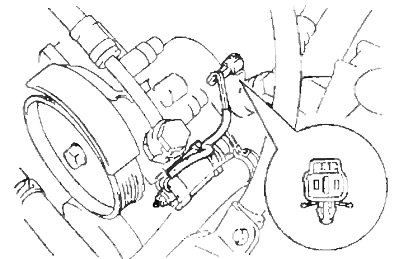
Checking the electromagnetic valve of the power steering pump
Using an ohmmeter, measure the resistance between the valve connector terminals.
- Resistance at 20°C - 7.6-6.0 Ohm
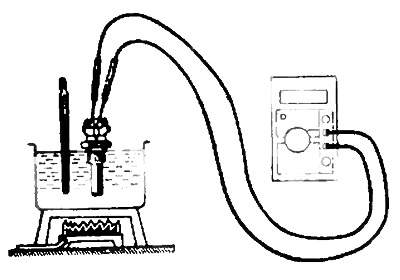
Checking the coolant temperature sensor Connect an ohmmeter and measure the resistance between the sensor terminals as shown in the figure.
- Resistance at 80°C - 1.48 -1.58 kOhm
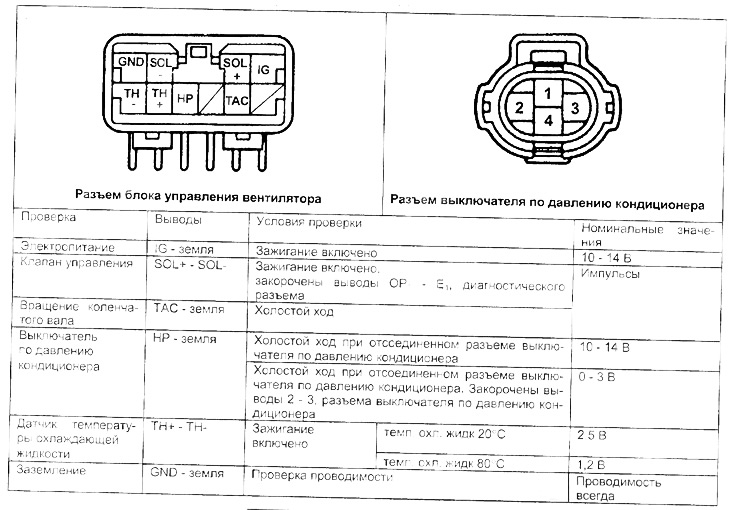
Checking the connectors of the cooling system fan control unit and the air conditioner pressure switch
1. Using a tester, measure the voltage between the terminals of the cooling fan control unit and the air conditioner pressure switch connectors.
2. Using an oscilloscope, check for the occurrence of pulses.
Note: the test is performed with the connector connected from the back side.
Table. Checking the connectors of the fan control unit and the switch by the air conditioner pressure